E-Paper



Why some provisions of the wildlife bill passed by Parliament created controversy
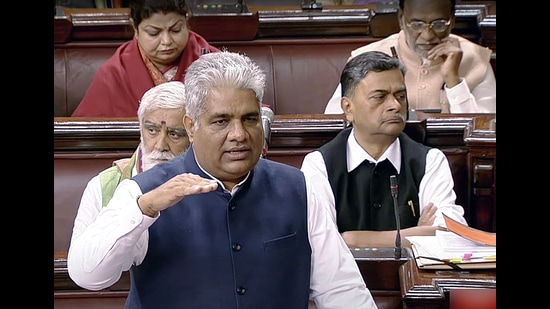
Union environment minister Bhupender Yadav told the Rajya Sabha that while protecting forest land is critical, it is equally important to safeguard the rights of the people who have been residing there for ages


NEW DELHI: The Rajya Sabha on Thursday gave its nod to the Wildlife (Protection) Amendment Bill for better implementation of the Convention on International Trade in Endangered Species of Wild Fauna and Flora (CITES) and to keep a check on illegal trade in exotic species and wildlife.
The legislation, which amends the Wildlife (Protection) Act, 1972, was cleared by the Lok Sabha on August 2 after several hours of debate on issues related to the conservation of endangered species, human-wildlife conflict and rights of forest dwellers, among others.
Responding to the debate, environment minister Bhupender Yadav told the Rajya Sabha that while protecting forest land is critical, it is equally important to safeguard the rights of the people who have been residing there for ages.
The government is bound to protect wildlife, including elephants, according to provisions of the law, the minister said.
On Wednesday, Yadav told the lawmakers: “India is a member of CITES. The pace at which wildlife resources and species are being lost… this agreement was made to address that. In India, illegal trade in wildlife is regulated under the Customs Act, Exim policy, directorate general of foreign trade and the Wildlife Protection Act. CITES made a provision for a separate regulation for illegal trade in wildlife. The UPA (government) did not complete their assurance under CITES.”
He added that India’s proposal for transferring the red-crowned roofed turtle and Leith’s Softshell turtle from Appendix II to Appendix I of CITES to provide greater protection was adopted by the Conference of Parties (CoP) to CITES at its 19th meeting in Panama last month.
The parliamentary standing committee led by Congress leader and former environment minister Jairam Ramesh, which submitted a 254-page report in April, had raised several concerns and urged the environment ministry to consider the suggestions of scientists and conservationists.
On Thursday, Jairam Ramesh said the concerns around trade or movement of elephants remained unaddressed in the bill.
According to the Congress leader, the amendment bill introduces a new subsection (4) to section 43 that takes away protection from trade in captive and wild animals. The panel report recommended the deletion of the clause allowing commercial trade.
While the recommendation was accepted by the ministry, the new wording still leaves a lot to interpretation, he said.
The bill was also criticised for provisions related to the formation of standing committees of State Boards for Wildlife, which is likely to ease the process of wildlife clearances for infrastructure projects at the state level.
It was pointed out that the concerns around trade or the movement of elephants still remained in the bill.
The amendment bill introduces a new provision that took away the protection from trade in captive and wild elephants. The parliamentary panel recommended the deletion of the clause which allowed for commercial trade and provide an explanation for provisions for the transport of captive elephants.
The reworded clause said: “Provided that the transfer or transport of a captive elephant for a religious or any other purpose by a person having a valid certificate of ownership shall be subject to such terms and conditions as may be prescribed by the central government.”
“Any other purpose needs to be clarified. Please drop it,” said Ramesh addressing Yadav.
“Mr Bhupender Yadav has been chairman of many committees, over 90% of these committees’ recommendations have been accepted. Today I have to give him only 50%. He is refusing important recommendations of the parliamentary standing committee. He has accepted,” the Congress leader said.
Environmental lawyer Ritwick Dutta said he believed that the concerns related to elephants and the standing committee for state wildlife boards continue to be deeply problematic. “But the amendment will provide for restriction and regulation of illegal import of exotic species, which are being kept illegally in the country. The existing law is silent on exotics. I am in Mizoram now and there are several cases of illegal import from Southeast Asia, South America etc. The clauses on exotics are the best possible addition to law. This makes the law CITES compliant and possession of exotic species can now be monitored and regulated,” Dutta said.
Kanchi Kohli, legal researcher at Centre for Policy Research, said it was important to understand whether the constitution of the standing committee for the state wildlife boards is to overcome the otherwise sluggish convening of the state board that is designed to be convened by the chief minister of a state. “We have to locate this decision within a regulatory landscape where several areas legally protected for wildlife conservation may need to be partially or fully accessed for linear infrastructure projects. A standing committee mechanism can enable a less deliberative and a more “efficient” decision when such areas come to be in demand by both government and private entities,” Kohli said.