
 E-Paper



With digital crop survey, govt to expand DPI to agri
The details of 60 million farmers and their lands will be included in the farmer and land registries.


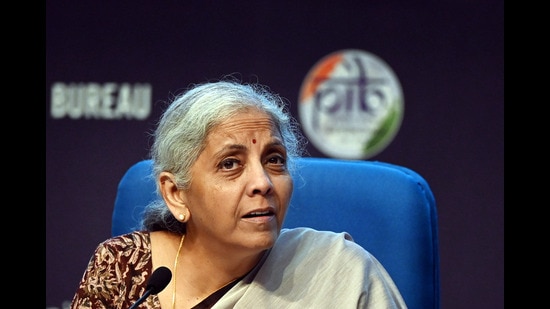
Finance minister Nirmala Sitharaman announced that the government will use digital public infrastructure (DPI) to conduct a digital crop survey (DCS) in 400 districts for the kharif season this year. She said the details of 60 million farmers and their lands will be included in the farmer and land registries.
A DCS creates “one verified source of truth” about the farmer and the crops that they sow, which can be used by multiple departments and stakeholders (such as insurance companies and banks). It involves creating a registry of geofenced plots. Photos of these plots will then be geotagged, and the registry will include details about the owners (including joint owners), details about which crop is sown and when, what is the expected and actual yield, standardisation of data at both the central and state level, photographic evidence of the crop, etc. It can also use satellite imagery to collect data. Specifics may vary across states.
The use of DPI for agriculture is not a new step — the pilot DCS was conducted in 12 states for the 2023 kharif season, then agriculture minister Narendra Singh Tomar had informed Lok Sabha in August 2023 in a written response.
“Buoyed by the success of the pilot project, our government, in partnership with states, will facilitate the implementation of DPI in agriculture for coverage of farmers and their lands in 3 years. During this year, DCS for kharif using DPI will be taken up in 400 districts. The details of 60 million farmers and their lands will be brought into the farmer and land registries. Further, the issuance of Jan Samarth-based Kisan Credit Cards will be enabled in five states,” Sitharaman said.
States such as Tamil Nadu, Karnataka and Kerala have created their own websites and apps to conduct DCSs. Madhya Pradesh chief minister Mohan Yadav had in June announced a DCS for this kharif season.
In May 2023, the agriculture ministry organised a workshop on DCS, where additional secretary Pramod Kumar Meherda explained that DPI for agriculture was an open source, open standard, and interoperable public good. At this event, user manuals for the DCS website and mobile app (both of which were developed by National Informatics Centre) were released.
DPI for agriculture depends on AgriStack, which creates a federated registry of all the farmers in the country, with each assigned a unique Farmer ID based on his or her Aadhaar. This registry will be linked to farmland plot records. The two registries together will be used by the central and state governments to assess eligibility for different schemes and benefits, and to subsequently disburse them. It gives farmers access to cheaper credit, farm inputs, localised and specific advice, and access to the market. The Agri Stack portal will also have details about the kind of crops planted, and the ideal amounts of fertiliser and water quantities required.
The agriculture ministry has already released multiple apps on Android to collect data related to farmers and farmlands --- DigitalCropSurvey UP (an AgriStack app for surveyors to use), KrishiMapper (to conduct surveys and include details about the caste of the farmer, crop information, land area measurements, geo-plotting functions, uploading photos), GCES (General Crop Estimation Survey, to gather field data from the designated plots along with images of plots and harvested crops), and Soil Health Card (to test soil samples from different plots).
DPIs in other sectors
Sitharaman said that DPIs also are planned in areas of credit, e-commerce, education, health, law and justice, logistics, MSME, services delivery, and urban governance. She proposed the development of DPI applications at “population scale for productivity gains, business opportunities, and innovation by the private sector”.
The idea behind a DPI is to create a set of open protocols that can ideally be used by any entrant. A bit like how the Simple Mail Transfer Protocol (SMTP) can be used by any email service provider (like Outlook, Gmail) to enable people to send emails to each other. Or how any fintech can offer UPI services after being vetted by the NPCI (National Payments Corporation of India).
To be sure, digital payments infrastructure such as UPI, e-commerce protocols like Open Network for Digital Commerce (ONDC), consent management framework for account aggregators, network to assess credit histories like Open Credit Enablement Network (OCEN), Ayushman Bharat Digital Mission (ABDM) which is dependent on the ABHA health ID, and Automated Permanent Academic Account Registry (APAAR) ID for students are all considered DPI and/or digital public goods (DPG) by the government and have already been implemented to varying degrees. All of them are premised on the idea of offering services on the basis of a “single source of truth” for their respective sectors.
For instance, OCEN wants to create a “single source of truth” about the credit histories of people who may not have formal credit histories.


