
 E-Paper



Xi Jinping discusses Taiwan in Beidaihe, QUAD navies exercise off Sydney
The focus of Malabar exercises is sub-surface and anti-aerial threat warfare.

 Prefer HTon Google


At a time when the Communist Party of China’s leaders are gathered for an annual conference at the seaside resort of Beidaihe to discuss the downturn in the Chinese economy and Taiwan, QUAD navies have begun exercising off the coast of Sydney to foil any security challenge in the Indo-Pacific.
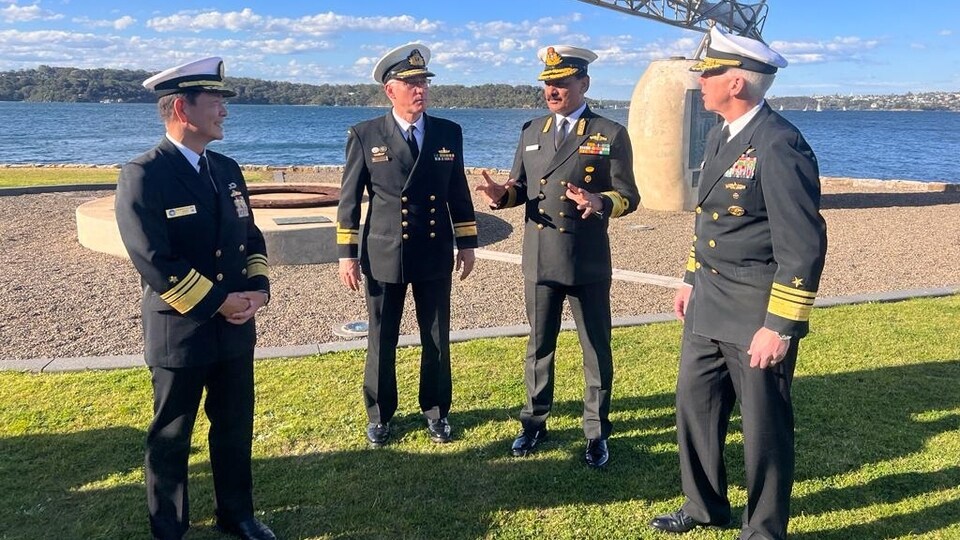
Led by US Virginia class nuclear attack submarine North Carolina and Arliegh-Burke class guided missile destroyer Rafael Peralta, the QUAD navies under Malabar rubric have assembled in Sydney harbor with Japanese Navy’s destroyer Shiranui, Indian Navy’s destroyer Kolkata, and Australian Navy’s destroyer Brisbane among other potent warships with shore-based Australian F-35 fighters, P8I anti-submarine warfare aircraft and integral helicopters. The Malabar exercises this time are tasked to counter the naval challenge in the Far-Pacific and increase the level of interoperability among QUAD forces. The exercises involving harbor and sea phase end on August 22.
While the participating US Seventh Fleet commander said that the exercises were not pointed at any country, the fact is that expanding the PLA Navy poses a serious threat not only to Taiwan but also to countries bordering the South China Sea including Japan and the Philippines. Last Saturday’s incident of a Chinese Coast Guard vessel using water cannons to block a Filipino supply boat delivering food and supplies to a Philippine-occupied shoal in the South China Sea shows that China will continue to bully ASEAN nations in the region with whom it has long seething territorial conflicts. These territorial disputes in the South China Sea, one of the busiest shipping lanes with trillion-dollar trade, are the Asian flashpoints and a fault line in the super power rivalry between US and China in the region.
The Philippine episode also reveals that China is getting more antsy with the country going into deflation, slow pace of economic growth and US companies shifting its global supply chains to other countries. While Western allies of the US are still debating on whether to follow Joe Biden’s route of not investing in China’s artificial intelligence, semiconductor chips and quantum computing sectors, there is clearly increased hostility between US and China around PLA belligerence over Taiwan and in the Indo-Pacific.
Even though the CPC led by paramount leader Xi Jinping are expected to discuss China’s next moves on Taiwan at Beidaihe, the long dragging Ukraine war will definitely sober PLA ambitions as conquering Taiwan won’t be a cakewalk for Beijing militarily and disaster diplomatically. Violating the sovereignty of Taiwan under the garb of the so-called One China policy will not only harden the position of the US-led west but also put QUAD powers and ASEAN on high alert and ready for any military emergency.


