
 E-Paper



‘Yes, death penalty is…’: AI lawyer responds to CJI Chandrachud's question | WATCH
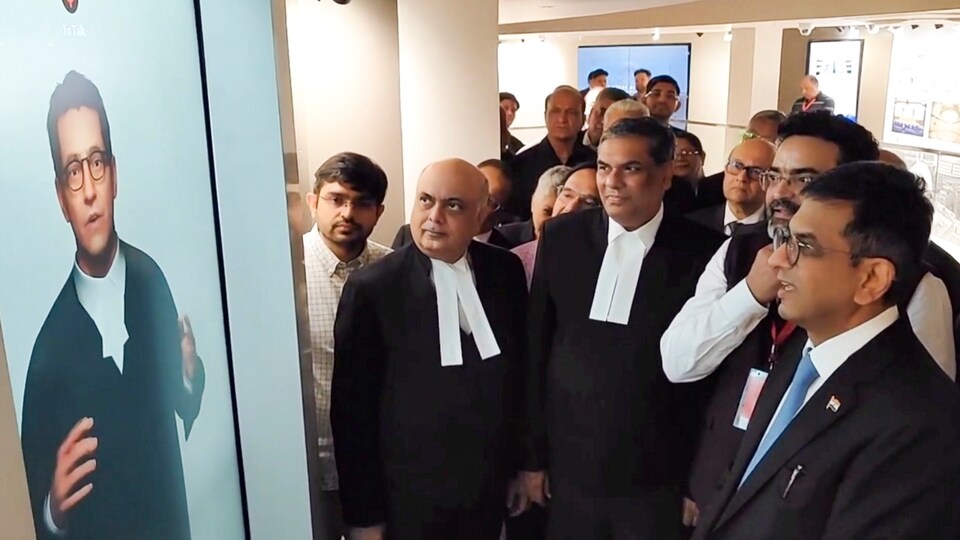
The AI lawyer's response to Chief Justice Chandrachud's query left him as well as other Supreme Court laywers visibly impressed.

 Prefer HTon Google


Chief Justice of India DY Chandrachud on Thursday interacted with an Artificial Intelligence (AI) lawyer at the National Judicial Museum and Archive (NJMA) at the Supreme Court premises.
Chandrachud said that the Museum reflects the importance of the court to the life of our nation, dedicating the museum to the nation.
The CJI, along with several other top court judges, took a stroll through the museum when he came across the AI lawyer. He then took a chance to test its ability and asked, "Is the death penalty constitutional in India?"
The AI lawyer, clad in an advocate's coat, responded, "Yes, the death penalty is constitutional in India. It is reserved for the rarest of rare cases as determined by the Supreme Court where the crime is exceptionally heinous and warrants such a punishment." This left Chandrachud visibly impressed, while other judges around him began clapping.
WATCH VIDEO:
The CJI has previously spoken about the capabilities of AI, advocating for the use of the technology in 'delivering justice' as well.
Earlier this year, Chandrachud highlighted that AI represents the next frontier of innovation that has the transformative potential to speed up and streamline justice delivery. He had said that using AI-powered tools, courts can streamline the administrative procedures, reduce paperwork and expedite the resolution of legal disputes.
ALSO READ | AI can streamline, speed up delivery of justice: CJI
However, he had also warned of the indiscriminate use of Artificial Intelligence and the systemic challenges that it poses.
On Thursday, Chandrachud spoke at the inauguration of the museum and said, "This has taken almost a year and a half in conceptualisation and planning. The actual execution has taken about six months."
"It's been done in record time. We thought that we must have not just a museum of artefacts, but a museum comparable to the best internationally, to project the importance of our institution and the high courts in delivering justice to our citizens and in protecting the fundamental rights of our citizens," he added.
The Chief Justice of India further noted that the designers of the museum were also the ones to design the Pradhanmantri Sangrahalay and the Teen Murti Bhawan and praised them for their efforts.
"The executors of this museum was already ahead of time. They knew what i was talking about. They had also designed the Pradhanmantri Sangrahalay at the Teen Murti Bhawan, so they had all the experience of doing a modern museum of a highest international quality," Chandrachud said.
Chandrachud is set to retire as the 50th Chief Justice of India on November 10 and he will be succeeded by Justice Sanjiv Khanna.


