
 E-Paper



Yunus accuses Sheikh Hasina of committing ‘worst civilian massacre’ since 1971
Addressing a gathering that included India’s high commissioner Pranay Verma, Yunus sought the international community’s support to carry out “meaningful and deep reforms” to turn Bangladesh into a “real and thriving democracy”


Dhaka: Bangladesh’s interim government’s head Muhammad Yunus on Sunday accused former premier Sheikh Hasina of committing the “worst civilian massacre” since the country’s independence in 1971 and destroying every institution amid a brutal crackdown.
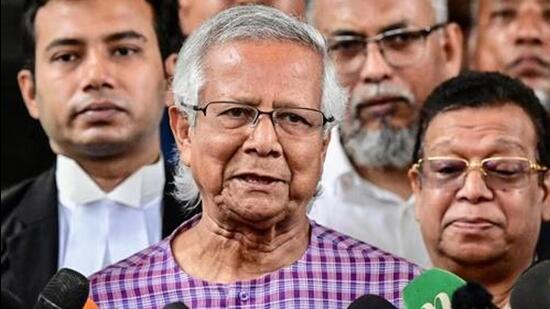
The Nobel laureate made the remarks while briefing diplomats and heads of missions for the first time since taking over as chief adviser of the caretaker administration on August 8, three days after Hasina stepped down and fled to India following weeks of protests in which more than 600 people were killed.
The interim government’s top priority, Yunus said, is bringing the law and order situation under control, with the armed forces aiding civil power as long as needed. As part of efforts to ensure accountability for killings and violence during the recent uprising, Yunus welcomed the UN rights office’s move to send a UN-led fact-finding mission to Bangladesh.
Addressing a gathering that included India’s high commissioner Pranay Verma, Yunus sought the international community’s support to carry out “meaningful and deep reforms” to turn Bangladesh into a “real and thriving democracy.”
“We will hold a free, fair, participatory election as soon as we can complete our mandate to carry out vital reforms in our election commission, judiciary, civil administration, security forces, and the media. We will also make sincere efforts to promote national reconciliation,” he said.
Describing Hasina’s regime as a “brutal dictatorship,” Yunus said, “She fled the country but only after the security forces and her party’s student wing committed the country’s worst civilian massacre since the country’s independence. Hundreds were killed and thousands were injured.”
“I took over a country that was in many ways a complete mess. In their efforts to stay in power, the Sheikh Hasina dictatorship destroyed every institution of the country. Judiciary was broken. Democratic rights were suppressed through a brutal decade-and-a-half-long crackdown,” said Yunus, a microfinance pioneer who was repeatedly targeted by Hasina with allegations of corruption.
He also said that elections were “rigged blatantly” and young people grew up without exercising their voting rights. “Banks were robbed with full political patronisation. And the state coffer was plundered by abusing power.”
“The top priority of the interim government would be to bring the law and order situation under control. We will be close to normalcy within a short period of time...,” Yunus said. The military will continue to aid the civil administration “as long as the situation warrants,” and the interim government is “pledge-bound to ensure safety and security of all religious and ethnic groups.”
Another priority is ensuring justice and accountability for the killings and violence during the recent protests. “I have spoken to the UN human rights chief Volker Turk. I welcomed the UN rights office’s move to send a UN-led fact-finding mission. We want an impartial and internationally credible investigation into the massacre and subsequent due judicial processes,” he said.
The students behind the recent protests want “meaningful and deep reforms” to turn Bangladesh into a real democracy, Yunus said.
“The task is huge, but doable with the support of all people and the international community,” he said. “I must succeed. We have no other option.”
The interin government intends to carry out robust and far-reaching economic reforms to restore macroeconomic stability and sustained growth, with priority on good governance and combating corruption. “We will uphold and promote all our international legal obligations, including international humanitarian law and international human rights law,” Yunus said.
Bangladesh will remain an active proponent of multilateralism and will maintain and enhance its contributions to UN peacekeeping operations. “Our government will continue to support the million-plus Rohingya people sheltered in Bangladesh. We need sustained efforts of the international community for Rohingya humanitarian operations and their eventual repatriation to their homeland, Myanmar, with safety, dignity, and full rights,” he said.
Yunus said the interim government will nurture friendly relations with all countries in the spirit of mutual respect and shared interests. “We call upon our trade and investment partners to maintain their trust in Bangladesh for economic prosperity. For our part, we won’t tolerate any attempt to disrupt the global clothing supply chain in which we are a key player,” he added.


