
 E-Paper



'Comet of the century' might fizzle out before reaching Sun’s orbit
The comet C/2012 S1 ISON, described by some as “the comet of the century,” has fizzled completely, and it is probable that it may disintegrate at or before reaching perihelion, according to new findings.


The comet C/2012 S1 ISON, described by some as “the comet of the century,” has fizzled completely, and it is probable that it may disintegrate at or before reaching perihelion, according to new findings.
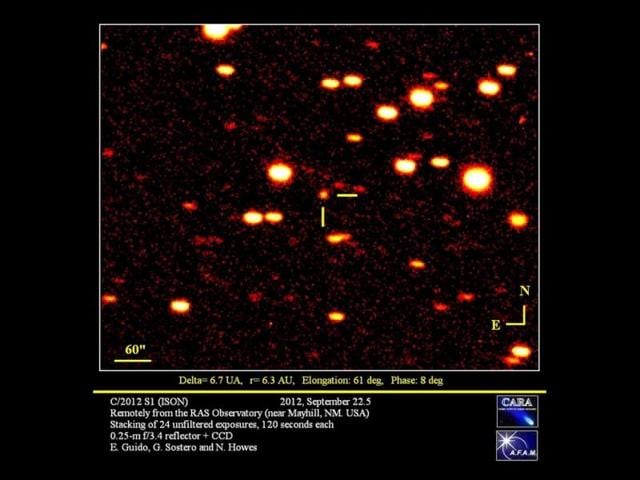
On September 2, 2012, two Russian astronomers discovered a comet designated as C/2012 S1 ISON.
When the orbit was calculated, astronomers realized that the object would pass at only 1.3 solar radii from the Sun on November 28, 2013.
It was contended that the object would be as bright as the full Moon and that in fact it could become “the comet of the century.”
Dr. Ignacio Ferrin, astronomer from the Institute of Physics of the University of Antioquia in Medellin, Colombia, has concluded a study of the comet using the latest observations available.
“Comet ISON has presented a peculiar behavior,” Dr. Ferrin said.
“The light curve has exhibited a ‘slowdown event’ characterized by a constant brightness with no indication of a brightness increase tendency.
“This slowdown took place around January 13, 2013. For 132 days after that date and up to the last available observation, the brightness has remained constant,” the astronomer said
Thus, the astronomer concludes that it is highly unlikely that the comet will be as bright as the full Moon.
This peculiar behavior could possibly be explained if the comet were water deficient, or if a surface layer of rock or non-volatile silicate dust were quenching the sublimation to space.
The strange behavior of comet ISON is reminiscent of what happened to comet C/2002 O4 Honig who remained with the same brightness for 52 days, after which it disintegrated with no observable residue.
It is to be noticed that comet ISON has been in that state for much longer, 132 days and counting.
However, astronomers do not know what is the current status of the comet, since it has entered the solar glare and it is unobservable.


