Sign in

Data finds Delhi air dirtier than Beijing, Centre continues to deny

Delhi might be the most polluted city in the world but the government insists that the Capital’s air is not as bad as that of Beijing -- contrary to the real time data available in public domain. HT Edit: Choking to death | Pollution control plan in limbo as Delhi gasps for breath

Updated on: Jan 30, 2014, 11:25:16 IST
Hindustan Times | By , New Delhi
Share
Share via
  • facebook
  • twitter
  • linkedin
  • whatsapp
Copy link
  • copy link

Delhi might be the most polluted city in the world but the government insists that the Capital’s air is not as bad as that of Beijing -- contrary to the real time data available in public domain.

HT Image
HT Image

The air-quality monitoring wing of the ministry of earth sciences has claimed that Delhi’s particulate matter 2.5 pollution levels never crossed 350 microgram per cubic metre (m/cum) while for Beijing, it was higher than 500 microgram and even reached 650 microgram.

The data is based on information collected from the ministry’s nine monitoring stations and doesn’t take into account records of the Delhi Pollution Control Committee and Central Pollution Control Board.

HT Edit: Choking to death: Delhi's air is dirtier than Beijing’s

Had it done that, it would have found that pollution levels on January 24 at Shahdara and Mandir Marg were alarming -– more than 900m/cum during evening rush hour. On Tuesday, the levels dropped to average between 230 m/cum and 430 m/cum at places such as Mandir Marg, Anand Vihar and Punjabi Bagh.

Article image

The World Health Organisation, which last year termed polluted air as a carcinogen, says PM2.5 at 10 m/cum is safe. India’s safety mark is 60 microgram.

HT on Wednesday did another check on PM2.5 data and Delhi again beat Beijing flat. While Chinese’s capital recorded a pollution level of 275 m/cum, Delhi University’s PM 2.5 level was 500 m/cum and ITO’s 360 at 7pm.

Moreover, the daily PM2.5 levels available for Beijing for 2013 showed that these varied from less than 50 m/cum to as high as 400 m/cum but largely remained below 250 m/cum, Centre for Science and Environment (CSE) said.

But for Delhi, where air pollution is higher in winter than in other seasons, the daily average for November 2013 and January 2014 period shows that pollution has hovered around 240 m/cum -- almost four times higher than the Indian standard. It even went as high as 575 m/cum, CSE said. Even at its highest, Beijing’s winter level didn’t go beyond 400 m/cum.

READ:

Pollution control plan in limbo as Delhi gasps for breath

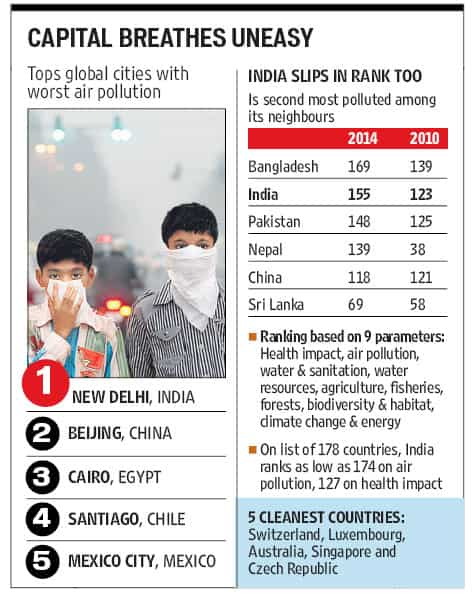
The results of Yale University Environment Performance Index (EPI) giving Delhi the worst ranking may differ from India’s stations monitoring air pollution. Yale findings are more reliable as the data is collected from independent sources and environmental satellites fitted with sensors.

Station monitoring provides correct exposure level only at a particular place, while satellite-based measurements are more universal, helping draw a clearer comparison between cities.

Read:How air and water pollution plagues Indian cities

Particles smaller than 2.5 microns in diameter (PM2.5 in shorthand) are fine enough to lodge deep in human lung and blood tissue and cause diseases ranging from stroke to lung cancer, the Yale study said.


EMBED height=600 width=665 src=http://aqicn.org/?city=Delhi/ITO

  • Chetan Chauhan
    ABOUT THE AUTHOR
    Chetan Chauhan

    Chetan Chauhan is the National Affairs Editor looking into all aspects of news and features from across India. A Chevening scholar with over three decades of experience in reporting and news management, Chetan has extensively covered all important aspects of the social sector, political economy, environment and climate change nationally and internationally. He did a journalism course at the Reuters Institute of Journalism in Oxford and Digital Media training at Nanyang Technological University in Singapore. He started as a reporter with The Statesman in 1996 and joined the Hindustan Times in 2000 in the metro bureau covering environment, crime and Delhi politics. He covered hot local news, from the Jessica Lal murder case to the rebellion of Delhi Congress MLAs against then Chief Minister Sheila Dikshit, to the replacement of toxic vehicle fuel with cleaner compressed natural gas (CNG) in the national capital. Some of his stories on air pollution became part of the Supreme Court’s landmark MC Mehta versus Government of India case in the National Capital Region (NCR), forcing the government to take corrective measures. As part of the national political bureau since 2004, he covered important central sectors such as environment, education, social justice, labour, rural development, water resources, renewable energy, agriculture, broadcasting and the Planning Commission for more than a decade producing several exclusive and investigative breaking stories. His specialisation is the environment, having covered at least a dozen United Nations global conferences on climate change, biodiversity and wildlife including climate summits in Paris, Copenhagen and Bali. He also covered India’s two five-year plans ---11th and 12th and reported on drafting and execution of right based laws such as Right to Education, Right to Information and rural job guarantee law, MG-NREGA, now being introduced in new format as VG-RAM-G Act. He has in-depth knowledge of social sector issues. He was one of the first to report on tigers vanishing from Sariska and Panna wildlife reserves in 2004 and 2008, respectively, leading to the setting up of the National Tiger Conservation Authority (NTCA) and the introduction of stringent penal provisions for poaching. He has written extensively on the rising human-animal conflict in India and the degradation of India’s biodiversity hotspots because of mining and other activities. Since 2004, Chetan has covered Parliament comprehensively and participated in training on the nuanced coverage of Parliament proceedings. He has travelled extensively across India to cover national and provincial elections since 1998, especially in the Hindi heartland states, considered India’s road to power. He writes a regular column for Hindustan Times, Ecostani, on important national politics, economy, Himalayan ecology and environmental issues. His other responsibilities include providing inputs for edits and edit page articles for the publication, apart from managing news flow from across India.Read More

Follow India news real-time updates and the latest news covered on Hindustan Times, featuring today's critical updates on Sonam Wangchuk LIVE and more across India.