
 E-Paper



Delhi: Centre’s pollution monitoring method flawed, claims CSE
The Centre for Science and Environment (CSE) on Wednesday claimed that the ministry of earth sciences had failed to take into account composite air pollution data for Delhi, while claiming that pollution caused by particulate matter of 2.5 microns in size in the Capital hardly touched 350 micrograms this winter.


The Centre for Science and Environment (CSE) on Wednesday claimed that the ministry of earth sciences had failed to take into account composite air pollution data for Delhi, while claiming that pollution caused by particulate matter of 2.5 microns in size in the Capital hardly touched 350 micrograms this winter.
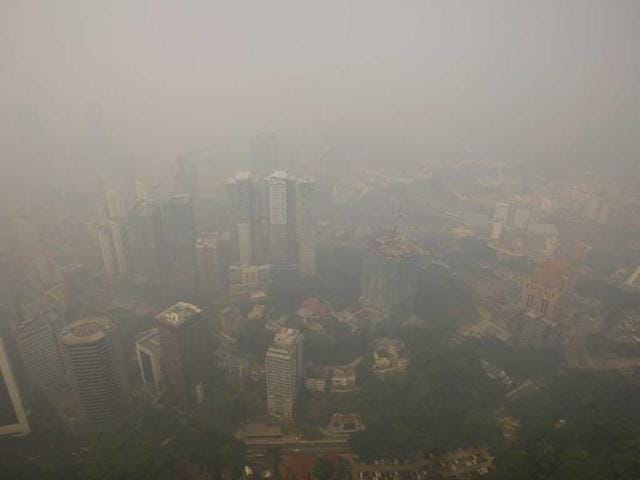
The ministry’s System of Air Quality Weather Forecasting and Research (SAFAR) had said in a statement that most of the time during January, PM 2.5 level in Delhi ranged between 100 and 300 micrograms. It said the level seen in Beijing — 500 to 670 micrograms — is rarely seen in Delhi.
The CSE reviewed daily average PM 2.5 pollution level for this winter for three non-SAFAR stations —R K Puram, Mandir Marg and Punjabi Bagh -- and found that on 17 days (14% of the days monitored), the level crossed the 350-microgram mark. Only one day in the last four months would qualify as excellent, four as good and 10 as slightly polluted, the CSE said.
On as many as 41 days (33% of the days monitored), the pollution level was five times of the national ambient air standard for PM 2.5 — 60 micrograms in a cubic meter of air. In Punjabi Bagh, the PM 2.5 levels crossed 600 on January 5 and was about 560 on December 7 and 8, the CSE said.
SAFAR recorded lower pollution levels than the Delhi Pollution Control Committee (DPCC), whose air quality data was reviewed by CSE, because its air pollution monitoring stations are at the venue of the Commonwealth Games 2010, some distance away from heavy traffic areas, the CSE said.
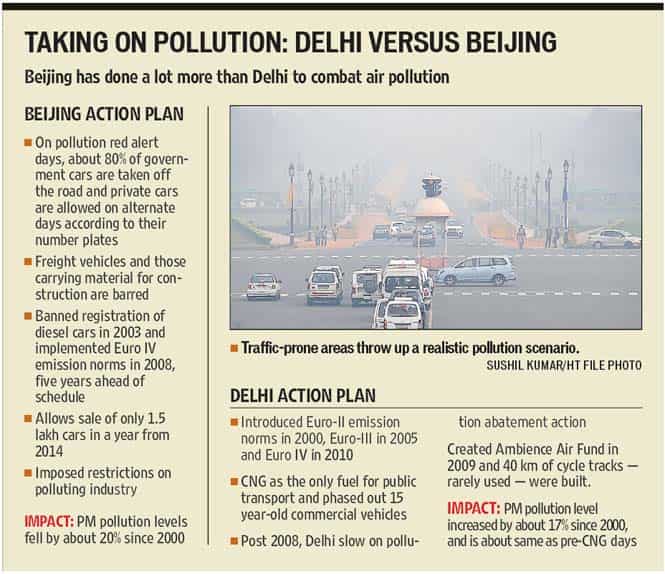
On the other hand, the DPCC’s monitoring stations are closer to traf fic- prone areas, depicting a more realistic pollution scenario.
“The SAFAR website does not put real time PM 2.5 pollution data for people to know the concentration. They (SAFAR) have opted for air quality index which is a calculation and not the real data,” said CSE’s Anumita Roy Choudhury.
The CSE’s claim has further deepened the debate over which city — Beijing or Delhi -- has higher PM 2.5 pollution levels.
Hindustan Times got an independent evaluation of the PM 2.5 pollution levels done by Douw Steyn, a professor of atmospheric science at the University of British Columbia in Canada.
Steyn analysis showed that Delhi has more frequent occurrences of moderately polluted conditions. But when the cities are badly polluted, Beijing has more severe conditions than Delhi. It meant that a bad Beijing day is worse than a bad Delhi day, but an ordinary Delhi day is worse than an ordinary Beijing day.
Steyn also said there were limitations to the comparison as data from most polluted parts of the two cities may not be available.
“The present question (which is the worst), simply demands that one make the comparison using data from the most polluted monitoring station in both cities. Of course, this is weakened by the possibility that pollutant monitoring stations in either cities are not at the most polluted location. This difficulty is hard to avoid,” he told HT in an email response.
The CSE said Beijing had made a lot of progress in combating pollution, resulting in particulate matter levels falling in the city. On the other hand, Delhi has not taken adequate measures and as a result, PM pollution levels were on the rise.
EMBED height=600 width=665 src=http://aqicn.org/?city=Delhi/ITO embed


