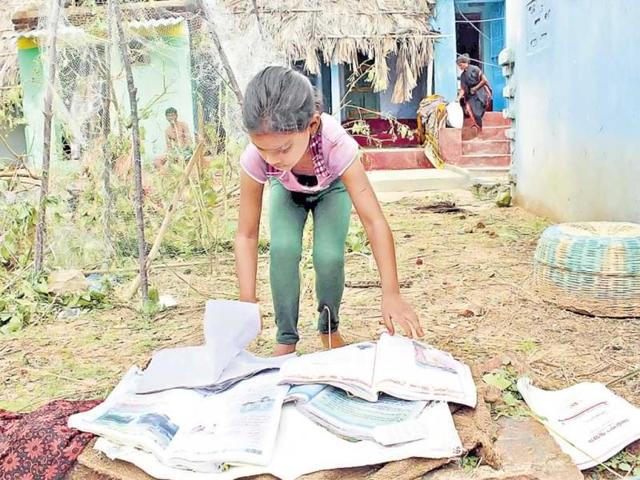
Deluge fails to deter Odisha girls from studying
Odisha’s twin calamities — cyclone followed by floods — have not dampened the determination of young girls to study. Despite their homes being swept away by torrent winds or washed away in floods, what some of the school-going girls saved were their books.

“Padh kar hi main Priyanka Chopra ki tarah ban sakti hun (I can become like someone like Priyanka Chopra only through education),” was the realisation of Bhagirathi Saumitra about importance of education. And this was evident from her effort in drying her class VIII textbook in bright sunshine after cyclone hit her New Podampita Village, around 170 km south of Bhubaneswar.
In some more houses in the village, girls could be seen drying books along with staple diet for the family — grains and fish. When everyone in her village ran to a hill for protection from the cyclone, Saumitra could only manage to collect few of her school books.
“We asked her to take some food for the night. She refused and insisted on taking the books,” recalled her father Chandra Balaram, while rebuilding his thatched mud house.
Around 440 km towards north in flood hit Balasore district, Anita Patra has repeated Saumitra’s act. She collected her wet books when her family abandoned their marooned village to take temporary shelter on the national highway between Kolkata and Chennai.“I have to complete my home-work after the Puja holidays. Two days were wasted because of floods,” she said, not distracted by honking trucks on the highway.
In flood affected and Muslim dominated Gopinathpur village, more girls attend school than boys. These girls are now fluent in Hindi and Oriya and read a bit of English also, whereas many of the boys are comfortable talking only in their mother tongue Oriya.

ABOUT THE AUTHORChetan ChauhanChetan Chauhan is the National Affairs Editor looking into all aspects of news and features from across India. A Chevening scholar with over three decades of experience in reporting and news management, Chetan has extensively covered all important aspects of the social sector, political economy, environment and climate change nationally and internationally. He did a journalism course at the Reuters Institute of Journalism in Oxford and Digital Media training at Nanyang Technological University in Singapore. He started as a reporter with The Statesman in 1996 and joined the Hindustan Times in 2000 in the metro bureau covering environment, crime and Delhi politics. He covered hot local news, from the Jessica Lal murder case to the rebellion of Delhi Congress MLAs against then Chief Minister Sheila Dikshit, to the replacement of toxic vehicle fuel with cleaner compressed natural gas (CNG) in the national capital. Some of his stories on air pollution became part of the Supreme Court’s landmark MC Mehta versus Government of India case in the National Capital Region (NCR), forcing the government to take corrective measures. As part of the national political bureau since 2004, he covered important central sectors such as environment, education, social justice, labour, rural development, water resources, renewable energy, agriculture, broadcasting and the Planning Commission for more than a decade producing several exclusive and investigative breaking stories. His specialisation is the environment, having covered at least a dozen United Nations global conferences on climate change, biodiversity and wildlife including climate summits in Paris, Copenhagen and Bali. He also covered India’s two five-year plans ---11th and 12th and reported on drafting and execution of right based laws such as Right to Education, Right to Information and rural job guarantee law, MG-NREGA, now being introduced in new format as VG-RAM-G Act. He has in-depth knowledge of social sector issues. He was one of the first to report on tigers vanishing from Sariska and Panna wildlife reserves in 2004 and 2008, respectively, leading to the setting up of the National Tiger Conservation Authority (NTCA) and the introduction of stringent penal provisions for poaching. He has written extensively on the rising human-animal conflict in India and the degradation of India’s biodiversity hotspots because of mining and other activities. Since 2004, Chetan has covered Parliament comprehensively and participated in training on the nuanced coverage of Parliament proceedings. He has travelled extensively across India to cover national and provincial elections since 1998, especially in the Hindi heartland states, considered India’s road to power. He writes a regular column for Hindustan Times, Ecostani, on important national politics, economy, Himalayan ecology and environmental issues. His other responsibilities include providing inputs for edits and edit page articles for the publication, apart from managing news flow from across India.Read More

E-Paper