
 E-Paper



Finally, a glimpse of God
The world's biggest atom smasher claimed the discovery of a new subatomic particle on Wednesday, calling it consistent with the long-sought Higgs boson - popularly known as the 'God particle'.'India is historic father of project' | Higgs namesake: A shy physicist | What is Higgs boson? | God particle found


To cheers and standing ovations from scientists, the world's biggest atom smasher claimed the discovery of a new subatomic particle on Wednesday, calling it consistent with the long-sought Higgs boson - popularly known as the 'God particle' - that helps explain what gives mass to all matter in the universe.
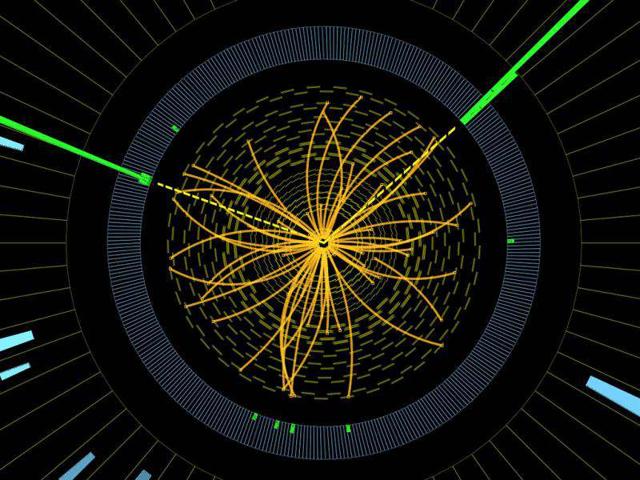
"We have now found the missing cornerstone of particle physics," Rolf Heuer, director of the European Center for Nuclear Research (CERN), told scientists.
He said the newly discovered subatomic particle is a boson, but he stopped just shy of claiming outright that it is the Higgs boson itself - an extremely fine distinction.

"As a layman, I think we did it," Heuer said.
"We have a discovery. We have observed a new particle that is consistent with a Higgs boson."
The Higgs boson, which until now has been a theoretical particle, is seen as the key to understanding why matter has mass, which combines with gravity to give an object weight.
The idea is much like gravity and Isaac Newton's discovery of it: Gravity was there all the time before Newton explained it.
But now scientists have seen something very much like the Higgs boson and can put that knowledge to further use.
CERN's atom smasher, the $10 billion Large Hadron Collider on the Swiss-French border, has been creating high-energy collisions of protons to investigate dark matter, antimatter and the creation of the universe, which many theorise occurred in a massive explosion known as the Big Bang.
Two independent teams of more than 5,000 scientists at CERN said on Wednesday that they have both observed a new subatomic particle - a boson.
Heuer called it "most probably a Higgs boson, but we have to find out what kind of Higgs boson it is."
Asked whether the find is a discovery, Heuer answered, "As a layman, I think we have it. But as a scientist, I have to say, 'What do we have?' "
"It is consistent with a Higgs boson as is needed for the standard model," Heuer said.
IMG alt=http://www.hindustantimes.com/Images/Popup/2012/7/cern-03.jpg align=bottom src="http://www.hindustantimes.com/Images/Popup/2012/7/cern-03.jpg"
"We can only call it a Higgs boson - not the Higgs boson."
The leaders of the two CERN teams - Joe Incandela, head of CMS with 2,100 scientists, and Fabiola Gianotti, head of ATLAS with 3,000 scientists - each presented in complicated scientific terms what was essentially extremely strong evidence of a new particle.
| | |


