
Govt says caste data will be made public at appropriate time
The government formed an expert panel headed by NITI Aayog vice-chairman Arvind Panagariya on Thursday to analyse 4.6 million entries from independent India’s first caste census that has turned into a charged political issue ahead of the Bihar polls, with parties demanding the data be made public.

The decision was taken in a meeting of the Union cabinet chaired by Prime Minister Narendra Modi, with the ministries of tribal affairs as well as social justice and empowerment to nominate other members of the committee which is expected to file its findings in a year.
About 180 million rural households were surveyed across India for the Socio Economic and Caste Census 2011, the provisional results of which were released this month with the aim to identify the root cause of poverty and ensure an efficient delivery system for welfare schemes.
Finance minister Arun Jaitley said that states should send their recommendations for caste consolidation expeditiously to the Panagariya committee instead of politicising the issue.
“The caste data will be made public at the appropriate time after the process of classification is complete,” he told a press conference.
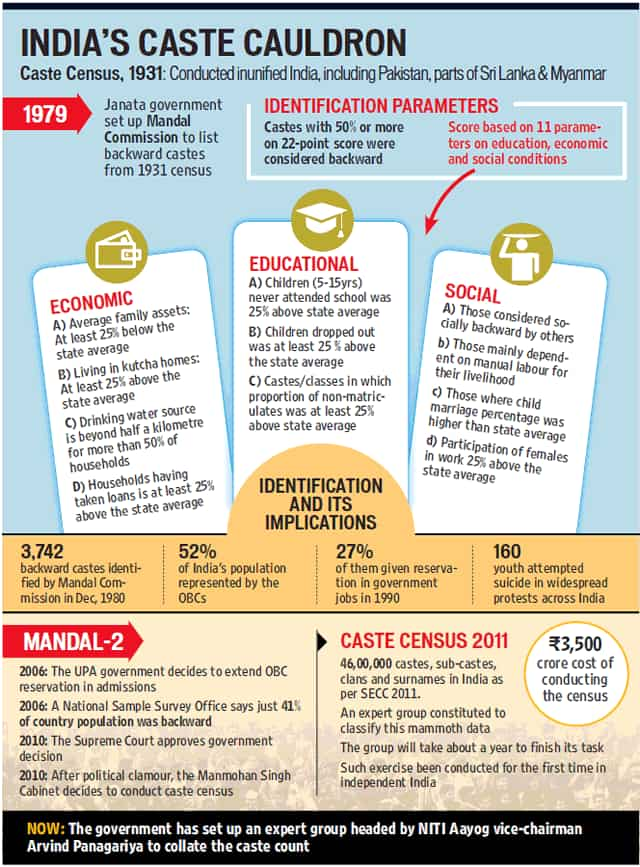
The census has become a political hot potato with the BJP’s rivals, particularly in states like Bihar and Uttar Pradesh that have complex caste equations, alleging that the government is not releasing the data as it is wary of its electoral fallout.
The CPI demanded on Thursday the data be disclosed so that special programmes can be planned to uplift those who have been maltreated and suppressed in the name of caste, joining a growing clamour from parties like the Congress, SP, RJD and JD(U), that signals a tough monsoon session ahead for the government.
Experts pointed out that the two caste surveys of 1931 and 2011 were conducted in different social scenarios.
P Padmanabha, registrar general of India in 1978, said that in 1931 people preferred to be listed under a higher caste status.
“A number of caste associations were formed and overnight honorific caste names were adopted, showing descent from Brahmins or Rajputs, etc. Various ambitious castes quickly perceived the chances of raising their status,” she wrote in a report as census commissioner.
Eighty years later, the situation has turned around, as claiming to be backward means entitlement to government benefits. This is a major concern for social sector experts looking at the 2011 caste data.
ABOUT THE AUTHORChetan ChauhanChetan Chauhan is the National Affairs Editor looking into all aspects of news and features from across India. A Chevening scholar with over three decades of experience in reporting and news management, Chetan has extensively covered all important aspects of the social sector, political economy, environment and climate change nationally and internationally. He did a journalism course at the Reuters Institute of Journalism in Oxford and Digital Media training at Nanyang Technological University in Singapore. He started as a reporter with The Statesman in 1996 and joined the Hindustan Times in 2000 in the metro bureau covering environment, crime and Delhi politics. He covered hot local news, from the Jessica Lal murder case to the rebellion of Delhi Congress MLAs against then Chief Minister Sheila Dikshit, to the replacement of toxic vehicle fuel with cleaner compressed natural gas (CNG) in the national capital. Some of his stories on air pollution became part of the Supreme Court’s landmark MC Mehta versus Government of India case in the National Capital Region (NCR), forcing the government to take corrective measures. As part of the national political bureau since 2004, he covered important central sectors such as environment, education, social justice, labour, rural development, water resources, renewable energy, agriculture, broadcasting and the Planning Commission for more than a decade producing several exclusive and investigative breaking stories. His specialisation is the environment, having covered at least a dozen United Nations global conferences on climate change, biodiversity and wildlife including climate summits in Paris, Copenhagen and Bali. He also covered India’s two five-year plans ---11th and 12th and reported on drafting and execution of right based laws such as Right to Education, Right to Information and rural job guarantee law, MG-NREGA, now being introduced in new format as VG-RAM-G Act. He has in-depth knowledge of social sector issues. He was one of the first to report on tigers vanishing from Sariska and Panna wildlife reserves in 2004 and 2008, respectively, leading to the setting up of the National Tiger Conservation Authority (NTCA) and the introduction of stringent penal provisions for poaching. He has written extensively on the rising human-animal conflict in India and the degradation of India’s biodiversity hotspots because of mining and other activities. Since 2004, Chetan has covered Parliament comprehensively and participated in training on the nuanced coverage of Parliament proceedings. He has travelled extensively across India to cover national and provincial elections since 1998, especially in the Hindi heartland states, considered India’s road to power. He writes a regular column for Hindustan Times, Ecostani, on important national politics, economy, Himalayan ecology and environmental issues. His other responsibilities include providing inputs for edits and edit page articles for the publication, apart from managing news flow from across India.Read More

E-Paper


