
Indian experts urge world powers to set climate targets mindful of poor
Three Indian institutions asked climate negotiators in Paris on Wednesday to decide in a “fair” and “equitable” manner a long-term global temperature limit in a bid to adequately allocate carbon budgets to developing countries so they can meet their goals of economic growth
Three Indian institutions asked climate negotiators in Paris on Wednesday to decide in a “fair” and “equitable” manner a long-term global temperature limit in a bid to adequately allocate carbon budgets to developing countries so they can meet their goals of economic growth.
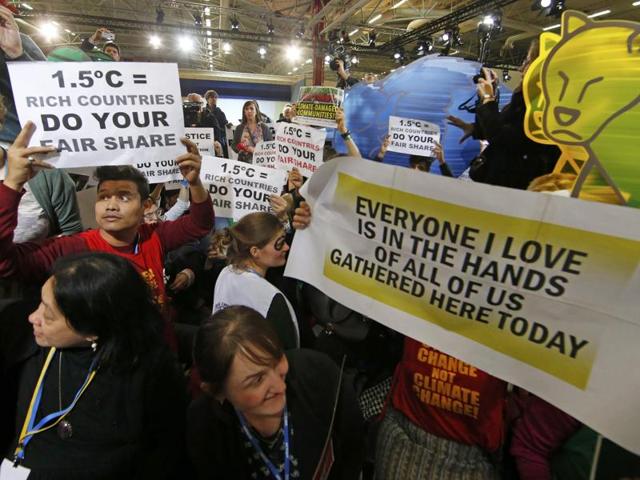
“We would like to draw the attention of the climate negotiators to the need to allocate the remaining carbon budget in a fair manner to all countries so that there is a chance for meeting this temperature target,” said a joint statement issued by the Centre for Science and Environment (CSE), IIT-Bombay and Tata Institute for Social Sciences.
They also said the emerging temperature goal of 1.5OC by 2100 would require massive enhancement of financial and technological support from developed countries to developing nations so they are able to move quickly onto low-carbon development pathways. Rich nations are yet to give such a commitment.
To meet the goal, they said, developed countries would have to significantly increase the level of their own efforts and reach net zero emissions in the next 5-10 years.
“In the absence of such commitments, a 1.5OC temperature target would remain a hollow shell – devoid of any real significance,” the statement said.
Negotiators are considering for the first time to include the ambitious 1.5OC goal in a possible climate agreement in addition to the initially-decided 2OC goal, a move that will have extensive implications for countries like India.
According to a report from the United Nations climate panel IPCC, meeting the 1.5 OC target will entail peaking of global carbon emissions latest by 2030 with India having to cap its emissions latest by 2020.
“Comparing the existing INDCs (countries’ climate action plans) to the available carbon budget indicates that for a better than even chance of meeting the 1.5OC target, the remaining carbon budget is exhausted well before 2030,” the statement said.
The ramification for India would be that it would get just 16% of the remaining carbon budget of 550 gigatonnes by 2030, which would be half of the rich nations’ allocation, even though India’s population equals the developed worlds’, the institutions said.
“The developed countries under the current dispensation would continue to misappropriate the remaining carbon space even in the future,” they added.
They calculation by the institutes makes it clear that the 1.5 OC target cannot become operational without the developed world vacating carbon space for countries like India with huge poverty elimination goals.
ABOUT THE AUTHORChetan ChauhanChetan Chauhan is the National Affairs Editor looking into all aspects of news and features from across India. A Chevening scholar with over three decades of experience in reporting and news management, Chetan has extensively covered all important aspects of the social sector, political economy, environment and climate change nationally and internationally. He did a journalism course at the Reuters Institute of Journalism in Oxford and Digital Media training at Nanyang Technological University in Singapore. He started as a reporter with The Statesman in 1996 and joined the Hindustan Times in 2000 in the metro bureau covering environment, crime and Delhi politics. He covered hot local news, from the Jessica Lal murder case to the rebellion of Delhi Congress MLAs against then Chief Minister Sheila Dikshit, to the replacement of toxic vehicle fuel with cleaner compressed natural gas (CNG) in the national capital. Some of his stories on air pollution became part of the Supreme Court’s landmark MC Mehta versus Government of India case in the National Capital Region (NCR), forcing the government to take corrective measures. As part of the national political bureau since 2004, he covered important central sectors such as environment, education, social justice, labour, rural development, water resources, renewable energy, agriculture, broadcasting and the Planning Commission for more than a decade producing several exclusive and investigative breaking stories. His specialisation is the environment, having covered at least a dozen United Nations global conferences on climate change, biodiversity and wildlife including climate summits in Paris, Copenhagen and Bali. He also covered India’s two five-year plans ---11th and 12th and reported on drafting and execution of right based laws such as Right to Education, Right to Information and rural job guarantee law, MG-NREGA, now being introduced in new format as VG-RAM-G Act. He has in-depth knowledge of social sector issues. He was one of the first to report on tigers vanishing from Sariska and Panna wildlife reserves in 2004 and 2008, respectively, leading to the setting up of the National Tiger Conservation Authority (NTCA) and the introduction of stringent penal provisions for poaching. He has written extensively on the rising human-animal conflict in India and the degradation of India’s biodiversity hotspots because of mining and other activities. Since 2004, Chetan has covered Parliament comprehensively and participated in training on the nuanced coverage of Parliament proceedings. He has travelled extensively across India to cover national and provincial elections since 1998, especially in the Hindi heartland states, considered India’s road to power. He writes a regular column for Hindustan Times, Ecostani, on important national politics, economy, Himalayan ecology and environmental issues. His other responsibilities include providing inputs for edits and edit page articles for the publication, apart from managing news flow from across India.Read More

E-Paper


