
 E-Paper



Young India's 'railway children': a dangerous life by the tracks
With India on course to have the world's youngest population by 2020, the plight of runaway children who make railway stations their home to escape poverty, violence and abuse has gone unadressed.

 Prefer HTon Google


The young boys huddled over a fire between two tracks just beyond the platforms of New Delhi railway station, oblivious to the trains rolling past. They were trying to boil some water to make tea.

One, a grime-encrusted urchin wearing a filthy baseball cap at a jaunty angle, said this was their home. He had run away after his mother died and he could take no more beatings from his alcoholic father.
The nine-year-old from Haryana said he slept on the platform or in a waiting room, scrounged for food and earned some money scavenging plastic bottles for reselling.
"I used to go to school but when my mother died everything was shattered," he said.
These were just a few of India's "railway children" - whose ranks are swelled by an estimated 120,000 runaways arriving each year at the stations of the world's fourth-largest railway network to make their homes there.
They have fled poverty, violence and abuse or are simply seeking adventure, attracted by the bright lights of the big cities such as Delhi, Mumbai and Kolkata.
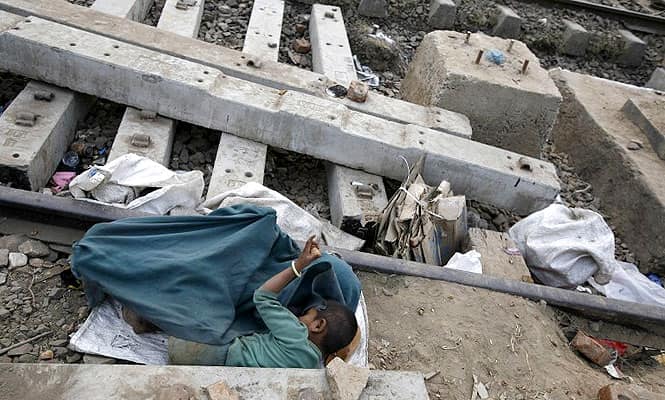
The children are a reminder that despite newfound wealth, ranks of billionaires and a growing middle-class, there is no magic wand to solve the problems of the old India.
Even though growth has slowed in the last few years, the chance to make money still attracts the railway children to the big cities. With India on course to have the world's youngest population by 2020, their plight is a signal the country could fail to exploit this economic advantage.
The last survey of New Delhi station in 2007 by charity groups estimated 35 to 40 children were arriving each day.
"Now it is increasing," said Pramod Singh from the Salaam Baalak Trust, who combs the platforms each morning for new arrivals and tries to bring them into his group's safety net.
Navin Sellaraju, country director of the Railway Children India, a branch of the UK-based organisation, said it is a huge issue in a country that has a fifth of the world's children.
"A good number of them have run away from poverty in rural areas of the most backward states. In Delhi and Mumbai, you have many from Uttar Pradesh, Bihar and West Bengal," he said, referring to large northern and eastern states whose combined populations exceed those of Brazil and Russia together.
"A lot of remote areas are connected by rail but not by road. A child can get on a train and travel without a ticket."
Despite the shelter of the stations, danger is everywhere.
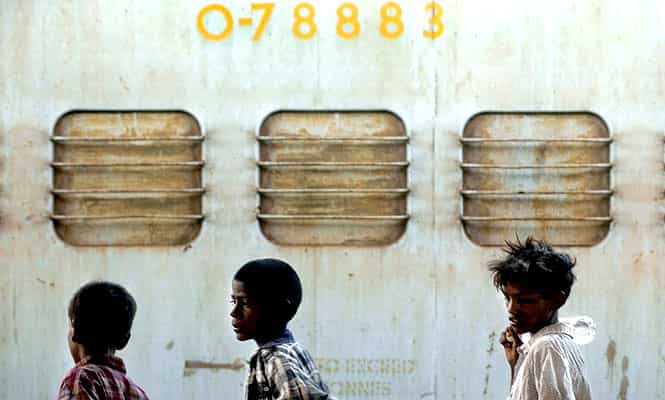
The minute the children arrive, they are exposed to the risk of physical abuse by older boys, sexual abuse by adults and gang rivalry. Girls are particularly vulnerable and are often taken off by traffickers with hours of landing.
Social workers try to get to them first.
"It is important to get to them within a day or so of arrival, otherwise it becomes difficult," Singh said. "They pick up survival skills. They are easily trapped."
Reluctant returnees
A number of boys were being cared for by Salaam Baalak and Railway Children in a shabby building in the station compound. Nine lads, all barefoot, sat on a rug, playing checkers. A few had arrived that morning. The oldest was thought to be 14.
One said he came from Kishanganj in Bihar state – a journey of nearly 1,000 km (620 miles). He arrived in Delhi three years ago but met social workers only in the past few months.
"I don't want to go home. Now I'm attached to this place," he said.
Railway Children's Kiran Jyoti said it was often hard to get the children to return to their families.
"Newcomers are reluctant to talk. They can take months to disclose where they are from," she said. "If they can't be restored to the family, they eventually have to go into long-term care."
Some do not want to return to abusive homes. Others simply like the freedom and the fact they can earn money - 250 rupees on a good day. On the downside, some take to sniffing substances and turn to pick-pocketing and petty crime.
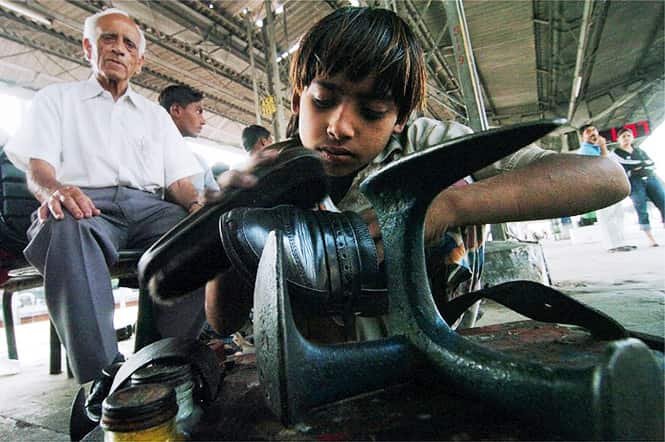
Indian law provides a framework to tackle the problem with child protection and anti-trafficking laws, but enforcing and funding those measures prove difficult, Sellaraju said.
The children have also suffered threats and violence from the police and railway officials but that is now changing.
"It used to be cruelty. Now no shouting, no handcuffs. We want child-friendly police stations. Protecting children is also a policeman's duty," said Thaneshwar Adiguar of the Special Juvenile Police Unit.
Railway companies are involved in the effort, setting up posts and spreading awareness through staff, vendors, porters and passengers with announcements and leaflets.
"There is a positive intent on the part of the government and railways but there are many challenges," Sellaraju said. "India is at a crossroads. There are two extremes which exist now."


