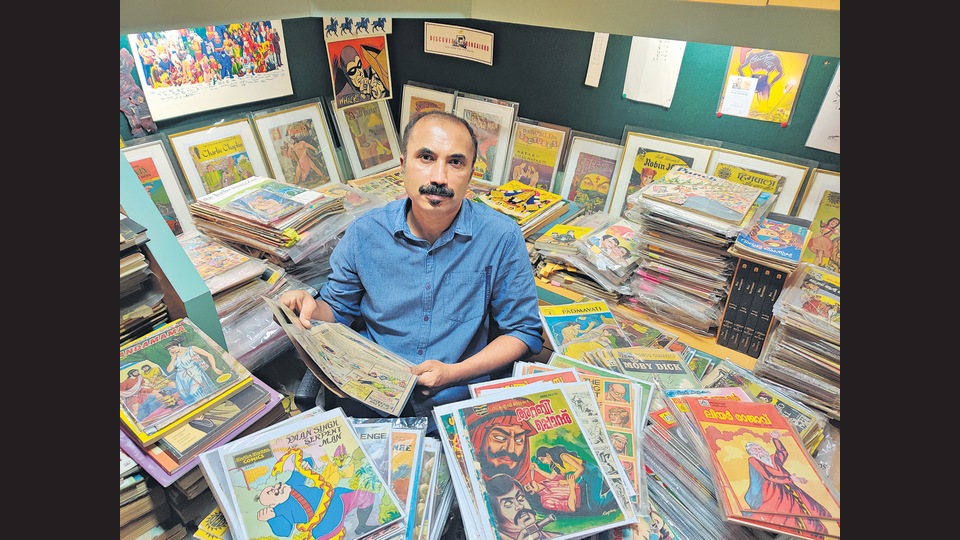
Arun Prasad, 46, began collecting comic books out of a sense of nostalgia. He’d misplaced his small but prized collection when his family moved from Kerala to Karnataka in 1990. To help him recover, a friend gifted him a couple of editions of the Indrajal comic Phantom.
Prasad, now a historian and writer based in Bengaluru, has since amassed a collection of 18,000 comic books from across decades and across India, in English, Hindi, Bengali, Malayalam, Tamil, Gujarati and Urdu. It’s become an archiving project, a case of owning little pieces of history. “Through these comics, one can revisit a rich and vibrant era in the country’s cultural past,” he says.
An ongoing project with web-comic creator and filmmaker Aarthi Parthasarathy, 36, will seek to place the pieces in his collection in their socio-economic context. “A lot of our regional comics have not been documented,” Parthasarathy says. “What we are doing is trying to revisit certain incidents and storylines and place them in context, eventually in the form of a book on India’s unique history of comics.”
To Prasad, the concept in India goes back to a time much before the modern-day European periodicals brought magazines and their comic strips to India in the 19th century. He believes their earliest form in our history is the rich and interesting history of visual storytelling through sequential art.
In Rajasthan, for instance, there is the ancient tradition of the Kavad, where stories are told with the aid of a three-dimensional wooden case with unfolding panels covered in artwork. Pattachitra is the art of telling stories through images on cloth-based scroll paintings, a living tradition in West Bengal and Odisha.
In fact, one could go further back, all the way to the rock art from 10,000 years ago in Madhya Pradesh’s Bhimbetka caves. Viewed together, they form a visual, sequential account of these human settlements and their cultural evolution.
The 2nd century BCE cave art at Ajanta in Maharashtra uses murals to tell tales of the Buddha’s journey, from his prior lives as both a human and an animal to his enlightenment and after. These tales would later be translated onto the page in the form of the Jataka tales, still a popular resource.
“Even temple sculptures and murals represent our mythical stories in sequential form through art,” Prasad says.
Panel discussion
When it comes to the combination of graphic imagery, words and paper, the earliest comics in India appeared in humour and satire magazines of the 19th century, inspired by the British weekly Punch.
There were numerous versions in regional languages, and almost all of them contained satirical cartoons, often lampooning British rule and policies. There was the Parsee Punch based in Bombay (printed in English and Gujarati), the Awadh Punch in Lucknow (published in Urdu). There was a Bengali Punch too. Some of these would remain in circulation until the 1930s, among other shorter-lived and relatively undocumented versions in regional Indian languages.
By the 1950s, the first Indian comic books were being printed in India. Pran Kumar Sharma brought out the first Chacha Chaudhary comics, in Hindi, in the late 1960s. Aabid Surti created comic strips in Gujarati, and created the highly popular Bahadur, arguably the first Indian superhero.
The success of Indrajal Comics (introduced by Bennett Coleman & Co in 1964) and the comic magazines of Amar Chitra Katha (founded in 1967) sparked the birth of Diamond Comics and Raj Comics in subsequent decades and, elsewhere in the country, comic books such as Handa Bhonda (Bengali), Madhu Muskan (Hindi), Poompatta and Paico Classics (Malayalam). Across the country, children became hooked. Parents didn’t mind because, unlike say Archies, there was no culture shock here; these stories were safe, entertaining, relatable.
Bobanum Moliyum or Boban and Molly, a comic first published by Malayala Manorama in the late 1950s, for instance, followed the adventures of mischievous 12-year-old twins from a middle-class Christian family in Travancore. Tales typically involved a lazy panchayat president, his wife and dog, but creator VT Thomas was adept at weaving in current, moral and cautionary tales about alcoholism, politics and other social issues.
Paper trail
Tracking down the comics isn’t easy, but it’s usually a rewarding exercise full of surprises. It was only when he’d found them all that Prasad realised, for instance, that the first 10 issues of Amar Chitra Katha were translations of western fairy tales in Hindi, Kannada, Gujarati, Marathi, Tamil, Bengali, Telugu and Malayalam. These included Jack and the Beanstalk, Cinderella, The Three Little Pigs, Sleeping Beauty and Little Red Riding Hood. There was no English version.
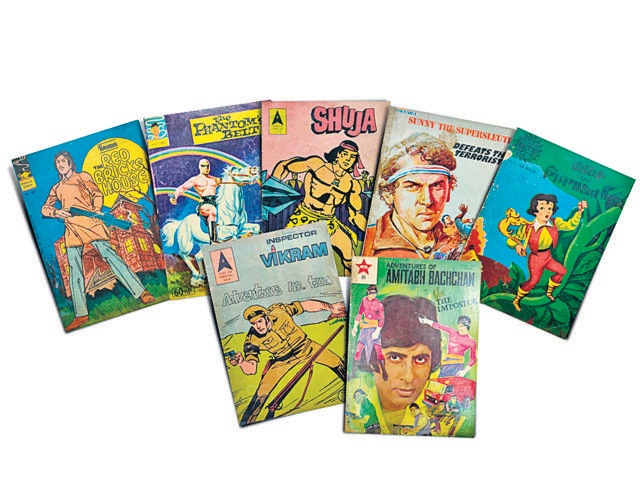
As word spread of his search, he laid his hands on rare comics such as a series on Indian mythology produced by the Tirupati Temple Trust; a national integration series published by the Ministry of Information and Broadcasting. A 10-edition Supremo Comics series that featured Amitabh Bachchan as a superhero. Rail Pari, a comic on the story of the Indian Railways, published by the Indian Railways.
Art meets truth
Prasad likes the visual appeal of old comic books with hand-drawn panels and lots of white space around the frames. Today with computer-generated images and graphic designs he feels somewhere the soul of comic books can get lost. “I feel happy that some independent creators are still working on hand-drawn comics with rich and strong content,” he adds. “The era of Indian comics with its superhero-oriented simplistic storylines and artworks aimed at children has passed. Today comics are getting into another level altogether.”
What excites him is this new level of current, political issues being tackled in comic-book or web-comic form. Over the past decade, these have included Kripa Joshi’s Miss Moti, about the everyday trials and triumphs of a plump woman with an extraordinary imagination; Rachita Taneja’s satirical feminist web comic Sanitary Panels; Rohan Chakravarty’s Green Humour series on man, wildlife and nature. Not to mention the wide range of graphic novels. “Things have come a long way,” Prasad says.
(This story has been updated to reflect that a vintage comic book centered on the adventures of cricketer Sunil Gavaskar, not actor Sunny Deol.)

 E-Paper