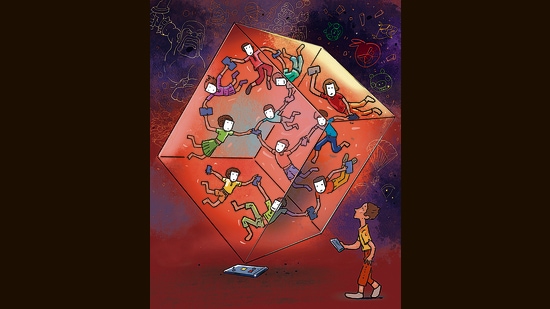
What started out as a gaming platform has become a safe space where teens can vent, chat, showcase a talent, even attend a virtual group therapy session, anonymously.
The new teen getaway is Discord. Where Facebook and Instagram lost out by being both more invasive and more popular, and Snapchat still rules because it destroys the evidence, the gaming platform offers spaces — called servers — in which users can chat, collaborate, perform, in utter anonymity.
(HT Illustration: Jayachandran)
What started out as a platform where gamers could strategise and swap tips, is now a space of #vent sessions, virtual therapy groups, karaoke nights, show premieres and poetry slams. Discord allows for greater anonymity partly because it has far fewer users (about 150 million monthly active users, against Instagram’s 1-billion-plus) and because, unlike most social-networking apps, it operates with a username as one’s only identifier.
School student Sarameet Mohanty, 15, from Bhubaneswar downloaded the app in May 2020, looking for more content from her favourite influencer, YouTube comic Sanskar Sharma.
“I felt like I had stepped into a fantasy world,” she says. There were other teenagers like her, from around the world, “casually hanging out”. “Initially it was weird to talk to strangers, but with the pandemic restrictions in place, they slowly became the only people I could open up to without fear of being judged,” Mohanty says.
They talked about family tussles and being confused about career prospects. She could talk freely, Mohanty says, without feeling like she was giving away too much about her life. Discord is where she first discussed data sciences as a possible career, she adds. It widened her world view “beyond Bhubaneswar”.
Two weeks ago, she also joined an online session about managing stress during exam season, conducted by counselling psychologist Kajal Makwana, on the Discord server of lifestyle influencer Taneesha Mirwani, 19. “No question was too silly and soon users were shedding inhibitions and talking about personal stories, like dealing with a stepmother who didn’t understand what they were going through during exam prep,” Mohanty says.
The 90-minute session attended by 50 Discord users touched upon dealing with parental expectations, the importance of frequent study breaks, and how to cope with failure.
Many influencers’ Discord servers are now run by social-media managers who respond to reactions, comments and requests by setting up sessions like the one with Makwana. Some are open-mic events; others are performance or art events. In India, these influencers include comedians Tanmay Bhat and Samay Raina and YouTuber CarryMinati.
The change for Discord, which was launched in 2015, began organically, but has since received a push from the platform too. “With over 19 million active servers of all sizes, Discord has become a place for study groups, karaoke nights, plant parenting advice and learning about cryptocurrency, and simply a place to hang out with your people,” co-founder and CEO Jason Citron said in a May 2021 blog post.
“For us, Discord is like WhatsApp on steroids,” says Melvin Sadankar, 22, who manages a local meme / community page in Mumbai that has over 1 lakh followers on Instagram and now over 2,000 members on Discord called AWSP. “We created channels on our servers called #vent where users spoke about heartbreaks, loneliness, the grief of losing loved ones to Covid-19, even coming out of the closet — things they couldn’t have done without the anonymity that Discord provided.”
Mumbai-based musician Avanti Nagral, 24, who has over 1.6 lakh followers on Instagram, started her Discord server, The Avantribe, a few months before she launched her song Sun Toh Lo (Please Listen) on YouTube in February 2021. The song draws from her experience of alienation in the pandemic, and her feeling of being stifled and invisible as her elders dealt with the stresses of their own changing lives.
The song unfolds in two parts, as she keeps pleading to be heard, and echoing voices respond: “Kuch nahi hua hai (Nothing has happened)”; “Yeh tera vehem hai (It’s all your imagination)”; “Log kya kahenge? (What will people say?)”
The lyrics resonated in a way she hadn’t expected, drawing, at last count, over 3.6 lakh views on YouTube. And her Discord server began to ping, with users talking about how misunderstood they felt. She responded by launching a series of Q&A sessions with therapists.
“The least we can do as artists with large outreach is be facilitators, advocating for mental health and connecting young people with licensed therapists,” Nagral says. One recent meet, held in October, featured psychotherapist Shanaya Boyce, 26.
In the 80-minute session attended by 70 users, Boyce fielded questions on polyamory, defined demisexuality (when attraction is always linked to a strong emotional bond), explained the difference between “asexual” and “aromantic”, and discussed the importance of one-on-one therapy. The Avantribe now has 13,900 members, and more mental-wellness sessions are planned.
“Personalised therapy cannot be replaced by well-meaning advice on forums, but mental-health sessions by qualified therapists on platforms like Discord can be a first step to self-awareness,” says Boyce. “Discord communities can also work as support groups, a place where like-minded people of more or less the same age can seek solace in each other and forge a sense of belonging and community.”

 E-Paper