
 E-Paper



Pans’ labyrinth: Swetha Sivakumar on how utensils shape a dish

 Prefer HTon Google


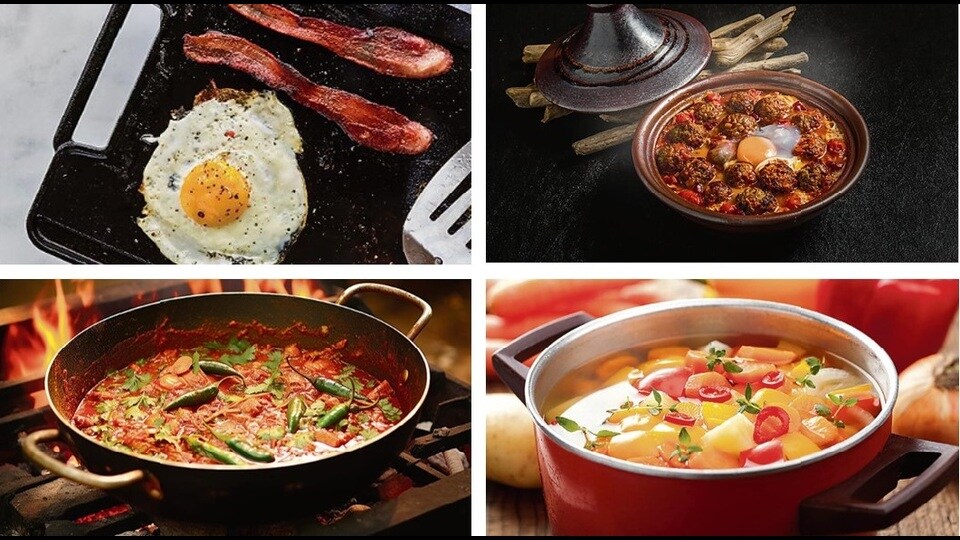
What makes the kadhai a favourite of the home chef? When is taller, better? When, and why, should one lose the sides altogether? Take a look.
How a dish turns out — the texture of the vegetables, the degree to which flavour soaks into protein — can depend, more heavily than we realise, on the shape of the utensil.
Shape determines how heat is distributed, how much heat is applied to the bottom, how much water evaporates from the surface.
It is shape, for instance, that makes the kadhai the favourite utensil for the home chef on a budget, or in a hurry. Onions brown far more quickly because the open concave shape exposes more surface area to heat at the bottom while allowing water to evaporate more quickly from the surface. One needs less oil, because a little stirring will get all the ingredients well-doused in the small pool that forms at the bottom.
A pool might form at the bottom of a handi (the matka-shaped utensil), but that is a much narrower base. Chopped vegetables would pile up and sweat, rather than shallow-fry and brown.
If one uses a dish with a flat bottom such as a sautee pan, meanwhile, one loses the little pool and, as a result, needs more oil. These are the ways in which shape becomes integral on a stovetop.
A kadhai is also ideal for a dry sabzi or a thick gravy such as channa masala — anything that is meant to be scooped up with a naan or roti — because the water the dish was cooked in dries up faster.
Some dishes, however, require a slower rate of evaporation. In these cases, it is better to use a handi. A south Indian poriyal, for instance, is a dish of chopped vegetables slow-cooked with very little water. The lid allows heat to build up, thus ensuring that the fibres in the vegetables have softened to the right degree by the time the water is gone. The end result is also a dish steeped in flavour, because it has been cooked through by superhot steam carrying volatile aroma compounds from the spices and vegetables.
Where do the other utensil shapes fit in? Dishes that contain meat or vegetables and a lot of liquid (gravies and curries) need cookware with high sides and narrow mouths such as handis and topes, to limit evaporation and sloshing when stirring.
A tall pan is essential when breaking down ingredients, for something like a stock, soup, stew or sambar. Here, one isn’t looking for speed but rather for a long, slow simmer. In the absence of a pressure cooker, this is also how most dals are cooked.
In a tall pan, it is the liquid that distributes heat. But it cannot do this evenly, so an occasional stir is recommended, if one doesn’t want the bottom or sides to stick or scorch. A tall pan also helps the cook more easily monitor how much liquid has been lost to evaporation.
In south India, kitchens are lined with tall pans, because much of each meal hinges on sambars, rasams and stews. There are other ancient civilisations where kitchens look very different, for an interesting reason: the scarcity of water.
The tagine, for instance, evolved in North Africa because it allowed hearty dishes of grains, fish, meat and vegetables to be cooked in their own broth, all in one pot, with very little added water. A simple, clever design tweak helps do this: The tall peak in the lid of the tagine serves to trap moisture and recycle evaporating liquid.
For superspeed, meanwhile, take the sides of a utensil away altogether. The tava or griddle is meant for quick, superheated action on a single ingredient that has been spread flat: dosas, chapatis, bacon, eggs. Because of the superheat, applied evenly across the food item, water quickly vanishes from the equation. But watch out for the action of superheated vapour. That’s what causes the holes in a dosa, the puffing-up of a chapati, the bubbles in a fried egg.
Handled right, the result is deliciously crisp or tender and soft. Neither a kadhai nor a handi could pull this off.
(To reach Swetha Sivakumar with questions or feedback, email upgrademyfood@gmail.com)


