
 E-Paper



Queen of the gambit: Talking chess and challenges with Harika Dronavalli


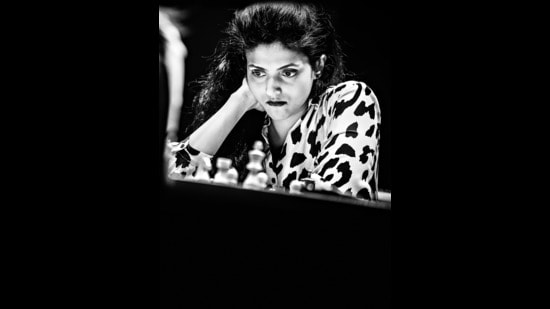
She just led India to an unprecedented global win. But it hasn’t all been good news. The 30-year-old grandmaster talks about the many ways the chessboard has changed her.
Harika Dronavalli, 30, has been marking time with chess accolades. But the board hasn’t always been kind to her. Until she began competing, at 8, she led a sheltered, pampered life. “My parents took care of everything for my sister and me,” she says.
Once she started competing, and winning, she faced an unexpected battle. The pressure to win turned to stress, then anxiety. Her parents supported her and rejoiced at every win; her father sold some of the family’s real-estate so they could take her to Spain, where she won her first international medal, a silver, at the World Youth Chess Championship (U-10 girls). She was 9.
At 12, she became Asia’s youngest Woman International Master or WIM. At 13, she made it onto the Indian national team. At 17, she won an Arjuna Award. At 20, she became only the second Indian woman to become a grandmaster, after Koneru Humpy. By then, she had won the Under-14 girls’ and Under-18 girls’ world youth chess championships and the girls’ world junior chess championship title.
Amid it all, she developed a fear of losing.
In a TEDx talk in 2019, Dronavalli spoke of how this fear took hold of her during play and stayed on after. “I started extremely bad [at the U-15 national championship] and I could see disappointed faces of my parents, my trainer, I was extremely upset. I couldn’t understand in the beginning how to handle it,” she said.
Oddly, it was losing that helped her conquer that fear, she adds. It forced her to acknowledge that failure was not an end but a way of preparing for the future. It taught her that she was more than what happened on the board.
She learnt to breathe at tournaments, and enjoy herself in the company of other competitors, at least when not actually competing. She learnt, she says, that losing doesn’t take away from one’s achievements.
“It’s not something you learn immediately, especially as a kid. It takes time,” Dronavalli says, speaking from her home in Hyderabad. “I’m much better than when I started.”
***
One platform on which Dronavalli very rarely loses is team events. At the recently concluded FIDE Women’s World Team Championship, the Indian team won silver.
Dronavalli, one of the five-member team, played 11 matches and didn’t lose a single one. She played on Board 1, reserved for the top player of each country. She beat World No. 2 Aleksandra Goryachkina of Russia and helped India win its first-ever medal at the event. She also won a silver for her individual performance.
“There was something about the women’s championship that we couldn’t crack in years, which makes this win special,” she says.
Playing for India is when she plays best, Dronavalli adds. “I work harder and play better at team events also because so many people depend on me. Somehow I have lost very few games in team events and when I do, I remember them, because I feel very guilty.”
Dronavalli is known to be a practical player. “She understands what it takes to play a good game, from time-management to making quick, practical decisions,” says Sagar Shah, an International Master and co-founder of chess news portal Chessbase India.
Shah has been tracking her progress. “She’s not overly aggressive, not overly passive, and because of her objectivity and grasp of positional chess, it is very difficult to beat her,” he says.
***
Growing up in Guntur, Andhra Pradesh, Dronavalli was introduced to chess by her father Ramesh Dronavalli, a civil engineer who loved sports. At 9, she began training under her coach NVS Rama Raju, who continues to mentor her.
For the little girl, this meant a life very different from that of other little girls. For one thing, she had taken a break from school to train. She was now training for eight to ten hours a day, with a few small breaks in-between.
“Since it worked, we continued with the same routine for many years,” Dronavalli says.
By 13, Dronavalli had opted out of school altogether. By then, she was also Asia’s youngest WIM. The board was clearly where her destiny lay.
“At that time I was training a lot, travelling and taking part in open tournaments [where both men and women play], to improve my game,” Dronavalli says. “It was all showing results. My parents didn’t feel like I was losing something by not going to school. Instead we were doing all we could to make a mark in chess.”
The fight to win continues. Dronavalli is currently playing in the first Indian Chess Super League (which concludes on October 17), and will be heading to Latvia next for the FIDE Grand Swiss Tournament. If she wins that, she’ll make it to the Candidates, a high-level closed tournament that will decide whether she makes it to the Women’s World Chess Championship.
That’s the ultimate title. “All those wins and she’s not done,” Shah says. “She is very clearly gunning for that ultimate title in chess.”


