
 E-Paper



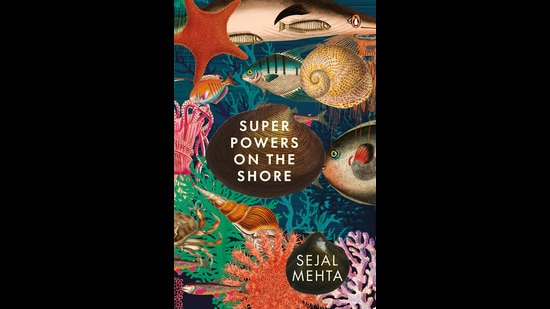
Read an exclusive excerpt from Superpowers on the Shore
The sands are alive, with nesting, hatching, egg sacs. One just has to know what to look for. In this excerpt from the chapter Power of Creation, a scene from Mumbai’s teeming Juhu Beach.


It looked just like bubble wrap.
Or, it looked like a white, soggy flower, coated in bubble wrap. There were a fair number of them across the beach: a foot long perhaps, fanned out, with five long ‘petals’, each jiggling with tiny bubble-like protrusions. They seemed to be anchored into the sand.
So many things on the beach can remind you of something else. In bigger cities, our trash is a tease. A blue tarp string will behave like a floating tentacle, or a transparent bag floating in the shallows will remind you of a jellyfish. Coming back to the bubble-wrapped flower, I could have dismissed it as a soggy plastic blob, but by then, I knew better. So, I looked closer.
Inside each bunch, lay a tiny nursery.
Each bubble held the tiniest squid baby you ever saw.
Each bubble was an egg, and because the babies were now ready to hatch, I could see an oval body that flashed red and white, and . . . eyes. They were all part of the flower-like entity, which was an entire egg mass of hundreds of these.
I looked up and saw another egg mass in the distance, and another. There were heaps of them containing hundreds of babies in each at various stages of development. This was not the Juhu beach I knew. For now, squid mums had claimed it for a nursery— except that it was on one of the most popular beaches in Mumbai. It was an evening like any other: cricket was being played at every possible pitch length, romancing couples were ignoring a thousand pairs of prying eyes, people were walking, playing, exercising, eating—it was business as usual. Except it wasn’t.
Alive.
That’s the word we left off at in the previous chapter.
A place that facilitates creation.
The fact that there are babies here should come as no surprise. It is an ecosystem, the intertidal zone. Sea slugs, sea snails and other residents lay eggs here in small sacs; juvenile crabs are seen scampering across the shores, sea sponges grow up here. But this was interesting because squids are not intertidal residents. They live in the ocean. A number of open ocean creatures come to the shores to lay eggs: turtles, octopuses, and cuttlefish to name a few. Fish species come to the shallows to lay their eggs. A walk along the intertidal region will reveal juveniles of damselfish, angelfish and puffers all zipping along, learning the ropes before their journey to the deep.
Even horseshoe crabs come to the shore every year now, guided by the full moon, to lay their eggs in spite of the increasing danger to their lives—they’re traded for their medicinal properties. Turtles use the dry areas of the shore, the area just above the tideline—it is not strictly the intertidal zone, but just the part that never gets wet. It’s natural for animals to choose spaces that would ensure the safety of their babies, and there are fewer predators in this zone, compared to in their homes. Not that the intertidal region is entirely safe—other terrestrial creatures, birds and even humans might, more often than not, get at and harm the juveniles.
Although sea turtles aren’t strictly intertidal creatures, their relationship with this stretch of land is primal and intense. I am stretching this narrative to beyond the tideline, so not technically the intertidal region, but just beyond, further up the shore. They land here to give birth and choose the sand for temperature-based gender selection of their babies. After the young ones hatch, they take their first steps across the shore into the comforting embrace of the ocean, which they recognize instinctively with no help, as the place that their mums came from.
.
The Long Walk to Freedom and Back
Hermit Crab watches as the humans run about on the beach.
They are carrying notes, call sheets, making teams, being generally chaotic.
They are being extremely human, she decides.
All this stress and anxiety hovering in the air.
Ruining, thinks Hermit Crab, the exciting energy actually running through the sand,
Blowing in the breeze, making the atmosphere thick with anticipation.
She looks towards the ocean.
They are almost here.
Hermit Crab staggers away slowly to a vantage point.
She likes watching this annual homecoming.
She even grudgingly likes the name humans had kept for it.
The Spanish word, arribada. ‘Arrival’, by sea.
She watches the humans with flashlights, sharing a laugh with the fishers who’ve
come to watch. She likes that the fishers knew more than the scientists who visit.
And she likes that the scientists understand that.
You and I, my man, she calls out to a passing local who doesn’t hear her.
She doesn’t mind. He knows she is here.
We know this place. We are familiars, she thinks, comfortably settling in.
She wonders how many would come.
And then, as the moon lights up the waves, they arrive.
Olive ridley turtles. Riding the waves to the shore.
A hundred turtles riding each wave, can you even imagine that?
Suddenly, everything is electric.
Over the next five days, the ladies arrive in thousands,
Gorgeous surfers breaking surface and riding to the coast to lay eggs.
Hermit Crab and her friends wave them in, and celebrate.
The humans cheer, and get to work, counting thousands of nests to record.
Can you imagine this kind of turn in the ocean?
Like a frequency only women catch.
Yes, yes she knows there’s the earth’s magnetic field at play here.
But, whatever it is, for that week,
Every night is ladies’ night.
.
(Excerpted with permission from Superpowers on the Shore by Sejal Mehta, published by Viking / Penguin India; 2022)


