
 E-Paper



The quantum realm in pop culture: Discworld, multiverses, and a Heart of Gold

 Prefer HTon Google


It’s been 100 years since we began to understand quantum mechanics. In sci-fi, its quirks have been dramatised to create wormholes, the TARDIS and so much more.
Perhaps the most significant thing quantum mechanics has contributed to popular culture is the multiverse theory.
This idea can be traced to Hugh Everett III’s Many-Worlds Interpretation of quantum mechanics, which he proposed in 1957.
To put it in terms of Schrodinger’s cat, when the box is opened, there is one universe in which the cat is dead, and another in which the cat is alive.
The real-world rider to this is that this is only possible on quantum — that is, infinitesimal — scale. Yet, almost every fictional multiverse, from the Marvel Cinematic Universe to Terry Pratchett’s Discworld, draws on the multiverse concept first put forth by Everett.
How else has quantum mechanics permeated popular culture?
Science-fiction
Quantum mechanics was a godsend for this genre. It was used to “explain” everything from spaceships to time travel (often in a single phrase that was never further elucidated).
The Star Trek universe imagines a version of space threaded with quantum slipstreams — pre-existing pathways formed by quantum fields. Ships with the right technology can “enter the stream” and ride it faster than light.
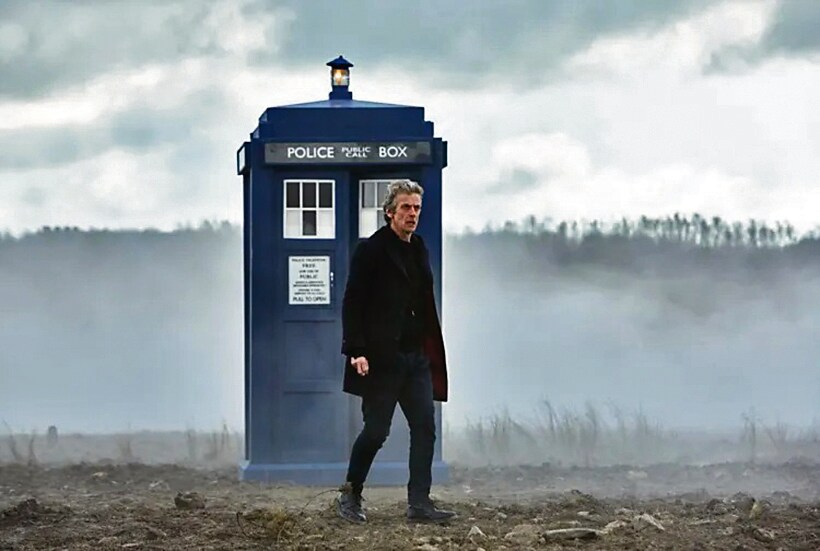
Doctor Who’s TARDIS (Time and Relative Dimension in Space) is a spaceship and time machine that can navigate the fabric of spacetime through quantum tunnelling.
Starships across sci-fi universes deploy “warp drives” to bend spacetime itself, and to make near-instant jumps across star systems.
Perhaps my favourite, for its sheer audacity, is the Heart of Gold in Douglas Adams’s Hitchhiker’s Guide to the Galaxy. This vessel uses an Infinite Improbability Drive to move very differently. It doesn’t travel through space at all. Instead, it calculates all possible quantum states of the universe, then “chooses” one where it is already at its required destination (often with very mixed results).
Art
Salvador Dali’s The Disintegration of the Persistence of Memory (1954) reflects his interest in the fragmentation of matter and the breakdown of classical reality, inspired by his deep interest in atomic theory and quantum physics.
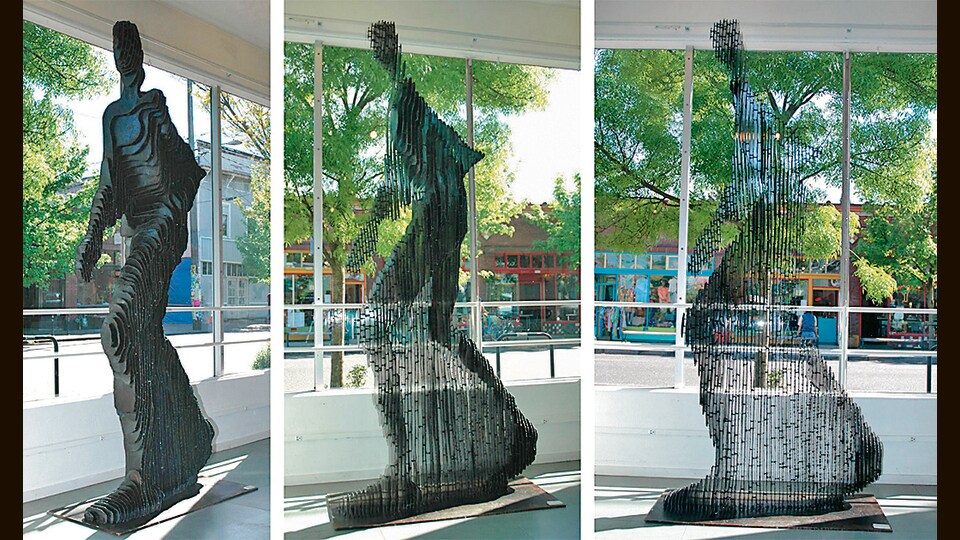
Julian Voss-Andreae’s Quantum Man (2011) is a sculpture of a human figure that appears solid from one angle but dissolves into abstract forms from another, symbolising the wave-particle duality of quantum mechanics.
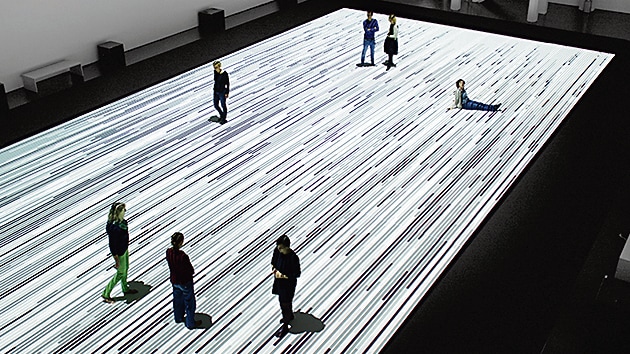
Ryoji Ikeda’s The Planck Universe (2015) is a multimedia installation that uses data visualisation and sound to explore the scales of the universe, from the quantum to the cosmic.
Carlo Bernardini’s Quantum Space (2010) uses optical fibres to create three-dimensional light structures that evoke the probabilistic nature of quantum particles.
Music
Quantum: Music at the Frontier of Science is a 90-minute concert that uses fragments of classical compositions to represent the entanglement, superposition and uncertainty of quantum mechanics. Composed by the Kitchener-Waterloo Symphony and music director Edwin Outwater, with help from the Institute for Quantum Computing at the University of Waterloo, it ends in a piece that merges Mozart’s Symphony No. 29 with discordant tones from a John Cage composition. A narrative voice offers minimal but helpful cues in brief interludes. The concert was first performed in 2012.


