
 E-Paper



After Ram Rahim’s imprisonment, Dera Sacha Sauda now ‘untouchable’ for political parties in Punjab
Politicians, who used to make a beeline to Dera Sacha Sauda considering its clout in the politically significant Malwa region, are now wary of even mentioning it publically for a number of reasons.

 Prefer HTon Google


Till 2017 Punjab assembly polls, almost all political parties loved to flirt with Sirsa-based Dera Sacha Sauda (DSS). However, the situation has taken a contrasting shift since and the dera has become nearly ‘untouchable’ for the political leaders.
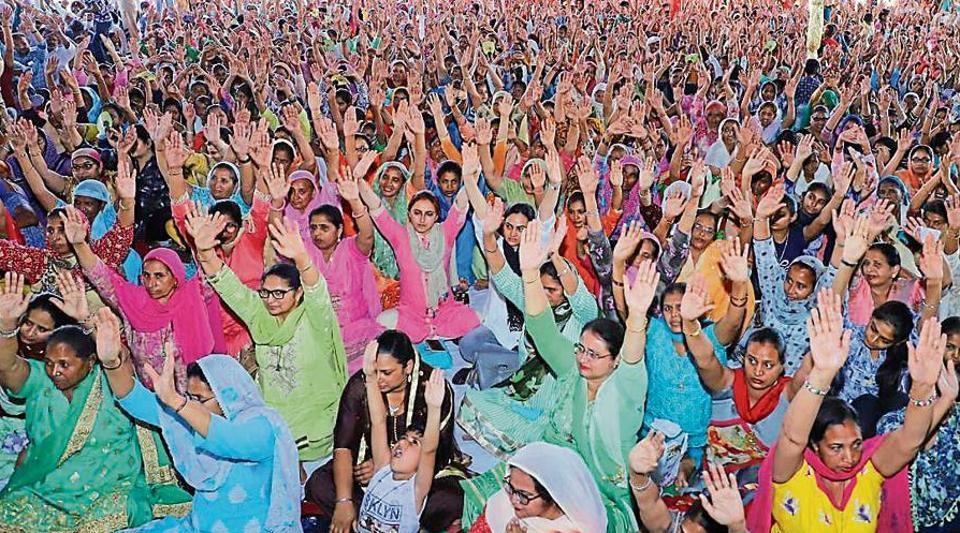
Politicians, who used to make a beeline to the dera considering its clout in the politically significant Malwa region, are now wary of even mentioning it publically for a number of reasons.
The dera earned a bad name after its head Gurmeet Ram Rahim was jailed in a rape case. What actually discredited the dera in Punjab was the alleged role of its followers in a series of sacrilege incidents of Guru Granth Sahib during the previous SAD-BJP regime, going by the facts coming to the fore in police investigations ordered by the Captain Amarinder Singh-led Congress government.
The investigations carried out by the police pointing to involvement of prominent dera followers in the desecration of Guru Granth Sahib and the findings of justice (retired) Ranjit Singh Commission have hit the dera’s image.
As these developments followed the imprisonment of Ram Rahim, the arrest of many dera leaders post-Panchkula violence has made the dera management completely inactive in Punjab.
While the Punjab Congress chief Sunil Jakhar has categorically clarified that the party will not seek Sirsa sect’s support, the SAD has stated it will follow Akal Takht’s edict of not taking support of the dera. The BJP — the alliance partner of Akali Dal — which the dera had supported in the 2014 Haryana assembly polls, is the only party from Punjab that has said it was not averse to reaching out to religious sects seeking votes. Aam Aadmi Party’s stand on the issue is also against reaching out the Sirsa dera.
“Conviction of its head in rape was a factor, but the alleged involvement of dera followers in sacrilege of Guru Granth Sahib was the final nail in the coffin. It meant the party seeking dera votes will have to face the ire of not only Sikhs but people from other communities for whom Guru Granth Sahib is as sacred,” said Bakhtaur Dhillon, a Bathinda-based senior journalist, who has been reporting on dera and the politics surrounding it.
With claims of over 40 lakh followers in Punjab, the dera still has the capacity to influence the polls in Patiala, Sangrur, Bathinda, Ferozepur and Faridkot Lok Sabha segments.
This is the reason why most of the political parties have distanced themselves from it, but they are keeping a close eye on the scenario. Even a section in the Congress feels that its senior leaders should not speak bluntly against the dera as it may go against the party.
DERA VS SIKHS, AND HOW AKALIS PAID FOR IT
The conflict between Sikhs and the dera is not new. It dates back to 2007 when dera head Ram Rahim committed a blasphemy by appearing in an attire similar to that of Guru Gobind Singh, the 10th Sikh master. Following this, the Akal Takht — the supreme religious body of the Sikhs — ordered to boycott the dera.
In October 2015, the issue came to the forefront again, when then Akal Takht jathedar Giani Gurbachan Singh pardoned Ram Rahim for the blasphemy.
As the Sikhs were already angry over sacrilege in Malwa region, which had taken place following a tussle between dera followers and a Sikh preachers in Bargari village over holding a congregations, the pardon to dera chief fuelled the anger of the community.
During anti-sacrilege protests, two Sikh youths were killed at Behbal Kalan and a few were injured in Kotkapura, pushing the Badal government on the backfoot and Akal Takht had to withdraw the pardon.
By this time, stories were out that the ‘pardon’ to Ram Rahim was part of a “deal” between Badals and the dera head to get support in the 2017 polls. Also, there were allegations that dera followers whose names had cropped in the Bargari sacrilege incidents were not booked by the government intentionally.
In the 2017 polls, the apprehension of the Sikhs got strengthened when Ram Rahim announced to support Akalis in the polls. All these developments backfired on Akalis and they could win only 15 seats in Punjab, the worst ever performance of the party.
Akalis faced further heat with the change in guard when the police under the Congress rule arrested dera men for sacrilege and Ranjit panel report had cast aspersions on dera’s role.
HOW DERA IS FLEXING ITS MUSCLES
After remaining dormant for some time, the dera has started reviving itself in Punjab by holding ‘naamcharcha’ (congregations) to make political parties aware of its clout.
Dera’s political wing head in Punjab, Ram Singh, however termed the congregations on last two Sunday as routine exercise.
“Attendance in these gatherings have shown that the base of the dera is intact. As far as the support to any political party is concerned, the sangat will decide it,” he said. The dera now plans a mega gettogether in Sirsa on its foundation day on April 29. “All ‘premis’ know who framed dera followers in false cases and who castigated them,” said Ram.
“There is a feeling in a section of the premis that the dera suffered because of its political activism,” said a former Congress leader from Bathinda, who once was closely associated with the dera, requesting anonymity. “Question is even if the dera asks followers to support a political party in Lok Sabha, will the order be followed? We should not forget that the dera order did not work for Akalis in 2017,” he added.
Going by the history, there is no favourite of the dera when it comes to politics and it plays its cards smartly to save its interests. And, ahead of the Lok Sabha polls, there’s no reckoner yet.


