
 E-Paper



Lok Sabha Elections 2019: In Jhalawar, voter awareness programme also focuses on conservation of endangered parrot species
In the Jhalawar-Baran Lok Sabha seat, the district administration has made the endangered Gagroni parrot its mascot for the 2019 Lok Sabha polls.


The voter awareness programme of the Jhalawar district administration, apart from focusing on the upcoming polls, is concentrating on the conservation of endangered Gagroni parrot.
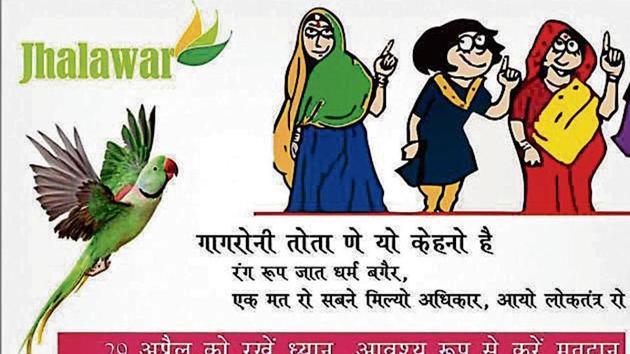
Gagroni parrot, known as Alexandrine Parakeet, is not only beautiful but is also known for imitating human voice.
Siddharth Sihag, district election officer, Jhalawar-Baran parliamentary constituency, said the Gagroni parrot, named after its habitat in the Gagron fort of Jhalarapatan town, Jhalawar, was once abundant in the region but is now on the verge of extinction. So the district administration thought of making it the mascot for the 2019 Lok Sabha polls.
“We have made a cartoon series under SVEEP programme which is based on Gagroni parrot. This will not only spread public awareness on voting but also about conservation of the endangered bird species,” he said.
While the Gagroni parrot based voter awareness programmes would be promoted on social media, its stickers will also be released on the billboard messages for Lok Sabha polls, he said.
Giving details of the Gagroni parrot, society for conservation of historical and ecological resources, wildlife biologist, Krishnendra Singh Nama, said the Gagroni parrot falls under schedule 1 (B) of the Wildlife protection act (WPA) 1972 and ‘near threatened’ list of the International Union for Conservation of Nature (IUCN).
“It is a medium sized parrot and derives its name from the Gagron fort of Jhalawar,” he said.
It is around 20 inches in length and longer than other varieties of parrots, he said. The male Gagroni parrot has a red ring on its neck and red spots on wings.
Poaching of this parrot for its household pet uses and flesh has lead to the sharp decline of the bird, said Nama.
Habitat destruction is another reason as it usually lives in the holes on straight and strong trees which nowadays are not seen, he said.


