
 E-Paper



Minor planet named after classical music giant Pandit Jasraj
Christened ‘Panditjasraj (300128)’, the minor planet 2006 VP32 was discovered on November 11, 2006, by the Catalina Sky Survey, a NASA-funded project.

 Prefer HTon Google


The International Astronomical Union (IAU) has named a minor planet between Mars and Jupiter after 89-year-old Indian classical vocalist Pandit Jasraj.
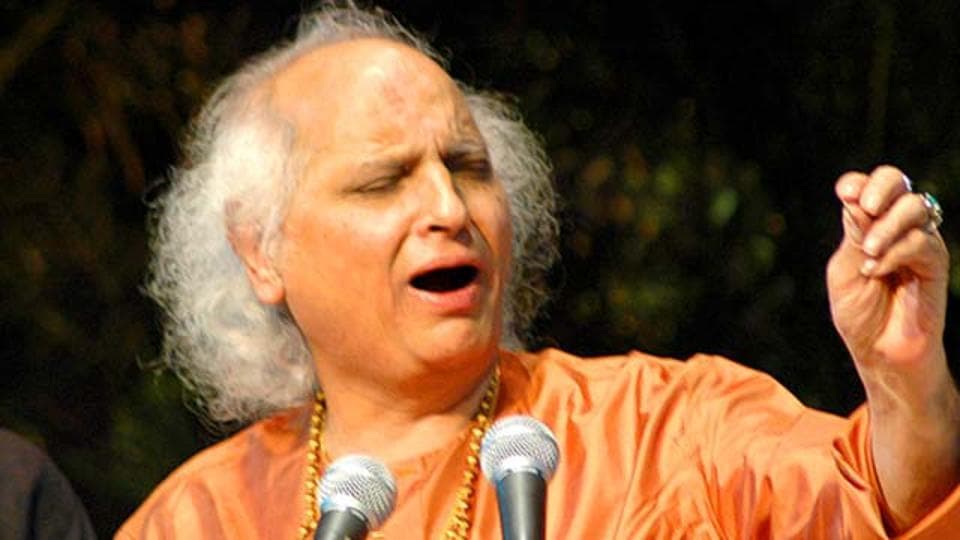
Christened ‘Panditjasraj (300128)’, the minor planet 2006 VP32 was discovered on November 11, 2006, by the Catalina Sky Survey, a NASA-funded project based at University of Arizona’s Lunar and Planetary Lab in Tucson, Arizona, that discovers and tracks near-earth objects. Panditjasraj was discovered by Mt. Lemmon Survey telescope at Mount Lemmon in the same state. The number 300128 is derived from Jasraj’s date of birth, January 28, 1930.
The citation reads, “Minor planet 2006 VP32 has been officially designated Panditjasraj (300128) by the International Astronomical Union (IAU).” It further states, “Sangeet Martand Pandit Jasraj (b.1930) is an exponent of Indian Classical vocal music. A life dedicated to music, Jasraj is the recipient of numerous awards, honours, and titles including the prestigious Padma Vibhushan and the Sangeet Natak Akademi Award. His distinctive voice traverses a remarkable four-and-a-half octaves.”
“I am speechless because this recognition is for something we cannot see, feel or touch,” Jasraj told HT on Sunday. “This is due to the blessings of God and my gurus. I dedicate this achievement to my country.”
Information on naming the minor planet Panditjasraj is published in the ‘Minor Planet Circulars/Minor Planets and Comets’ on behalf of IAU.
Scientists of the Public Outreach and Education Committee of Astronomical Society of India (ASI-POEC) were unaware of the development, and said neither did IAU officially approach Indian Astronomical community to seek any inputs nor this process bestows any unique honour.
“IUA gives away the rights to name non-interesting minor planets to a clutch of private companies, largely 10 years after they are discovered, where individuals can name these astronomical bodies at a cost,” said Aniket Sule, Chair, ASI-POEC. “In this case, there’s 90% chance that a fan named the minor planet after Pandit Jasraj for a price.”
Jasraj’s daughter Durga said the family was informed in the early hours of September 24, and received the citation early Saturday morning.
“This recognition is not by the nation or government; nor is it based on something achieved on Earth. It’s beyond our planet, and it took us a few days for the news to sink in,” said Durga. “This is the first time that Indian classical music has been recognised, and we have no words to express our happiness.”
NASA defines asteroids – sometimes called minor planets – as rocky, airless remnants left over from the early formation of our solar system about 4.6 billion years ago. A majority of the asteroids are found in the main asteroid belt located between the orbits of Mars and Jupiter.
“Babuji is worldly wise and has a lot of friends who are into the sciences,” Durga told HT on Sunday. “He would have many conversations with Dr APJ Abdul Kalam, who was also a musician. He also has interactions with young and upcoming scientists from Isro and NASA; some chat with him and some learn music.”
Though no Indian musician’s name was given to a minor planet earlier, dozens of them have been named after western musicians and opera singers.


