
 E-Paper



Steep, unhealthy rise in use of artificial lights at night across India, shows study
Analysis shows that globally the increase in artificial lighting has increased by 2.2% every year, but it’s as high as 7.4% in India


In what could illuminate the extent of light pollution in the country, artificially lit areas at night across India has increased by 33% between 2012 and 2016 — a rise of 7.4% per year, revealed the first-ever calibrated satellite radiometer designed for night lights. The total radiance of lit areas over the country also increased by 7.1% per year or 31.6% during the same period.
The study is important because light pollution, which is caused by excessive, misdirected or obtrusive outdoor lighting, has adverse effects on humans, plants and animals.
The analysis, led by GFZ German Research Centre for Geoscience, using data from Visible/Infrared Imager Radiometer Suite (VIIRS), showed that globally, the increase in artificial lighting over the Earth’s surface has increased by 2.2% every year – 9% from 2012 to 2016 – with a 1.8% growth in total radiance. While China saw an increase by 2.1% every year, Pakistan saw a drop of 4.9%, UK (0.1%), US (-0.1%).
At present, there are no international or national guidelines to curtail light pollution. Doctors said the amount of light the human eye can adjust to and finds useful is between 400 and 500 microns. However, the current LED lights or those installed on advertising hoardings and even some street lights are well beyond 500 microns.
Researchers said the growing transition from high-pressure orange sodium lamps to energy-efficient and cost-saving white Light Emitting Diodes (LED) for street lights has become counter-productive since governments are installing more LEDs which in turn are making the skies significantly brighter.
Stating that the extent of areas lit by artificial light is likely to be higher since the satellite sensors detect light between the ranges of 500 to 900 nanometres (nm), lead author and professor Christopher Kyba told HT, “Since the satellite sensor is not sensitive to part of the light from LEDs (blue light below 500 nm), we expected to see a decrease in light emissions when a city switches from orange sodium lamps to white LEDs. But we don’t see that at all.”
The 10-member team pointed out that there is very little evidence that brighter lights make cities safer. Giving an example of two street lamps that are 3mts tall but 50mts apart, Kyba said, “It doesn’t matter how bright you make them, it is always going to seem “dark” in the space between them. But if you shorten the distance between the lamps, then you can have an evenly lit surface and therefore don’t need nearly as much light.”
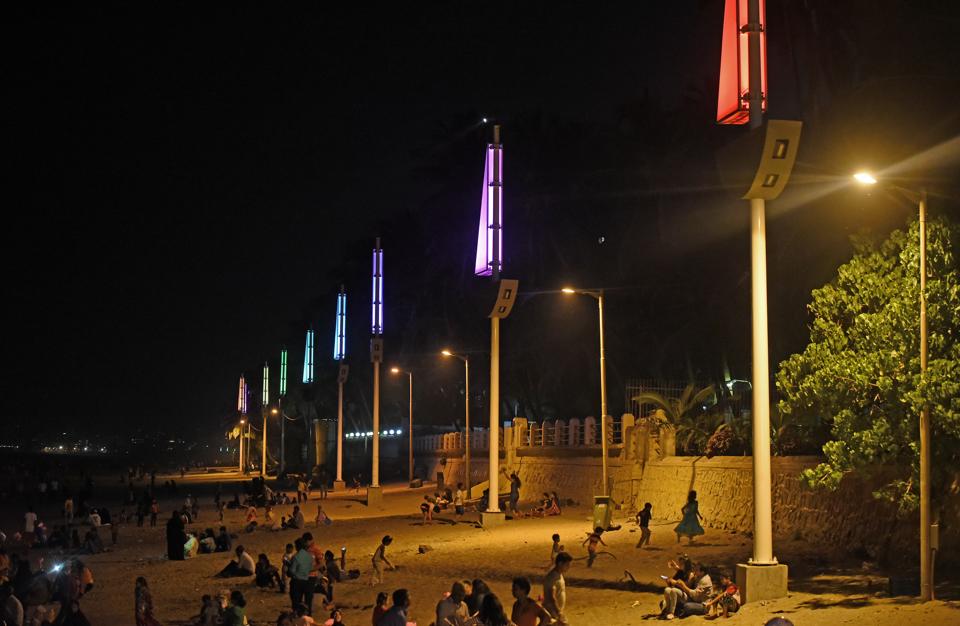
Although light pollution is not widely recognised as a problem, environmentalists in October criticised the installation of 100 high-mast lights at Juhu by the Brihanmumbai Municipal Corporation (BMC), under the beach beautification project.
“There needs to be a policy not just for street lighting, but a comprehensive policy for light pollution,” said Sumaira Abdulali, convener for Awaaz Foundation who has written to chief minister Devendra Fadnavis, municipal corporation and officials from the state environment department, sharing with them the impact of light pollution. “People in rural India are deprived of basic lighting while cities provide electricity to power excessive number of lights on streets and advertisement hoardings that are glaring and pose a danger to humans.”

Stay updated with all the Breaking News and Latest News from Mumbai. Click here for comprehensive coverage of top Cities including Bengaluru, Delhi, Hyderabad, and more across India along with Stay informed on the latest happenings in World News.


