
 E-Paper



‘Trees along Konkan wildlife corridor felled for mining, infra’
Despite a ban on tree felling at the Dodamarg-Sawantwadi wildlife corridor in south Konkan, petitioners before the Bombay high court (HC) have alleged deforestation

 Prefer HTon Google


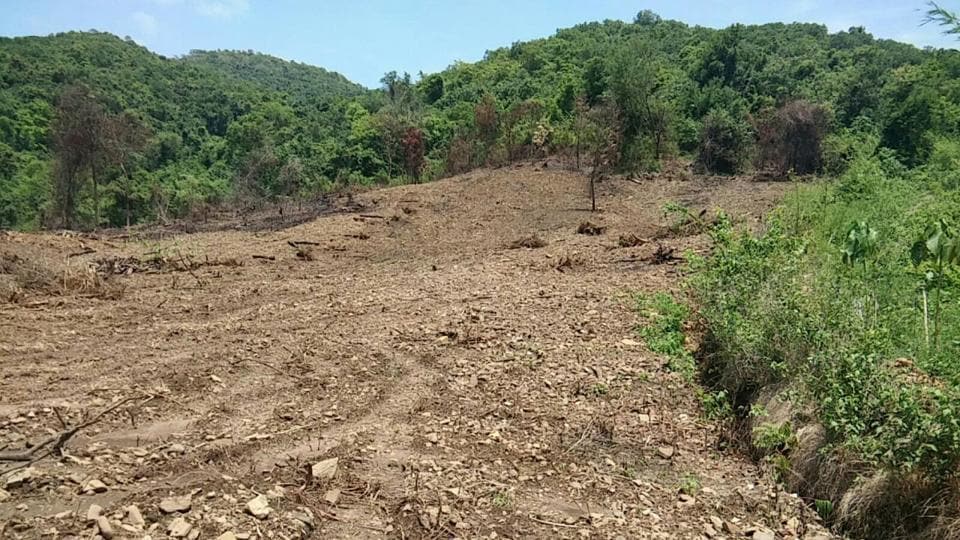
Despite a ban on tree felling at the Dodamarg-Sawantwadi wildlife corridor in south Konkan, petitioners before the Bombay high court (HC) have alleged deforestation across 639.62 hectare (ha) for mining, construction of roads, and rubber plantations for over 10 years.
Through successive orders over the past decade, the HC in 2012 and 2013, based on 2011 petition by Awaaz Foundation, had directed the Union environment ministry and Maharashtra government to ensure the 38 km-long and 10 km-wide corridor in Sindhudurg district to be protected as an eco-sensitive area (ESA) where environmentally destructive activities are prohibited. The HC had reiterated its order in 2018, based on a 2016 petition by NGO Vanashakti, declaring the belt a ‘no tree felling zone’.
“The wildlife corridor is being steadily denuded. After brazen disobedience of HC orders, the state has chosen to do little to protect the region’s ecology. Repeated reminders to authorities have fallen on deaf ears. Our only hope is the judiciary to intervene again,” said Stalin D, director, Vanshakti.
On Wednesday, the HC bench headed by chief justice Dipankar Datta and justice AS Gadkari, while hearing an interim application (IA) by Vanashakti through videoconferencing, directed the Union environment ministry to file their response regarding the steps taken to comply with previous HC orders. The matter has been kept for hearing on Friday.
Parag Vyas, advocate appearing for the Centre told HC that the environment ministry would be finalising the Western Ghats eco-sensitive zone final notification by September. However, as per submissions by the petitioner and confirmation by the state forest department, the entire Dodamarg taluka and majority of Sawantwadi had been left out of the draft notification proposed by Maharashtra.
“As far as the ESA declaration for this particular corridor is concerned, Maharashtra will have to inspect and submit a proposal demarcating the exact area proposed as ESA for the corridor,” Vyas said.
The NGO’s affidavit alleged contempt by Central and state bodies for non-implementation of previous court orders for failing to declare the ESA even after seven years. The affidavit brought on record a March 2019 report highlighting deforestation across 639.62 ha area of the corridor, of which 229.38 ha or 35% green cover had been lost in Dodamarg taluka alone. The report used satellite images and assessed deforestation between 2009 - 2018. It further said tree felling across 52 villages in the corridor (26 in Dodamarg and 26 in Sawantwadi) had been undertaken across private lands for rubber and pineapple plantations, mining, procuring wood and construction of roads. Some villages had witnessed deforestation the size of 15 ha each.
“Consequences of such rampant deforestation had come true upon the occurrence of a massive landslide in village Asaniye in Dodamarg on August 6, 2019,” the IA said.
Nitin Kakodkar, principal chief conservator of forest (wildlife) said, “The state is committed to notify the proposed area as an ESA. We have appointed Wildlife Institute of India Dehradun to identify the exact coordinates and area of the corridor, which will be sent as a proposal to the state and then the Centre. However, due to the Covid-19 pandemic, execution of the study has been delayed.”
Sushant Khandekar, sub-divisional officer, Sawantwadi said any cases of tree felling, even on private land was handled by the forest department that had identified a tree officer for such inspections.
Sawantwadi deputy conservator of forest Samadhan Chavan said, “We had identified 76 major spots in both talukas where tree felling took place over 10 years mostly across private land. Cases have been filed in each case and fines collected. The process is ongoing. No tree felling has taken place on government or forest land since the HC’s 2018 order.”
The HC bench on Wednesday also listed and clubbed another application (to be heard on Friday) filed by Awaaz Foundation that prayed for the completion of the ESA declaration process of the corridor as well as a restraint on mining.
STATE RENEWED CONSENT FOR MINING IN CORRIDOR
The Kolhapur regional office of the state pollution control board renewed an iron ore mining license at Kalne village in the Dodamarg-Sawantwadi belt last year. Operations to handle 7.5 lakh metric tons of iron ore per annum up till March 31, 2021 across 32.25-hectare area at Kalne, were allowed. Mining activity in the area led to the destruction of 32.2 ha green cover. MPCB had said mining operations were first issued permissions in 2009 much before the petition to protect the area had been filed, and renewing such consent is permissible for any proposed ecologically sensitive area as well.
“There has been a conspiracy by vested interests since the Madhav Gadgil panel recommenced Sawantwadi-Dodamarg as an ESA banning mining. First, the vested interests diluted the Gadgil panel recommendations against the wishes of local people and ecologists. They then lobbied to exclude villages of this area from the proposed ESA contrary to HC orders,” said activist Kailash Anerao.
WHAT’S AT STAKE AND WHY THE ESA
Located in Sindhudurg district, Dodamarg-Sawantwadi belt lies in the heart of the biodiversity hotspot, the Western Ghats. The area is a source of perennial water bodies. Dodamarg taluka has 62 villages while Sawantwadi has 82. The forest department had identified 25 biodiversity-rich villages within this corridor through a rapid assessment in 2013. According to the forest department, seven tigers were photographed at Dodamarg from 2014-2019 and there is evidence of 22-25 tigers using this landscape. The wildlife corridor is also home to leopards, elephants, and a host of biodiversity. It connects the Radhanagari Wildlife Sanctuary in Kolhapur to Bhimgad Wildlife Sanctuary in Karnataka. It is an integral part of the Sahyadri-Konkan wildlife corridor through which several wild animals move. The 38kmx10km corridor is home to 303 plant species, 127 types of trees, 66 types of shrubs, 29 types of climbers, four types of bamboo, 15 kinds of grass and 99 types of medicinal plants. It also has leopards, sloth bears, wild buffalo, pangolins, king cobra, civet cats, and several residents and migratory bird species
(Source: State forest department, petitions filed before the Bombay HC)


