
 E-Paper



Worm kills crops, breaks families in Maharashtra
104 farmers committed suicide in January in Vidarbha; 14 lakh facw losses as 14.91 lakh hectares of cotton has been infested by pink bollworm


Just before Dilip Gaikwad, a cotton farmer from Chinchghat village in Yavatmal district of Vidarbha, 190km from Nagpur, consumed pesticide on his 12-acre farm, the 45-year-old sent his personal belongings, a mobile phone, motorcycle keys and odd-change, back to his house, which was barely 700 metres away.

There was no letter left behind for his family – wife, two sons and mother – explaining why he took the extreme step. He, however, did leave behind 10 quintals of sub-grade cotton and a bank debt of Rs1.18 lakh.
“He was visibly upset for over a week,” said Vanita, his 37-year-old widow. “The past two-three years have been difficult and they have been an almost unending struggle to make money from our farm. Last year’s losses just broke his back. We got only 10 quintals of cotton from a 5-acre field, instead of the usual 50 to 60 quintals. The pink bollworm attack destroyed the crop and even him.”
Gaikwad had spent Rs1.25 lakh to cultivate the crop and he would have made Rs40,000 after selling it in the market. He never got to selling it though.
His wife said he also filed an online application for a farm loan waiver, but until December-end, there was no confirmation about whether he had been found eligible for it.
In January, 104 farmers with plights similar to Gaikwad’s committed suicide in Vidarbha, continuing the more than a decade-long trend of despair and distress in the face of agrarian uncertainties. While there could be several reasons behind the suicides, the pink bollworm attack, which has destroyed standing cotton crop across nearly 15 lakh hectares in the region, is being seen as the latest trigger in the vicious cycle, said experts and officials.
So far, only two cases in January have been found to be eligible for the compensation of Rs1 lakh offered by the government for farmers’ suicides. The remaining cases are under various stages of inquiry by the tehsildar’s offices across 11 districts.
Between 2001 and 2017, 16,912 farmers committed suicide in Vidarbha, as per records maintained by the district administration.
“There is no doubt that the substantial losses of standing cotton crop is one of the reasons for the suicides in Vidarbha now, and we will continue to see a spurt in these numbers, until the government speedily disburses the compensation announced by it,” said Vijay Jawandia, a well-known farmers’ leader and activist.
HT has reported that the latest data from Vidarbha and Marathwada, submitted to the state government by the divisional commissioner’s offices, reveal that nearly 40 lakh cotton farmers have suffered losses in this pest outbreak – the worse since the advent of BT cotton in the country and the state in 2002.
The many faces of grief…
Even as the Gaikwad family grapples with its loss, Vanita’s eldest son, 17-year-old Vishal, who could not pass his Class 10, has already stepped into his father’s shoes.
“I used to help my father with farming. I’ll continue with farming with the help of some elder relatives. We don’t have any other options,” said Vishal, dismissing queries about continuing his studies. “My younger brother, Vivek, is in Class 7 and he will continue with studies. I was never too bright.”
Vishal and his mother also plan to work as agricultural labourers and use the family’s few assets, including a pair of bullocks and a motorcycle, to earn a living this year.
Just 132km away from where the Gaikwads live – in Shendurjana Bazar village in adjoining Amravati district – the Asode family has been grieving too.
Bhaskar and Devku Asode lost both their daughters – Madhuri, 24, and Swati, 21 – in the span of three months between October 2017 and January 2018. Swati, who had passed Class 12 and was pursuing a dress-making course at the local Industrial Training Institute, committed suicide on January 5 by consuming a pesticide. Her sister had committed suicide in October.
The family blames their struggle to survive with depleted farm income as the main reason behind the suicides.
“It’s such an unfortunate case. We had not found Madhuri’s case eligible for compensation under farmers’ suicides. In her sister’s case, we think it is eligible because she used to keep the family’s farm accounts. This year, the family didn’t earn any proper income owing to the pest attack on their cotton crop,” said an official from the Tiwasa tehsildar’s office who has been tasked with inquiring into the suicide cases.
At the Asodes home, inside the village’s Dalit alley, there is a full-size photo of Dr Babasaheb Ambedkar on the door. The brick house, a ground-plus-one structure with three rooms, was built using the government subsidy of Rs1 lakh that the family received under the Pradhan Mantri Awaas Yojana.
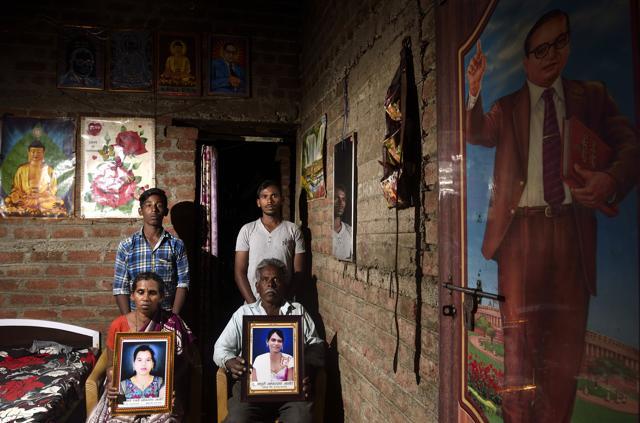
“Swati kept our farm accounts… earlier it was done by her elder sister, Madhuri,” said Bhaskar. “This year, we only made losses. We cultivated cotton over three acres, but got yield of only 10 quintals owing to the pink bollworm attack. The inferior quality cotton was sold for Rs4,200 and some for Rs3,500. After six months of our labour in December, our income was as good as nothing... there was no money for sowing this year; forget a possible wedding or education.”
The mother feels Swati feared that like their elder daughter, they wouldn’t be able to get her married too this year. “There was no money. We were in talks with a family [for the marriage]. We would have borrowed money to get her married. I wish she had just confided in us. But, we didn’t know till the end,” said Devku.
The Asodes survive on their one-acre land and their income as agricultural labourers. Last year, they took on lease another two-acre land, under an informal system, to cultivate cotton for the year. In such agreements, the understanding is that the input cost is borne by the tiller and crop produced gets shared in a 50-50 ratio with the original land owner.
“The pink bollworm attack has left at least 20 per cent of such cultivators in Vidarbha without recourse to government compensation. The compensation will go to the land owner and not the tiller of the land,” said Maroti Chaure, a farmer and a social worker with Kisan Mitra, an NGO that works with farmers in Amravati.
Circumstances have also forced the Asodes’ son, Sagar, to give up on aspirations of pursuing a commerce degree course in college. He will, instead, focus on his job as a worker in a thermal power company to earn Rs8,000 a month for a 12-hour shift. The youngest in the family, Rahul, a school student, will continue his education, for now.
In the nearby village of Mamdapura, also in Amravati district, 50-year-old Ashok Kadu, too, is just another number on the list of farmers committing suicides. Kadu killed himself by drinking an insecticide in his farm on January 10. He had a debt of Rs34,000, but was more worried about the losses incurred on his four-acre farm after cultivating two of Vidarbha’s main cash crops, cotton and soyabean.

“We got a yield of just three quintals on our two-acre cotton farm instead of the usual 25 quintals owing to the pink bollworm attack,” said Aniket, Kadu’s 17-year-old son. “On the other two acres, we had planted soyabean and we got literally no yield owing to poor and untimely rains. My father was clearly worried. He had been quiet for a few days, but didn’t share his tension.”
Aniket will now take over farming as his elder brother, 19-year-old Harish, is said to be a simpleton by the family.
“Harish doesn’t understand accounts. Ankit has cleared his Class 10 and there were plans to take admission for him for further studies, but that’s not possible now. How will he get the time? I am not of much help, as I suffer from low sugar,” said Anita, Kadu’s widow.
Kishore Tiwari, veteran farmers’ leader and chairman of the Vasantrao Naik Shetkari Swavlamban Mission, said: “Across Vidarbha and Marathwada, you will witness suicides and the next few months threaten to be even worse. I am with farmers when they say the government is insensitive about their issues. But the agriculture department failed to do enough to protect farmers.” The mission focuses on the 14 suicide-prone districts of Maharashtra and recommends measures to reduce the farm hardships.
Tiwari said he had cautioned the government earlier about this disaster, but for a long time, the state administration was on the defensive and refused to accept the scale of the pest attack.
Stay updated with all the Breaking News and Latest News from Mumbai. Click here for comprehensive coverage of top Cities including Bengaluru, Delhi, Hyderabad, and more across India along with Stay informed on the latest happenings in World News.


