Sign in

Mahanadi, Krishna, Cauvery: How India’s water wars are spreading

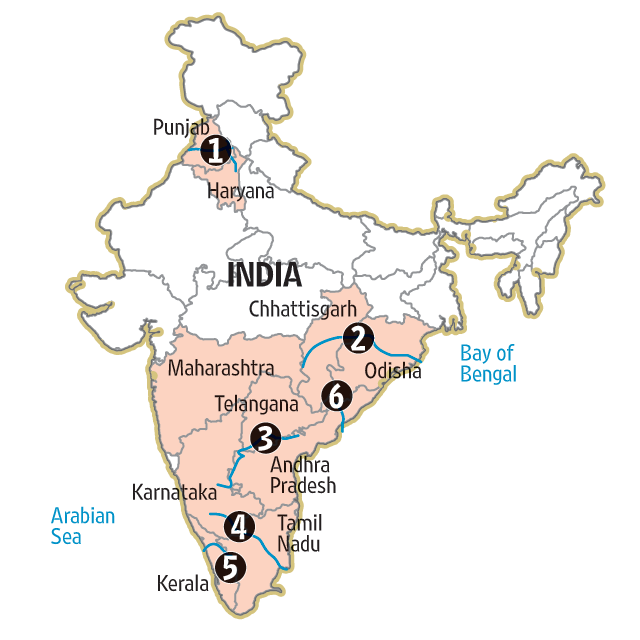
Odisha called for a bandh in August to protest against Chhattisgarh’s projects on Mahanadi, a river shared by the two states, forcing Centre to intervene. Punjab, for its part, has refused to provide Sutlej water to Haryana despite an SC order, resulting in a public spat between the NDA-led governments of Parkash Singh Badal and Manohar Lal Khattar.

Updated on: Sep 22, 2016, 16:03:16 IST
Hindustan Times | By , New Delhi
Share
Share via
  • facebook
  • twitter
  • linkedin
  • whatsapp
Copy link
  • copy link

Last year, the Intergovernmental Panel on Climate Change told policy makers that by 2050, most countries will be fighting over water.

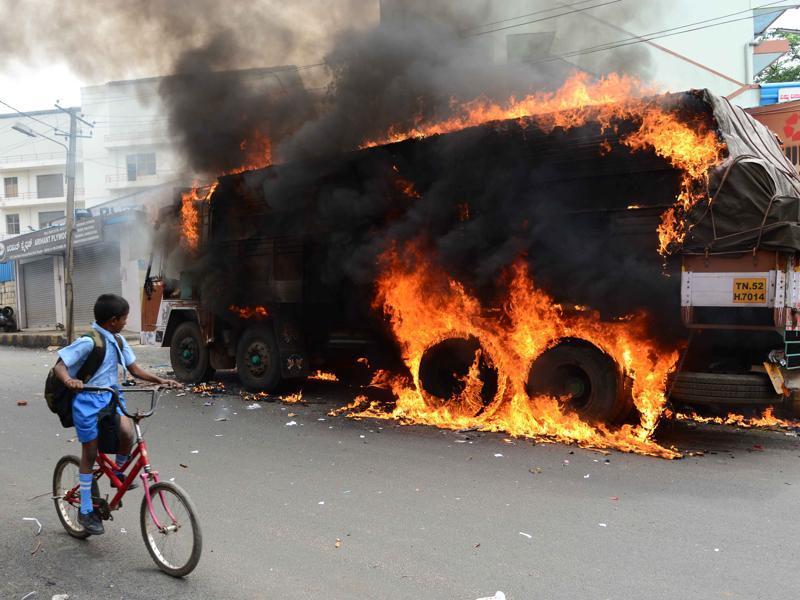
The genesis of the rising water disputes lies in the unclear and overlapping Indian water law that allows states to exercise absolute territorial power over water flowing through their territories and politics that incentivises water wastage. (Kashif Masood/HT Photo)

Barely a year later, India is already witnessing deaths, strikes and incidents of self-immolation over sharing of the natural resource between its constituent states. Karnataka has been on the boil ever since SC ordered that it release Cauvery water to neighbouring Tamil Nadu.

Odisha called for a bandh in August to protest against Chhattisgarh’s projects on Mahanadi, a river shared by the two states, forcing Centre to intervene. Punjab, for its part, has refused to provide Sutlej water to Haryana despite an SC order, resulting in a public spat between the NDA-led governments of Parkash Singh Badal and Manohar Lal Khattar.

The genesis of the rising water disputes, however, lies in the unclear and overlapping Indian water law that allows states to exercise absolute territorial power over water flowing through their territories and politics that incentivises water wastage.
Article image

In the Constitution, water is a state subject that allows excess use of water without consulting lower riparian states. In such a scenario, the Centre can only redress conflicts with limited powers of arbitration. At best, it can appoint an inter-state water tribunal whose order can be challenged in the Supreme Court – leading to a long-drawn judicial battle. The Cauvery dispute first landed in the apex court in the 1950s, and the Sutlej water-sharing dispute between Punjab and Haryana has been languishing there since 1975.

There is another dimension to this problem that gets overlooked. Many states promote water-intensive crops that gulp down the limited natural resource. For instance, the cultivation of pulses in Tamil Nadu and Karnataka has more than doubled in the last 20 years, and this is spurring farmer protests over sharing of Cauvery water.

“Our agriculture economy wastes more water than it conserves,” says Himanshu Thakkar, an independent water expert. “We have invested billions in dams and irrigation networks, but very little on water conservation.”

India has seen three droughts in the last 10 years (the most for a decade in the last 150 years), and the situation will only worsen due to climate change. Terming 54% of India as “water-stressed”, a 2015 World Resources Institute report said: “Almost 600 million people are at higher risk of surface-water supply disruptions.”

Vandana Shiva of Navdanya, a non-government advocacy group, has written on how water is being “abused” and “overused” in India. To illustrate her point, she cites how the amount of water used to produce a quintal of farm produce in India is the highest in the world.

There is a solution to this quandary, but it would require harsh and politically difficult decisionmaking. The erstwhile Planning Commission, in its 12th Five Year Plan (2012-17) report, recommended putting a price on every drop of water, scrapping power subsidy for pumping ground water, and providing incentives for water conservation and reuse. Sadly, it still remains a recommendation.

(With inputs from state bureaus)

  • Chetan Chauhan
    ABOUT THE AUTHOR
    Chetan Chauhan

    Chetan Chauhan is the National Affairs Editor looking into all aspects of news and features from across India. A Chevening scholar with over three decades of experience in reporting and news management, Chetan has extensively covered all important aspects of the social sector, political economy, environment and climate change nationally and internationally. He did a journalism course at the Reuters Institute of Journalism in Oxford and Digital Media training at Nanyang Technological University in Singapore. He started as a reporter with The Statesman in 1996 and joined the Hindustan Times in 2000 in the metro bureau covering environment, crime and Delhi politics. He covered hot local news, from the Jessica Lal murder case to the rebellion of Delhi Congress MLAs against then Chief Minister Sheila Dikshit, to the replacement of toxic vehicle fuel with cleaner compressed natural gas (CNG) in the national capital. Some of his stories on air pollution became part of the Supreme Court’s landmark MC Mehta versus Government of India case in the National Capital Region (NCR), forcing the government to take corrective measures. As part of the national political bureau since 2004, he covered important central sectors such as environment, education, social justice, labour, rural development, water resources, renewable energy, agriculture, broadcasting and the Planning Commission for more than a decade producing several exclusive and investigative breaking stories. His specialisation is the environment, having covered at least a dozen United Nations global conferences on climate change, biodiversity and wildlife including climate summits in Paris, Copenhagen and Bali. He also covered India’s two five-year plans ---11th and 12th and reported on drafting and execution of right based laws such as Right to Education, Right to Information and rural job guarantee law, MG-NREGA, now being introduced in new format as VG-RAM-G Act. He has in-depth knowledge of social sector issues. He was one of the first to report on tigers vanishing from Sariska and Panna wildlife reserves in 2004 and 2008, respectively, leading to the setting up of the National Tiger Conservation Authority (NTCA) and the introduction of stringent penal provisions for poaching. He has written extensively on the rising human-animal conflict in India and the degradation of India’s biodiversity hotspots because of mining and other activities. Since 2004, Chetan has covered Parliament comprehensively and participated in training on the nuanced coverage of Parliament proceedings. He has travelled extensively across India to cover national and provincial elections since 1998, especially in the Hindi heartland states, considered India’s road to power. He writes a regular column for Hindustan Times, Ecostani, on important national politics, economy, Himalayan ecology and environmental issues. His other responsibilities include providing inputs for edits and edit page articles for the publication, apart from managing news flow from across India.Read More

Get the latest India News, breaking headlines and real-time updates from across the country. Stay informed about politics, government policies, crime, weather and major national developments.