
 E-Paper



India can avoid water wars in the future by mixing old and new solutions
With more than half of India’s population living in water-scarce regions, a smart blend of modern and traditional solutions are needed to prevent a dystopian future of mass migrations and water wars.


Drinking water shortages are known to spark scuffles , but last week, it led to Sunil Giri, 23, losing his life. Giri was beaten to death in the Ramgarh district of Jharkhand for objecting to his neighbour Anwar Hussain taking more than his share from a drinking-water tanker that had reached the drought-affected village after several days.
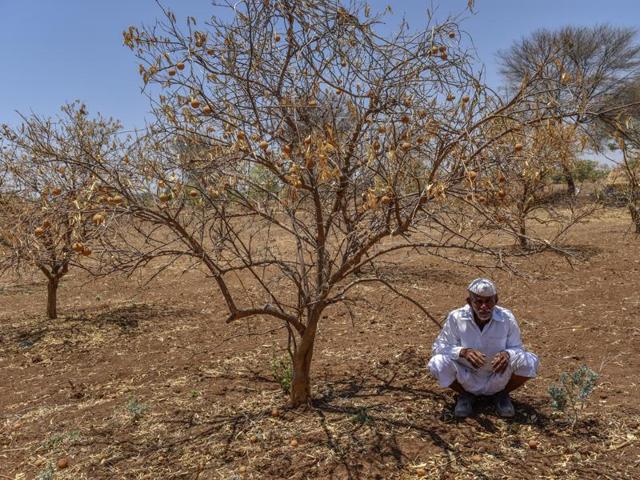
Similar violence over water sharing has also been reported from water-scarce districts in Maharashtra, Uttar Pradesh, Madhya Pradesh, Rajasthan, Andhra Pradesh and Telangana since April.
Scarcity kills in other wars too. In April, 12-year-old Yogita Ashok Desai died of heatstroke after her fifth trip to fetch water from a handpump in drought-hit Beed district of Maharashtra, when temperatures had crossed 47 degree Celsius.
In the first week of May, a 15-year-old girl died and 23 others were injured when the roof of an underground water tank collapsed while they were waiting to collect water from the almost dry tank.
Lost sources
The World Resources Institute’s March 2016 report said 54% of India was water stressed, with scarcity affecting every part of the country except Himalayan region and the Ghats. “Almost 600 million people are at higher risk of surface water supply disruptions,” the report said, attributing water stress to climate change and poor water management.
The map below illustrates competition between companies, farms and people for surface water in rivers, lakes, streams, and shallow groundwater. Red and dark-red areas are highly or extremely highly stressed, meaning that more than 40 percent of the annually available surface water is used every year. Find out more at the World Resources Institute’s website.

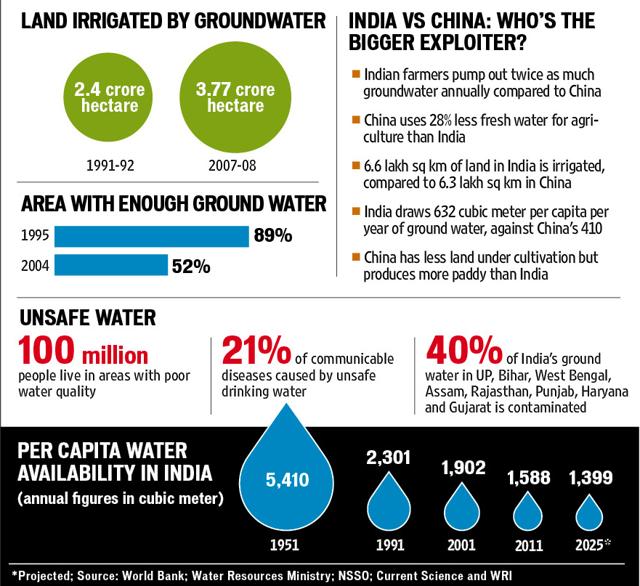
With the surface water sources dwindling, people have shifted to unregulated tapping of ground water --- for agriculture and drinking --- leading to levels dipping by three times over the last 60 years, making groundwater the main drinking water source for 80% of the population.
Rising temperature also mean higher human loss.
Of the 4,204 lives lost to annual heat waves over the past four years, half were in the drought year of 2015.
“The deaths were a result of flawed government emphasis on building high-cost dams and canals that have wiped traditional ways of water harvesting,” said Himanshu Thakkar of South Asian Network of Dams, Rivers and People.
Another concern is that 50% of ground water sources in the country are not “completely safe”. Of the 660 districts, ground water in 276 districts has high levels of fluoride, 387 districts have nitrate above safe levels and 86 districts arsenic, shows data from Central Ground Water Board’s latest report.
Close to 650 major towns and cities in India are on the banks of rivers contaminated with pesticides from farms and effluents from industry, said the latest report of the Central Pollution Control Board, which sickens 100 million people each year because of contaminated drinking ground water.
If that’s not enough, more and more states -- Haryana and Punjab in north to Tamil Nadu and Kerala in south to Arunachal and Assam in north-east -- are entangled in disputes over sharing water from major rivers.
The way ahead
If ground water exploitation continues, the World Bank estimates that the per capita water availability in India ---- where 46 farmers committed suicide every day in 2014 --- by 2030 may shrink to half from the 2010 level of 1,588 cubic metres per year, which will push India into the ‘water scarce’ category (1,700 cubic metres per year), from its existing ‘water stress’ classification (1,000 cubic meter per year).
“The water situation is scary,” said Arvind Panagariiya, vice-chairman of the National Institution for Transforming India (NITI) Aayog, which is holding consultation with states on water stress management. “We have to adopt a bottom up approach with a mix of modern and traditional solutions that are acceptable and inclusive”.
To start with, the water resources ministry has drafted two model bills --- first for overall water management and second for ground water --- aimed at improving water management and groundwater levels. Shashi Shekhar, secretary for water resources, said the water problem was escalating and the proposed laws could ensure better and efficient water management.
But, a lot depends on states as water is a state subject. Some, such as, Maharashtra and Rajasthan have started community based Jal Swabhilambhan schemes that give ownership of government-aided watershed management to the communities. “We just aid and assist the villagers in creating durable water assets. The villages decide what they want,” said Sriram Vedire of Rajasthan Water Authority, who initiated the programme in half of the state’s districts in early 2016.
It is too early to state whether the Rajasthan model works but independent studies have shown that similar community-based watershed management programmes has improved ground water levels in Jhabua districts of Madhya Pradesh. Panagariya hoped that it can work elsewhere too, provided “right” government intervention happens.
Mukul Sanwal, retired civil servant and former director of UN Climate Change Secretariat, said restoring traditional water harvesting and management systems like ‘Bundis (household ponds)’ to store rainfall water has worked and will work as it is a time-tested model, which was abandoned during the British era. “Even Mughals gave tax rebate if farmers invested in water harvesting,” he said.


