
 E-Paper



An unusual tale of two leaders, their friendship and their parties in crisis
The Congress-Yechury equation survived the brutal withdrawal of the Left’s support from the UPA in 2008. Both parties now face an uphill task.


New Delhi: In two minds about whether to invite Trinamool Congress chief Mamata Banerjee for a strategy meeting of key Opposition parties in December last year, Congress president Sonia Gandhi decided to consult — not a party colleague — but Communist Party of India-Marxist (CPI-M) general secretary, Sitaram Yechury, for his opinion.
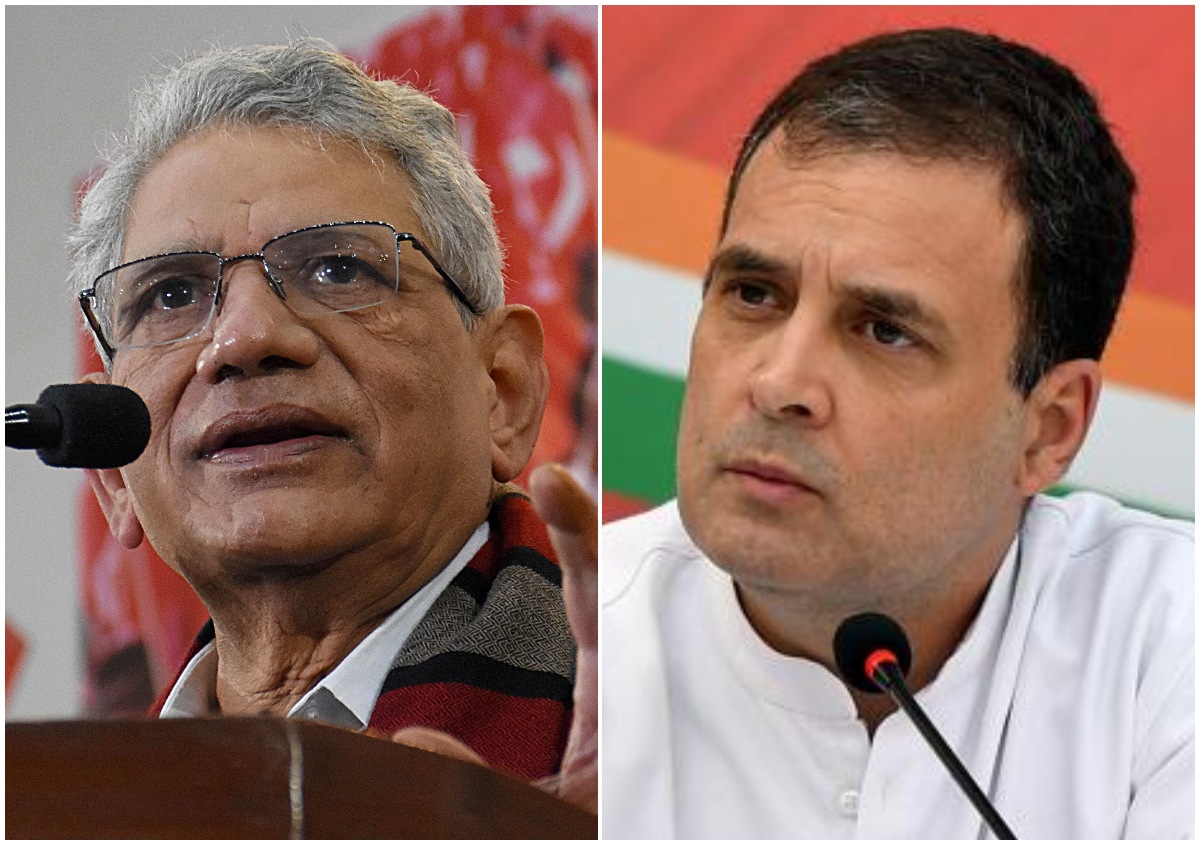
In Lutyens’ Delhi, it was, however, another example of an unusual bond between the Gandhi family and the general secretary of India’s major Left outfit that fights tooth and nail against the Congress in Kerala.
A bond that outlasted UPA
The Congress-Yechury equation survived the brutal withdrawal of the Left’s support from the Congress-led United Progressive Alliance (UPA) in 2008 over the Indo-United States (US) Nuclear deal. But before that, for four years between May 2004 and July 2008, the Left and Sonia Gandhi-led National Advisory Council (NAC) had shared many dreams. From the rural employment guarantee scheme to the right to information and right to education, all of UPA’s signature schemes providing legislation-backed rights found ardent supporters among the Left parties.
The then Prime Minister Manmohan Singh went a step ahead and even institutionalised a UPA-Left coordination committee that met regularly to accommodate the “outside supporters”. Months after the Left’s withdrawal of support, Yechury rued that they couldn’t take the political credit for those “pro-people legislations”. Singh too, in a meeting with Left delegation at his parliament office, told Yechury, “I miss your counsel.”
The political ties, no doubt, suffered temporary damage. An angry Pranab Mukherjee, (then defence minister), yelled at CPI-M boss Prakash Karat that “you will be decimated in Bengal” when he invited Karat at his home in a last-ditch effort to prevent the withdrawal of support. PM Manmohan Singh, too, lost his cool and told The Telegraph that if the Left wants to withdraw support, “so be it” and Congress strategist Jairam Ramesh coined “Sitaram Obituary” to refer to the Left leader, whose party has the habit of pulling off support from elected governments.
But the political gulf notwithstanding, personal equations only grew with time. Yechury was the only visitor to Mukherjee’s office a day after the 2008 trust vote of the UPA government. Sonia and Rahul Gandhi, according to many leaders from both Left and the Congress camp, remained sceptical of Prakash Karat and other leaders but saw Yechury in different light. The inter-personal equations also translated into political alliance amid the rise of a common, formidable opponent — the Narendra Modi-led BJP.
“The Congress finds it easier to handle the Left parties. We know what they stand for and there is a clear map of Dos and Don’ts,” said a Congress leader who was involved in drafting the Common Minimum Programme — a scrap book of demands of various UPA partners and the Left.
This convergence has only deepened.
Rahul Gandhi opted for a pact with Yechury’s party to elect a CPI-M leader to Rajya Sabha in 2020 from Bengal rather than accept Mamata Banerjee’s offer to nominate a common candidate from Congress and Trinamool. Rahul Gandhi approved a poll deal with the Left in the 2021 West Bengal election even as a large number of Congress leaders suggested otherwise. Or whenever Yechury, the only communist to write an obituary on Micheal Jackson, suggested to Sonia a joint protest on issues such as price rise or Rafale, she would say, “You must tell this to Rahul.”
A set of similar political challenges
But beyond the personal bonhomie lies a story of political decay.
In January 2013, Rahul Gandhi was elected as the Congress vice-president. On the sidelines of the event, he told one of his trusted confidantes that his anointment as president will also happen “in due course.”
Two years later, Yechury was almost bulldozed to the party’s top post by his Bengal comrades fed up with Karat’s ideological doggedness. The CPI-M’s “Calcutta Club” had pleaded with Karat not to pull the rug out from under the UPA. But he stood by his ideological commitments, overlooking strategy for street politics.
But ever since Gandhi (party president from 2017-19) and Yechury started leading the party, the two outfits have only dived to near decimation. The Congress has been reduced to just two chief ministers and 53 Lok Sabha MPs. In the last two rounds of assembly polls, the Congress couldn’t win a single state on its own.
Yechury’s CPI-M too, didn’t fare any better. The party’s government in Tripura, which ran for 19 years, lost to BJP in 2018. The Left parties didn’t get a single seat in 2021 West Bengal polls and are struggling to stay relevant in national politics with just three MPs in Lok Sabha — down from 43 in 2004.
It’s also an irony perhaps that while the two leaders have witnessed a rapid shrinking of the footprint of their organisations, Gandhi and Yechury remain the most popular leader of the respective parties. But the electoral setback has not diminished the two leaders’ popularity inside the party.
The clamour for Rahul Gandhi’s return as the Congress president has only grown louder. In the CPI-M too, there are hardly any visible alternatives to Yechury.
At the personal level, both are democratic and large-hearted. Yechury would write a column in bourgeois media and then quietly transfer his payment to a comrade in need of financial help. A colleague told Rahul Gandhi, “Stop being a philosopher and be a leader”. The former Congress chief replied, “We should meet more often.”
Both leaders also face the problems related to senior leaders, albeit in their own ways. The G23 rebels in the Congress are demanding a “collective and inclusive leadership”— a demand designed to prune Rahul Gandhi’s authority. On the other hand, the CPI-M has too many veterans at the top level and needs to inject fresh blood in the organisation — something that started in Bengal in the state unit reshuffle last month.
Gandhi and the Congress conundrum
The Congress veteran and former president, late Pranab Mukherjee, always maintained that the Congress can be only led by a vote-catcher. The Congress is not a Leftist party, he would argue in his close circle, and can’t be happily rest on ideology alone.
While Sonia Gandhi led the party to two consecutive terms in power, Rahul Gandhi not only oversaw two election defeats but also lost from his family turf of Amethi. He is now an member of Parliament from Wayanad.
Yet, a large section of the Congress refuses to consider anyone else at the top post. The party’s Maharashtra state president Nana Patole tweeted, “After the defeat of the Modi government in the year 2024, the Congress government will come in the country under the able leadership of Rahul Gandhi.” Congress’ chief spokesperson Randeep Surjewala maintained that “every Congress worker wants Rahul Gandhi to lead the party. The next president, however, will be decided through the organisational elections.”
Even a G23 leader admitted, “If Rahul contests the election, we don’t have the power to defeat him.”
But Rahul Gandhi’s reappointment possibly doesn’t solve the problem. The Congress is looking at two plans that have already been tossed to the leadership.
The first plan is to appoint a non-Gandhi leader at the top post while Rahul Gandhi will continue to provide the overall ideological direction. According a senior leader, “In January, four names were proposed to Rahul Gandhi — Ashok Gehlot, Sachin Pilot, Bupesh Baghel and Mukul Wasnik — as possible leaders of the Congress. Gandhi identified at least two of these names as “good choices”.
The other plan, according to another key strategist, is to appoint working presidents to cover different parts of India. “May be Ghulam Nabi Azad can be the working president for North India and Mukul Wasnik can take charge of Western India,” said the leader who did not want to be quoted.
While Rahul Gandhi is largely seen as responsible for the electoral decay in the Congress, party leaders recognise that the solution, however, lies only with him. Without his backing, no alternative candidate would be accepted as the party president or get nominated to the Congress Working Committee (CWC).
“When he announced he will step down after the poll debacle in a CWC meeting, the top executive body had to anoint Sonia Gandhi as the interim president. It is clear that the Congress is accustomed with the Gandhis. So, any other president has to get the full backing of Rahul,” said a senior Congress leader.
Sitaram and survival of the Left
While the Congress thrives on a Gandhi family driven organisation, in the CPI-M, collective leadership — be it in politburo or the Central Committee (CPI-M’s equivalent of CWC) — is supreme. The leader does not always his way. For instance, in the last Party Congress, Yechury was personally keen to see Ashok Dhawale, Maharashtra unit secretary, in the politburo, but the party decided otherwise.
Yechury has served two terms as general secretary. His last opportunity for another term might come in the Kozhikode Party Congress scheduled in the next few days. But within a party that is a stickler for collective leadership, what can Yechury do to revive the party?
Left ideologue Samudra Guha maintained that his top priority must be to “to identify and empower those crucial workers or leaders who can organise a movement or strengthen the organisation at the ground level”.
“As the most popular leader of the CPI-M, he needs to inspire the organisation. And to do so, he must find new faces and the performers. Remember, Pramod Dasgupta had just 34,000 members when he was asked to lead the party. But he turned it into a mammoth organization that ruled Bengal for 34 years,” said Guha.
It’s also the same recipe for Rahul Gandhi, a Congress leader added, “to find the right people for the right job”. How two men, leading two parties which have declined under their watch, but who remain indispensable for their future, and have an unlikely bond between them, take their next steps will be important factors in shaping India’s oppositional politics.
 ABOUT THE AUTHORSaubhadra Chatterji
Saubhadra Chatterji is Deputy Political Editor at the Hindustan Times. He writes on both politics and policies.


