On November 30, the National Democratic Alliance (NDA) government led by Prime Minister (PM) Narendra Modi completed half of its second term in office. It has now been in power for seven-and-a-half years. Given the PM’s emphasis on reforms, this offers an opportunity to review the NDA’s track record on economic reforms since 2019, and offer a comparative perspective with his first term.
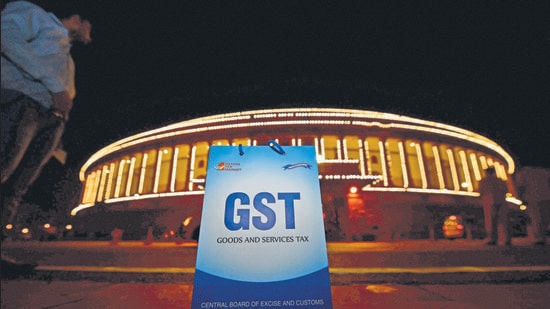
Reforms slowed as the first term progressed, but the government managed to institute two key reforms around its midway point — the GST and the Insolvency and Bankruptcy Code (PTI)
The government has implemented several key reforms in the last two-and-a-half years. These include a reduction in the corporate tax rate; greater autonomy to major ports in their operations; an increase in the foreign direct investment (FDI) cap in defence; an increase in the FDI cap in insurance; and the end of retrospective taxation. Most of these reforms took place during the Covid-19 pandemic. The corporatisation of the Ordnance Factory Board, liberalised FDI rules for the telecom sector, and the release of forward-leaning regulations for both drones and geospatial data-gathering and use were other important reformist steps.
Then, there have been other partially completed reforms. Three of these relate to fine-tuning the insolvency and bankruptcy framework introduced in the Narendra Modi government’s first term in office. The Covid-19 period also saw some relaxation in labour regulations through the Industrial Relations Code, though it is yet to be notified.
There was also movement on long-awaited reforms such as the creation of an asset reconstruction company (which is yet to be operationalised); national monetisation pipeline (ongoing); and privatisation of Air India (financial obligations by Tata to be completed by December 2021).
The impetus for many of these reforms came from Covid-19, and they are all significant. But they do not match the exemplary record of the Modi government’s first year in office (2014-15). In that period, the government opened most of the railways to FDI, allowed more private sector participation in coal production, enabled FDI in construction projects, extended the validity of industrial licences, removed the last 20 protected sectors on the small-scale industries list, and deregulated diesel pricing.
Reforms slowed as the first term progressed, but the government managed to institute two key reforms around its midway point — the Goods and Services Tax (GST) and the Insolvency and Bankruptcy Code (IBC). A striking similarity in the two terms relates to pulling back on big ticket reforms. In the first term, it was the land acquisition bill, and in the second term, it is the farm laws. There are many reforms that still remain on the Modi government’s agenda. This includes some reforms that could potentially see the light of day soon, such as the Electricity Amendment Bill (EAB). EAB has been listed to be introduced in the winter session of Parliament. There are other reforms that are on the back-burner such as establishing the already approved Railway Development Authority. Some reforms are slowly gaining more traction such as the privatisation of banks and central public sector enterprises. Other beneficial business reforms the government can consider include strengthening the national single window system; offering business owners central government permits in less than 10 days; simplifying GST; and releasing proposed regulations with cost-benefit analysis and input of stakeholders. Further, judicial reforms such as establishing a paperless court system and filling judicial vacancies in the Indian courts can send a positive signal to businesses by enabling faster judicial recourse.
The modest pace of reforms can perhaps be attributed to electoral imperatives. And that is why 2022 is crucial. Seven states go to polls — the politically critical Uttar Pradesh, the PM’s home state of Gujarat, and the agriculture battleground state of Punjab. Whether the BJP focuses on socio-cultural priorities and populist promises or sticks to economic reforms will be largely determined by how it fares in the coming year.
Kriti Upadhyaya is an associate fellow with the Wadhwani Chair in US-India Policy Studies at CSIS in Washington DC. She specialises in Indian economic reforms and maintains the CSIS Reform Scorecard

 E-Paper