
 E-Paper



Businesses must put their load on electric trucks
If the goal is rapid, at-scale freight electrification, the clearest path is to give large freight users electrification targets

 Prefer HTon Google


Between 2020 and 2025, electric buses went from minority traffic to a familiar sight on Indian roads, priced nearly 30% below diesel and backed by public procurement in most states. India went from about 500 electric buses in 2020 to over 63,000 buses contracted in 2026, with 16,000+ on the road — valued at $8 billion. The government was firmly at the wheel of this transformation, and it delivered.
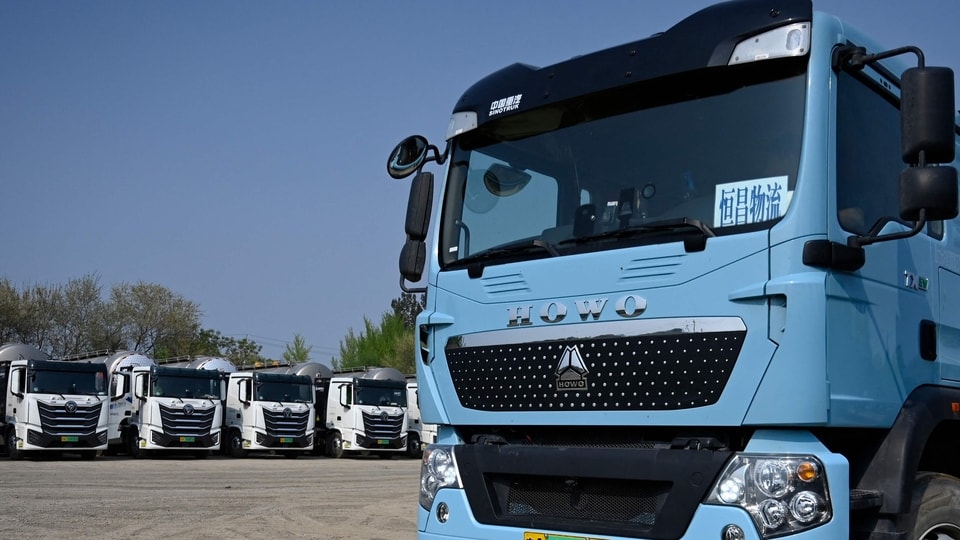
Contrast that with freight. Despite years of pilots, subsidies, and industry pledges, fewer than 1,000 electric heavy-duty trucks operate on Indian roads, out of a fleet of nearly four million. The global discourse on commercial vehicle electrification rests on a single proposition: As battery prices fall and electricity stays cheaper than diesel, market forces will drive the switch. This is only partly true. Cost competitiveness is a powerful tailwind, but it is also fragile, reversible, and unevenly motivating across the supply chain. The single most consequential lever available to accelerate freight electrification is a fleet electrification mandate, which compels India’s largest industrial shippers to convert diesel trucks to electric on a defined timeline.
But cost savings alone won’t do it. Indian trucks consume roughly ₹6 lakh crore of diesel every year. At today’s grid tariff of about ₹8/unit, full electrification could cut this to ₹2.1 lakh crore, a 65% saving. At renewable tariffs of ₹4/unit, savings climb to nearly ₹4.8 lakh crore, or 80%.
These same economics underpinned India’s electric bus transition, where high upfront capital costs were amortised over long-term service contracts, resulting in the 30% savings. But economics alone didn’t drive that shift, active orchestration by the public sector did: the PMO, multiple ministries, state governments, and public transport agencies together created demand, de-risked procurement, and proved e-buses could scale. Freight, however, sits overwhelmingly in private hands, and cost reduction alone cannot sustain adoption at scale. Three structural gaps explain why and point to what must be done.
First, the accountability gap. Ask a large cement or steel company about its emissions and you’ll get a polished report covering Scopes 1 and 2, meaning emissions from its own operations and purchased power. Ask about freight, which falls under Scope 3, and the answer, sometimes confidently is: It’s neither within their control nor their ownership. Yet cement alone moves on roughly 50,000 trucks a day, and logistics can account for 15-17% of a cement company’s costs. Disowning this on the grounds of “not my emissions” has gone unchallenged for too long — especially now that electric freight, under the right commercial model, can cost less than diesel, removing any excuse that reporting it is commercially burdensome.
Scopes 1 and 2 disclosures are mandatory under SEBI’s Business Responsibility and Sustainability Reporting (BRSR) Core framework for India’s top 1,000 listed companies. Boards review them, investors question them, and rating agencies score them against these. Even if not always taken as seriously as other compliances, this loop works because it isn’t optional. Without similar regulatory teeth, freight (Scope 3 emission) stays someone else’s problem.
The second, and much more serious issue, is the reversibility problem. Diesel prices swing, and every swing changes the electrification math. A shipper who switched because electric freight was 20% cheaper will keep benchmarking against diesel, expecting the same discount indefinitely, regardless of what it costs the operator to deliver it. But the risk sits asymmetrically: Savings accrue to the shipper, while operators carry the capital risk of trucks, batteries, and charging infrastructure, with revenue exposed to diesel prices and annual rate renegotiation. Without long-term contracts locking in volume and revenue, the business case stays fragile no matter how good the underlying economics look. Electricity tariffs aren’t guaranteed to hold either. As rooftop solar schemes succeed, discoms increasingly worry about losing their best-paying customers. Today’s subsidised EV tariffs may not last, and not every state offers the time-of-day structures that match commercial charging patterns.
Eliminating this requires mandating the transition on the shipper side. Only then does procurement move past annual diesel-price comparisons, unreasonable price expectations and start rewarding long-term efficiency and diesel reduction.
The third is that shippers hold the demand. Large industrial shippers set the rates, corridors, volumes, and contract durations. Directing even a share of that demand toward electric fleets will drive the transition at scale and fast. Leave it voluntary, and it doesn’t. Trucks follow contracts, not the other way round. A phased mandate requiring large shippers above a defined emissions or production threshold to convert a specified share of contracted freight to electric on a fixed schedule creates demand that cannot be ignored. It forces capital planning, pushes the greening conversation into heads of commercial functions, and gives OEMs, financiers, and charging-infrastructure operators the order visibility they need to invest at scale. These targets will also sharpen the government’s own infrastructure planning. Sector-specific mandates will define a limited set of high-priority freight corridors, and those become the corridors where charging stations, grid capacity, and parking infrastructure should be built into national highway expansion plans first.
The mechanism need not be built from scratch. Scope 3 freight disclosure could be phased into the BRSR Core framework over the next two reporting cycles — first requiring disclosure, then mandating reductions. But, an even simpler method would be for shippers of a defined turnover or fleet-size threshold to be mandated to electrify, on a sector-by-sector approach, starting with cement, steel, mining and chemicals. The ministry of road transport and highways and the ministry of heavy industries could jointly anchor implementation, by focusing attention on the most-used electrifying highways. If the goal is rapid, at-scale freight electrification, the clearest path is to give large freight users electrification targets, phased through a mechanism the government already knows how to run and contracts that investors are already familiar with.
(Mahua Acharya is founder-CEO, INTENT, and former MD & CEO, CESL, Government of India. The views expressed are personal. X: @mahuaacharya)


