
 E-Paper



Chandrayaan will help us profit from the heavens
India aims to leverage the success of Chandrayaan-3 and tap into the enthusiasm for space exploration to drive its high-tech economy and future space missions

 Prefer HTon Google


After Chandrayaan-3’s success, India’s goal is to not only build on Isro’s extraordinary achievement but also to harness popular enthusiasm for space exploration towards concrete outcomes for the country’s high-technology economy. Unlike the IT and biotech sectors, space remains a State-led industry. Governments such as those of the United States have deep pockets and can act as anchor customers until segments of the space sector stabilise and become self-sustaining. Most government and private funding is directed to practical space applications such as satellites that provide immediate returns on investment. Military requirements are a primary driver of satellite infrastructure as are other State-led requirements such as monitoring weather patterns and ecological degradation. All this needs cutting-edge innovation that only space exploration can drive.
Beyond space applications, there are ambitious plans to sustain human presence beyond Earth. The International Space Station (ISS) has sustained continuous human presence in low earth orbit for more than two decades. This presence has been made possible partly by private companies whose spacecraft ferry cargo and crew between the ISS and Earth. Since the ISS is due to be decommissioned by 2031, Nasa plans to replace it with at least three smaller commercial space stations. Its most audacious project is the Artemis programme, which seeks to return humans to the Moon permanently. Artemis is a multinational programme involving several space agencies and private companies. Nasa alone expects to spend $41.5 billion on Artemis between 2023 and 2028. Assuming this budgetary support continues and expands, the total budget for lunar exploration across global space agencies and companies over the next 20 years could run into hundreds of billions. Indeed, a key goal of long-term programmes such as Artemis is to provide some sense of certainty to private space companies involved in lunar projects. As a signatory of the associated Artemis Accords, India can choose to participate in this gigantic enterprise and exploit its commercial potential.
The tasks of building a sustained human presence on the Moon and developing a lunar economy will require a mind-boggling range of innovations. Engineers will have to work continuously on making heavy launch vehicles less expensive, support human spaceflight, come up with radical new spacecraft designs, and develop reliable communications and navigation infrastructure. Then there are less-glamorous but equally vital tasks: Designing habitats, learning how to grow food in lunar greenhouses, designing solar panels suited for the Moon’s dusty and atmosphere-free environment, developing new forms of power storage, extracting lunar water ice and purifying it. All of these technologies will have important spinoffs for applications on Earth.
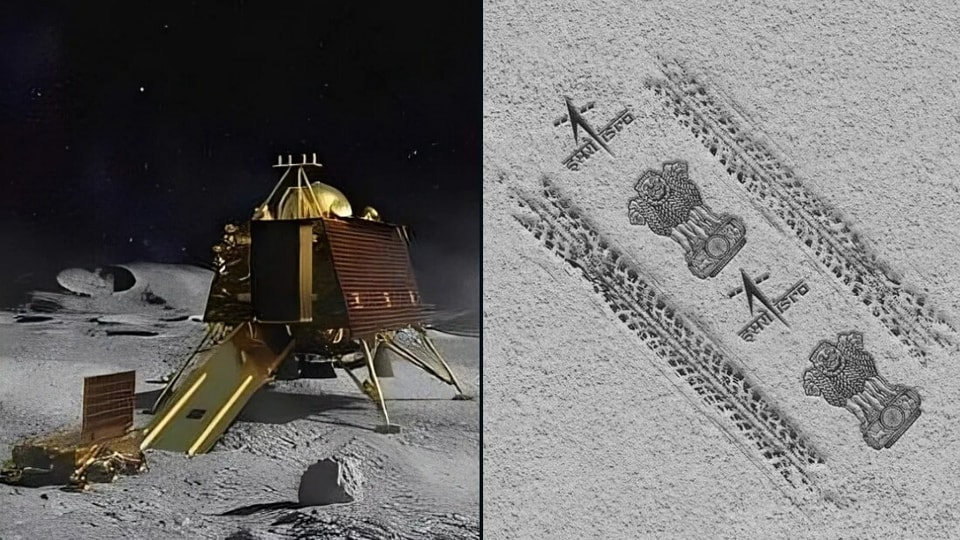
Spacefaring nations including India hope to eventually use the Moon as a launch pad for getting to Mars and the asteroid belt. India’s Chandrayaan-1 in 2009 helped confirm the presence of water ice in the Moon’s polar craters, thus spurring the ongoing international race to get to the lunar south pole. Water ice is necessary to sustain humans on the Moon, but also provides the hydrogen and oxygen needed to fuel rockets headed into deep space. With its success, Chandrayaan-3 has now given India a solid footing in this race. The scientific and commercial possibilities are immense. The Moon may also generate an economy of its own someday. Exaggerated claims notwithstanding, lunar mining for gold or platinum is unlikely to be financially viable because of the costs involved. However, there may be some specific elements or minerals for which a business case can be made. For example, if nuclear fusion power generation becomes feasible, the Moon’s reserves of Helium-3 could become invaluable.
The potential of the space economy hasn’t escaped India’s attention. In April, the government announced a landmark Space Policy, which allows the private sector access to a range of space activities, including rocket launches, satellite operations and even asteroid mining. The policy makes the Indian National Space Promotion and Authorisation Centre (IN-SPACe) the sole agency for authorising space activities and seeks to create a level playing field between the private sector and Isro. A separate policy on foreign direct investment is also expected shortly.
While these are welcome developments, some foundational problems remain. One, IN-SPACe is saddled with the dual role of both authorising private space activity and promoting it. Two, India badly needs a space law. Without one, IN-SPACe has no legal basis to act and there is no mechanism to resolve disputes, either between companies or between companies and IN-SPACe. And finally, India will need active diplomacy to ensure its private companies get to participate in multinational projects, whether in low Earth orbit, the Moon or beyond. Chandrayaan-3 must only whet India’s appetite to profit from the heavens.
Aditya Ramanathan is with the Takshashila Institution. The views expressed are personal


