E-Paper



Climate and Us | A movement that puts a spotlight on West's wasteful consumption
India's new sustainable lifestyle movement, LiFE, will leverage social networks to influence norms surrounding the climate crisis. This is especially crucial when the global south and north see several disparities in climate action.

 Prefer HTon Google


India launched a global sustainable lifestyle movement on Sunday. It is significant because such a movement puts the spotlight on consumption patterns in developed and developing countries. One of the issues that has been side-lined several times in climate negotiations is that of per capita CO2 emissions. The forbidden words during climate negotiations are historical responsibility, carbon space, and per capita emissions.
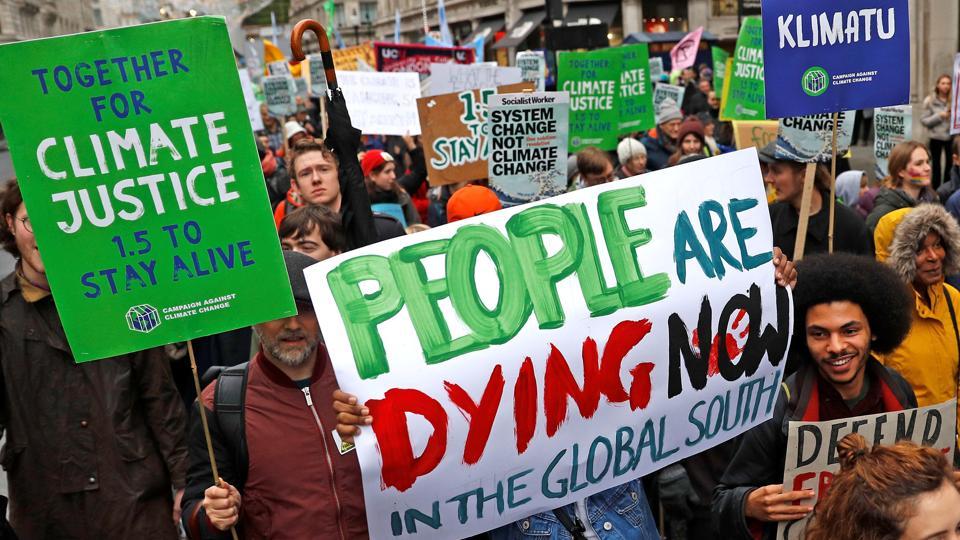
The fact that lifestyles and access to basic services are vastly inequitable in the global south and north can be highlighted through a campaign like this.
The launch of the movement will initiate a global call for papers inviting ideas and suggestions from academics, universities, and research institutions on an environment-conscious lifestyle, which can also persuade individuals, communities and organisations to change their way of living.
According to Niti Aayog, which is overseeing the programme along with the ministry of environment, forest and climate change (MoEFCC), LiFE plans to leverage the strength of social networks to influence social norms surrounding the climate crisis.
Niti Aayog and MoEFCC in partnership with the United Nations, World Resources Institute, Centre for Social and Behaviour Change (CSBC) and Bill and Melinda Gates Foundation (BMGF), are inviting ideas from across the world for various research areas. These include behaviour-change solutions aimed at individuals, households and communities on water, transport, food, electricity, recycle and reuse. Ideas are also invited on innovative solutions that promote wider adoption of traditional, climate-friendly practices and/or create livelihood options for communities that may lose their jobs with a shift towards climate-friendly production; international, national and/or local best practices that can be feasibly scaled-up for driving behaviour change related to climate action.
During the Glasgow climate change conference (COP26), a major point of contention was any reference to historical responsibility in the final Glasgow Pact text. A key grouping of developing countries which includes India and China who call themselves the Like-Minded Developing Countries (LMDC) raised objections against some segments of the draft proposal and said it amounted to “carbon colonialism” by rich nations.
LMDC said the draft document on the outcome of the summit — particularly its focus on the 1.5°C target for all countries — is reinventing the terms of the 2015 Paris Agreement, which made a differentiation between climate action and ambition. LMDC negotiators said over 60% of the carbon space was occupied by developed countries with only 18% of the world population, and that the historical responsibility of these regions in causing the climate crisis cannot be ignored. They proposed to the COP26 presidency that there be recognition of this historical responsibility and the limited carbon space in the final deal. But the US did not want any reference to the principle of “Common But Differentiated Responsibilities” and “Respective Capabilities” with regard to the carbon budget. Expectedly, the final Glasgow Pact text was very soft on making these connections.
More recently, following the Stockholm +50 conference to commemorate 50 years of the landmark Stockholm conference, a statement of key recommendations came out. When the recommendations were being drafted, scientists and researchers pointed out that the statement failed to capture the issue of consumption. Because, we don’t just need sustainable consumption and production but some countries need to cut back majorly. There is no accountability for historical consumption patterns either.
India has highlighted at various forums the disparity in per capita emissions and resource consumption among developed and developing countries. For example, Australia and US’s per capita emissions are 22.1 tco2eq per person and 20.2 tco2eq per person in the US respectively compared to only 2.4 tco2eq per person in India and 5.3 tco2eq per person in Brazil respectively according to Climate Equity Monitor, an online dashboard for assessing equity in climate action put together by MS Swaminathan Research Foundation (MSSRF). The resource consumption per capita country-wise also shows the US had the highest per capita electricity consumption in 2019 followed by Australia.
The Climate Equity Monitor also has an interactive map of the global carbon budget with the categorisation of countries based on how much of the global budget they have already exhausted. Most annexe 1 countries have consumed more than their fair share and are in debt while non-annex 1 countries have credit for not yet consuming their share. As per the Joint Research Centre of the European Commission, China contributed the highest annual cumulative CO2 emissions in 2020 followed by US, India and the EU.
So, this movement can do just that, highlight the disparities and drive change. It's also backed by some big names. When Prime Minister Narendra Modi launched the LiFE movement on Sunday, Bill Gates, Microsoft co-founder and Co-Chairman of Bill & Melinda Gates Foundation; Lord Nicholas Stern, Chair of the Grantham Research Institute; Prof Cass Sunstein, the Robert Walmsley University Professor at Harvard; Inger Andersen, UNEP Global Head; David Malpass, World Bank President among others joined him to welcome the initiative.
But the movement should also be an opportunity to highlight and address inequities within India. There is a chance that such a movement becomes only outward-looking with little introspection on what is happening in the country. Energy poverty for example is severe in India with millions of people losing work hours during heat wave spells; 71% of Indians cannot afford a healthy diet according to an analysis by Centre for Science and Environment. It suggests that the diet of an average Indian does not contain enough fruits, vegetables, legumes, nuts and whole grains; the access of clean water and environment also remains elusive in most parts of the country.
So, the movement should also address the wellbeing and livelihoods of millions of poor people in India, if it's an honest effort at fighting climate crisis. It should also focus on a just transition of coal dependent states which may soon undergo a major transition in industry and jobs.
From the climate crisis to air pollution, from questions of the development-environment tradeoffs to India’s voice in international negotiations on the environment, HT’s Jayashree Nandi brings her deep domain knowledge in a weekly column
The views expressed are personal