
 E-Paper



Democratic transmission of street-to-statute is breaking
Democracy does not fail when citizens take to the streets. It fails when the journey from street to statute ends halfway.

 Prefer HTon Google


This summer, across India, the same pattern of protest emerged with almost nothing but method in common. Marina Beach in Chennai filled with NEET protesters, aspirants gathered at public service commissioner’s office in Ranchi, Youth Congress workers near the Prime Minister’s residence in Delhi, BJP workers at the doors of rival governments shared no common organisation, manifesto, or ideology. Judged by the metric of visibility and immediate executive response, they often succeeded. A minister resigned. Examinations were cancelled. Parliament, meanwhile, stayed busy. Bills were debated and enacted. And yet, the grievances that brought citizens onto the streets remained largely unresolved.
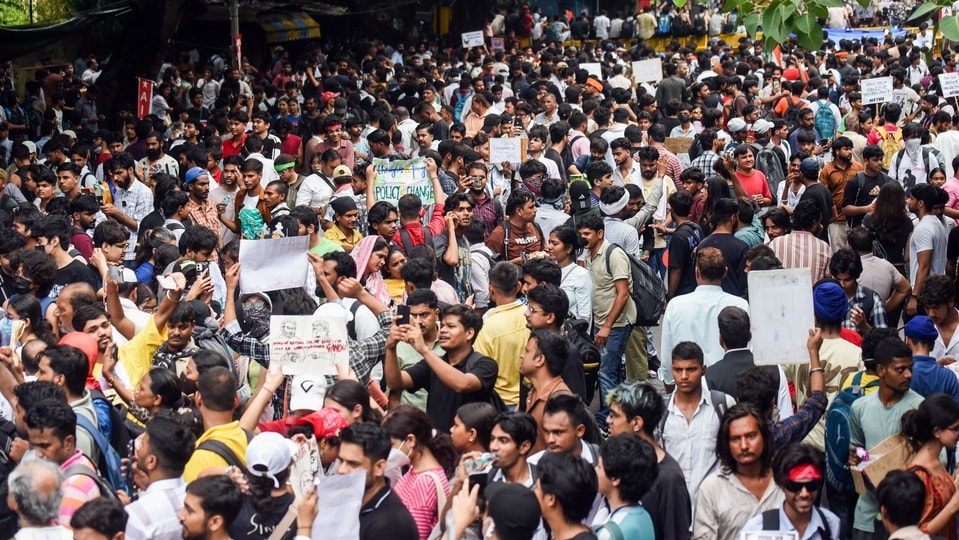
It is tempting to conclude that Indian democracy now rewards disruption over deliberation. But the deeper crisis is that India’s representative institutions have become far better at converting public anger into amplified political spectacle than at converting dissent into legislation. Protest was never meant to replace representative politics. Street was the opening move alone. Citizens made grievances visible. Parties organised them into political demands. Legislatures debated competing solutions. Governments translated those debates into reforms. Today, that democratic transmission belt is breaking. Part of the explanation lies in the changing nature of protest itself. Political theorist Anton Jäger describes our moment as one of hyperpolitics. Decentralised, issue-specific movements assemble rapidly and dissolve just as quickly. Their strength is speed and weakness is durability. A swarm can expose administrative failure or force an immediate concession. It cannot redesign recruitment systems, rewrite examination laws, or reform public institutions. Those tasks require organised political parties and legislatures.
The larger failure lies not with protesters but with the institutions meant to receive their demands. Twenty-four-hour TV and algorithmic social media reward confrontation far more than months of committee work. Mobilisation is politically more valuable than legislation. Executive dominance has narrowed the Opposition’s room to manoeuvre. But losing a legislative battle is different from declining to fight one. Even where parliamentary arithmetic makes victory unlikely, parties can still draft bills, demand committee scrutiny, build public coalitions and force sustained deliberation.
NEET illustrates this disconnect. After the 2024 paper leak, the Opposition demanded the Education Minister’s resignation. Two years later, a fresh controversy revived almost the same demand. What remained largely absent was a sustained legislative effort to strengthen examination governance, statutory oversight or institutional accountability. The slogan endured because institutional response barely evolved. None of this argues for less protest. Streets are the spaces where citizens without wealth or privileged access make invisible grievances politically visible. The danger is not that citizens bypass Parliament but that Parliament fails to absorb what they say.
Ministries should be required to table a written response to nationally significant protests within a fixed number of sitting days, followed by a parliamentary debate or committee hearing. A public scorecard tracking which parties pursued legislation and which merely organised demonstrations would make the gap between mobilisation and law impossible to ignore. Democracy does not fail when citizens take to the streets. It fails when the journey from street to statute ends halfway.
Shubhrastha is a political consultant and writer. The views expressed are personal


