
 E-Paper



Disability rights: A call to our CJI to champion this cause with all his might
As a disabled person who served as one of Justice Chandrachud’s judicial clerks and witnessed his commitment to accessibility and disability rights, I hope that he ensures that this cause receives sustained institutional attention.

 Prefer HTon Google


On the morning of November 9, I attended the swearing-in ceremony of India’s 50th Chief Justice (CJI), Justice Dhananjaya Y Chandrachud. I wished the CJI the very best for the arduous duties that lie ahead in his upcoming tenure, and clicked a picture with him. As someone who is disabled — blind since birth — for me, Justice Chandrachud’s assumption of our judicial system’s top post is a matter of considerable joy and expectation.
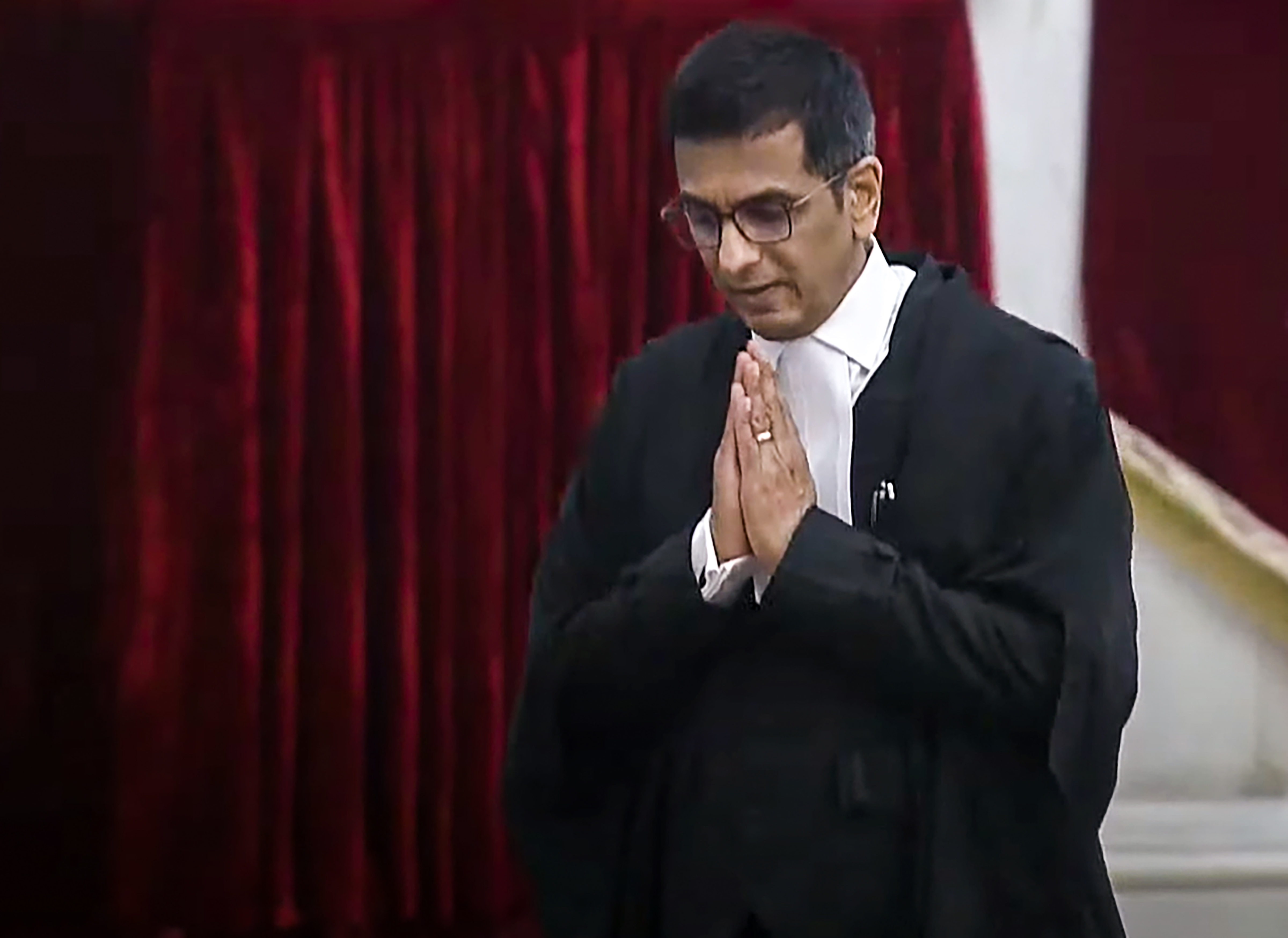
In the 2020-21 court year, I had the honour of serving as one of Justice Chandrachud’s judicial clerks. Even in 2022, the disabled continue to face a series of structural obstacles that hinder the realisation of their full potential. The legal profession, despite its avowed commitments to the values of equality, is, unfortunately, no exception.
A blind friend was recently unable to secure an internship at any of India’s leading law firms. He was categorically told by a partner of a firm that he would not be able to cope, given his disability. Our profession, much like our society, lacks an appreciation of the unique challenges that disabled individuals face and the additional support that they need in overcoming them. As CJI Chandrachud recently noted in the Professor Shamnad Basheer memorial lecture, titled Making Disability Rights Real, demands for reasonable accommodation are often viewed with contempt and derision (assuming one even knows what a reasonable accommodation is, in the first place).
Against this backdrop, my experience of working as a clerk for CJI Chandrachud was empowering and positive. In many ways, he was a model employer when it came to providing me with the additional support that I needed, such as giving me extra time to complete my work, because I had to troubleshoot accessibility challenges and could not effectively skim-read as my sighted counterparts could.
When my clerkship began, the Supreme Court website would require every visitor to enter a visual “captcha” to access most facets of the website, such as cause-lists, judgments, and daily orders. Accessible captchas for the disabled — in audio or text form — were not provided. Justice Chandrachud personally saw to it that this issue was addressed by the Supreme Court Registry which introduced an audio and text captcha. He also put out an instruction in all his cause-lists that all documents filed in his court had to not only be available in soft copy form, but also in a fashion that would preserve their accessibility to the disabled. All high court websites also deployed visually impaired-friendly captchas and adopted more disabled-friendly practices.
In his judgments on disability rights, Justice Chandrachud’s recognition of the harsh and challenging social realities that India’s disabled population confronts shines forth. Illustratively, in a three-judge bench judgment that he authored in February 2021, Vikash Kumar v UPSC and ors, Justice Chandrachud began the judgment by noting: “It [the case] tests what the law professes with how its ideals are realised. The language of our discourse, as much as its outcome, should generate introspection over the path which our society has traversed and the road that lies ahead in realising the rights of the disabled.”
He described the Rights of Persons with Disabilities (RPwD) Act as being an instrument that “tells them [the disabled] that they belong, that they matter, that they are assets, not liabilities and that they make us stronger, not weaker.” He also wrote about creating the RPwD Generation: “A generation of disabled people in India which regards as its birthright access to the full panoply of constitutional entitlements, robust statutory rights geared to meet their unique needs and conducive societal conditions needed for them to flourish and to truly become co-equal participants in all facets of life.”
In Avni Prakash v National Testing Agency and Ors, Justice Chandrachud documented the plight of a woman affected by a writing disorder called dysgraphia, who was the victim of “a tragedy of errors.” He situated her case within the framework of reasonable accommodation and inclusive education and issued guidance to minimise the occurrence of candidates with disabilities suffering due to insensitive exam-conducting bodies.
In Ravinder Kumar Dhariwal v Union of India and ors, Justice Chandrachud provided a detailed exposition of the challenges faced by persons with mental disabilities at the workplace. He held that the initiation of disciplinary proceedings is a facet of indirect discrimination against the disabled. As those with mental disabilities are more unlikely to comply with existing rules and protocols, the initiation of disciplinary proceedings has a particularly discriminatory impact on them. In a recent judgment in State Bank of India v Ajay Kumar Sood, Justice Chandrachud explained how a failure to make court documents accessible can shut out an entire gamut of citizens from our justice delivery process.
Taking a cue from his commitment to this cause, there is enormous scope for him to positively impact the lives of the disabled in his upcoming tenure. I can identify at least five areas that call for immediate intervention.
First, the Supreme Court and all courts across India should formulate an equal-opportunity policy, as mandated by the Rights of Persons with Disabilities Act, 2016. This would help make our courts disabled-friendly workspaces for court staff and interns associated with the court system.
Second, the Supreme Court, and other courts across India, should appoint a grievance redressal officer, to deal with complaints of disability-based discrimination.
Third, every court should designate some staff members who can guide and assist citizens with disabilities who have an interface with the court system, in any shape or form.
Fourth, lawyers and litigants with disabilities should, as a general rule, be allowed to appear via video conferencing in any matter that involves them.
Finally, the rules of practice and procedure of all courts should be suitably modified to ensure that court documents are more disabled-friendly. I had raised some of these issues in the shape of an interlocutory application in an ongoing Supreme Court matter [Rajiv Raturi v Union of India]. However, that matter has not been listed since February, 2019, and no concrete progress has taken place pursuant to that intervention.
With the above measures, and sustained institutional attention to this issue, one hopes that, under Chief Justice Chandrachud’s leadership, the judiciary will do its bit to make — to use the Chief Justice’s phrasing — disability rights real.
Rahul Bajaj is an attorney at Ira Law, co-founder of Mission Accessibility and a senior associate fellow on disability rights at the Vidhi Centre for Legal Policy. Disclosure: He regularly assists the eCommittee, Supreme Court of India, on disability rights causes
The views expressed are personal


