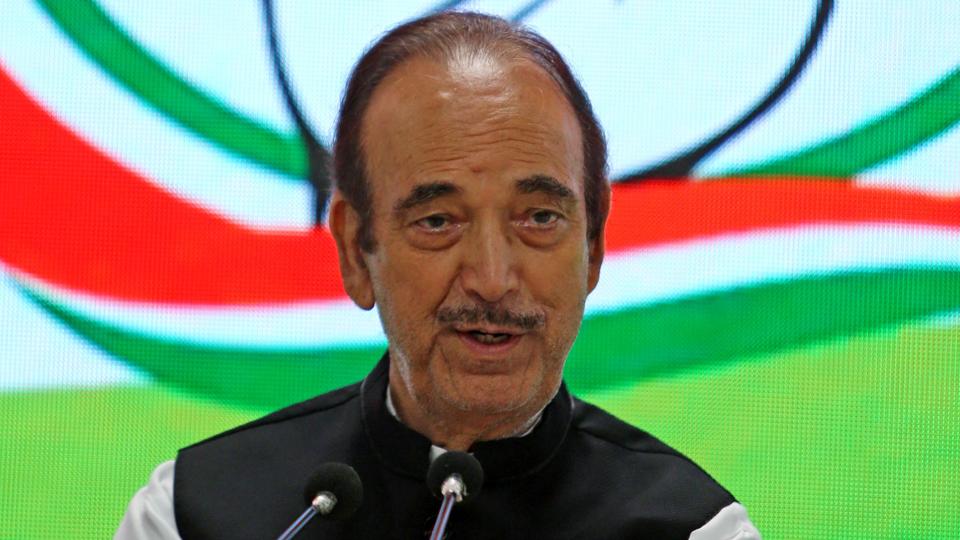
Distantly Close: Azad’s parting shot: Congress must pay heed to the bitter truth
In what appears more a charge sheet than a resignation letter, Azad's harsh tone, scathing description, and partly illogical exposition stem from a fundamental truth: That the Congress is being run into the ground. The leadership must take action
What Ghulam Nabi Azad wrote by way of his trenchant critique of the Congress is all right, but the way he wrote it is all wrong. One cannot but arrive at this conclusion after reading, many times over, his letter to Sonia Gandhi, the interim president he called a “nominal figurehead” who let her “immature” son Rahul Gandhi run the party through remote control.
But what set the leader from Jammu and Kashmir apart was the bitter note on which he called it quits. (ANI)
Leave apart the pejorative tone. His broadsides would’ve cut ice for the element of truth they bore, had he not in the same letter called the late Sanjay Gandhi an “iconic” leader. To those who had seen the latter run amok before and during the Emergency rule of the 1970s, his generous description of Indira Gandhi’s younger son made irony die a thousand deaths. Countless excesses of that period stand against Sanjay’s name. That’s one piece of history that isn’t erasable.
In this writer’s considered view, Sanjay was the original remote controller in the extra-constitutional mode whose shenanigans cost dear his mother and the party she led in terms of public image and politics. Proof of it was the Congress’s defeat and that of the mother-son duo in the 1977 Lok Sabha elections. The result: India’s first non-Congress regime at the Centre.
Azad reminisced fondly about Sanjay as he gave him his first break in politics in the 1970s. He did not expand at any length on how and why his original mentor was an exceptional leader except for having talent-scouted him into the party fold. In fact, he recalls being president of the Jammu and Kashmir Youth Congress (1975-76) during the Emergency period after having joined the Congress a couple of years earlier. At that time, he recalled, it was “still taboo” to be associated with the party (in Kashmir), given its post-1953 history that touched the nadir with the arrest of Sheikh Abdullah.
That really leaves one wondering: What was the "lower low" for the Congress? The arrest of Sheikh Abdullah or the detention of the entire national Opposition when he was the state’s Youth Congress chief? Without condoning the lack of inner-party democracy against which Azad has belatedly, but rightly, revolted, one is constrained to ask: How much democracy was there in the country in the mid-1970s?
That his exposition lacked logic and was driven by the instinct to self-insulate is proved further by the remote-control parallel he drew between today’s Congress and yesterday’s United Progressive Alliance (UPA) regime. The construct begs the question whether he raised the issue of two power centres at any point in time in the decade for which he was a minister under Dr Manmohan Singh.
The wisdom dawned on him retrospectively while penning the five-page communication that was less of a resignation letter and more of a charge sheet against Sonia and Rahul Gandhi.
A message lost in vituperation
This critique of Azad should not, however, be mistaken as any kind of endorsement of Rahul Gandhi’s working style that barricades him from the party, resultantly holding him captive to the counsel of those he’s comfortable with or trusts, at times without due diligence. His unilateralism in devising tactics and then expecting the party to fall in line, without adequate internal discussion or debate, has had underwhelming results. There admittedly were — and are — good reasons for a section of the party's old guard to feel expended or marginalised. Foremost among them was Azad, a veteran of 50 years who served in the party and governments under all Congress presidents and prime ministers since Indira Gandhi’s days.
That there is something fundamentally wrong in the way the Congress is being run is evidenced by the efflux of leaders young and old since the party’s 2014 and 2019 electoral routs. Over the past eight years, it has also lost 39 out of 49 assembly polls.
But what set the leader from Jammu and Kashmir apart was the bitter note on which he called it quits. The mismatch between his public image and the tenor of his letter was glaringly disconcerting. There would’ve been a lot many takers for his views within the Congress and without had he understatedly recorded the points he flagged to Sonia Gandhi. What seriously called into question his intent was his frontal attack on Rahul Gandhi and the bid to prejudge/prejudice the October 17 organisational elections announced a day after his resignation.
Party loyalists cite a particular passage from the letter to underscore Azad’s purpose to "deconstruct" Rahul Gandhi and "discredit" Ashok Gehlot (widely seen as the Gandhis’ choice for party chief). It reads: "Unfortunately, the situation in the Congress party has reached such a point of no return that now proxies are being propped up to take over its leadership. The experiment is doomed to fail because the party has been so comprehensively destroyed (by Rahul Gandhi) that the situation has become irretrievable. The chosen one (new president) will be nothing more than a puppet on a string.”
The pro-establishment elements buttress their argument by citing the example of Kapil Sibal, another prominent G-23 dissident who exited the party without demur. He has since entered the Rajya Sabha as an Independent, supported by the Samajwadi Party. The rancour Azad displayed wasn’t also as evident when Captain Amarinder Singh, Jitin Prasad, RPN Singh, and Sushmita Deb walked out.
Congress must confront the bitter truth
The 73-year-old veteran who gave five decades of his life to the party deserved better. He lost the sympathy he so richly deserved because he acted against his grain, forgetting apparently that there’s always a civilized, less reviling way of bidding adieu, of breaking ties held dear for long. There’s a way to be deferential to once-upon-time companionships which cannot be prolonged.
The circumspection, the felicity of language, was expected more from Azad. He was held in high esteem by his colleagues for his equanimity, poise, and certitude. By his own standards, the letter and spirit of his parting note to Sonia Gandhi was odious. To many in the party, it read the way Himanta Biswa Sarma and Sunil Jakhar talked before they shifted allegiance to the BJP.
Worse still, the venerated leader packed bags while the party was busy preparing for its ambitious Kanyakumari-Kashmir Bharat Jodo Yatra starting September 7. His jibe that before Bharat Jodo, the leadership should’ve undertaken a “Congress-Jodo” exercise, lent itself to the charge that the timing of his departure was conscious and pre-arranged.
The coincidence led to the conclusion that he acted in concert with Prime Minister Narendra Modi, who profusely praised him on the completion of his term last year as leader of the Opposition in the Rajya Sabha. Be it as it may, the Congress must realise that it’s losing talented and experienced leaders not because they had no future in the party. It has lost them amid a fast-growing perception that the party itself has no future. A grave prognosis for the 137-year-old Congress that led the freedom movement and ruled India for over five decades.
Regardless of his savage tone, it should pay heed to Azad’s take on what ails the party. For truth, like medicine, is bitter.
HT’s veteran political editor, Vinod Sharma, brings together his four-decade-long experience of closely tracking Indian politics, his intimate knowledge of the actors who dominate the political theatre, and his keen eye which can juxtapose the past and the present in his weekly column, Distantly Close

 E-Paper