Distantly Close | Imran Khan lives by the sword as a leader defiant of the army
Imran Khan has been soft on the militant religious right while attacking the policies of the US and other western powers that have a strategic interest in Pakistan. Neither these global players, nor the Pakistan army, can countenance a recklessly brave and popular leader with leanings towards rival powers in the region.
In Pakistan’s political theatre, faces change, not the roles they enact. That’s what venerated human rights activist, the late IA Rahman alluded to, when he said: “Hamari siyasat mein cherey badalte hai, kirdaar nahin.” He made the comment in the context of President Pervez Musharraf’s run-ins with the judiciary which inflamed the streets and cost him his job in 2008. The military dictator had grabbed absolute power nine years earlier after ousting the democratically elected Nawaz Sharif in a coup.
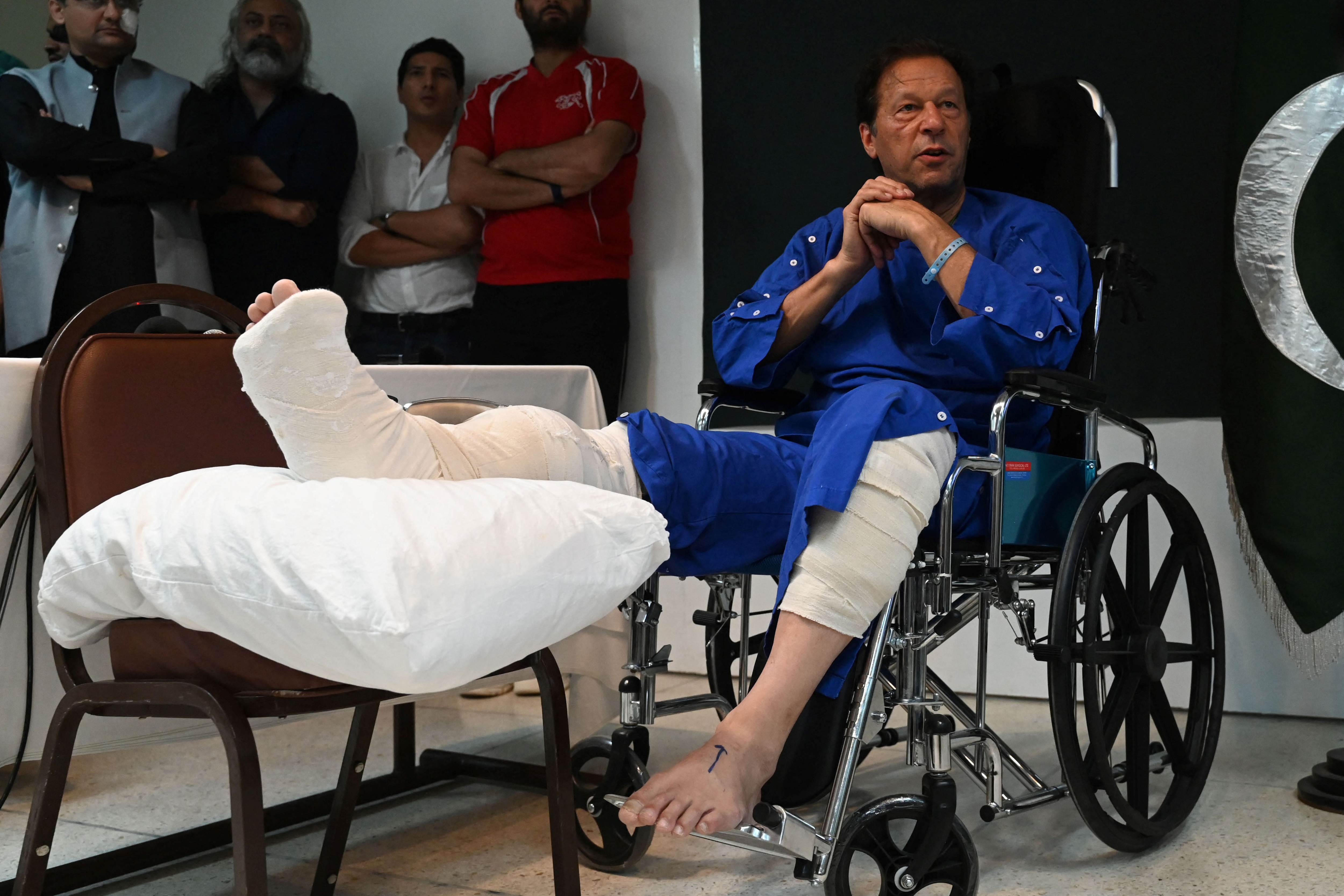
The gun-attack Imran Khan survived in his temporarily abandoned march to Islamabad isn’t a first. (AFP)
The gun-attack Imran Khan survived in his temporarily abandoned march to Islamabad isn’t a first. Pakistani politicians who defied the gumboots have always courted peril. History repeated itself as a tragedy each time a civilian leader with mass support ventured to tame or take on the army brass. The trend has continued unabated since the 1979 hanging of Zulfikar Ali Bhutto (ZAB) on Gen Zia-ul Haq’s watch.
ZAB was a political giant done in by his own protégé. His execution was forever termed a “judicial murder” by his equally charismatic daughter, Benazir Bhutto who took the bullet 28 years later amid a fierce faceoff with Musharraf’s military dispensation. She was killed on emerging from the rooftop of her car after a public meeting at Liaquat Bagh, the Rawalpindi milestone where Pakistan’s first premier, Liaquat Ali Khan was assassinated in 1951.
Attack on Khan a throwback to the 2007 bombing of Benazir’s procession
There are striking similarities between the attempt on Khan’s life and what Benazir faced on returning to Pakistan from an eight-year exile. She escaped by a whisker when a human bomber struck her convoy on her arrival from abroad in Karachi, killing over a hundred bystanders and people walking in the procession. That was in the October of 2007. She ran out of luck two months later at Liaquat Bagh. There’s a lesson there for Khan’s Pakistan Tehreek-e-Insaaf (PTI) to buttress its leader’s security for he may not be that fortunate the next time.
A lot of water has flowed down the Indus since Benazir’s tragic exit. A shrinking force under her husband Asif Zardari and son Bilawal, the Pakistan People’s Party (PPP) her father founded in 1967, shares power at the Centre with its traditional rival, the Pakistan Muslim League (PML-N) of Nawaz and Shehbaz Sharif. They assumed control on the strength of a majority ‘manufactured’ in the national assembly with the army’s not-so-covert backing. The convergence of interests to ease out Khan in a no-trust vote was a repeat of 2008 when they acted in tandem to dislodge Musharraf.
Widely perceived as the army’s prop through the manipulated 2018 polls, Khan’s defiance of his political progenitor — the milt-establishment and their civilian proxies — isn’t as altruistic as he makes it out to be. His is a poor encore of the manner in which Nawaz Sharif turned against his uniformed benefactors, having uneasy ties with four successive army chiefs: Asif Nawaz Janjua, Jahangir Karamat, Abdul Waheed Kakar and Musharraf. Refusing to play the second fiddle, the PML leader, who’s in exile in London, won his open war on the pro-army presidency of Ghulam Ishaq Khan through a court battle in 1993. That transformed him into a rebel from being a child of the establishment.
In that tumultuous period, Benazir, the famed daughter of the east, acted against her grain to move in the opposite direction to take Sharif’s place in the army’s scheme of things. She quietly built bridges with the military’s Rawalpindi-based power centre, called the General Headquarters to regain the PM’s office for a second truncated stint. To assert her relevance she too, while neutralizing the fauj, staged a long march in the lead-up to the elections that staged her return.
Khan hasn’t learnt from previous PMs’ experience with the army
Given his proclivity to play to the gallery, Khan, who has a below-par governance record, hasn’t apparently learnt any lessons from the experiences of his PML and PPP counterparts. Even in the worst of times, Nawaz Sharif had lines open to the army through his brother, Shehbaz, who now is the Prime Minister and Chaudhary Nisar, a senior member of his cabinet who came from an army family. There indeed were occasions when the younger Sharif blindsided his somewhat obstinate elder brother to reach out to the military leadership.
The worsening economy and the PTI leader’s refusal to play ball with Rawalpindi afforded the PPP-PML (N) an opening to ride back to power with the army’s push in the existing assembly. What left them and their backers in the garrisons in a spot, are the public forces Khan has since unleashed through an amalgam of religious nationalism and strident anti-Americanism. A heady mix that moves the masses, it’ll also cut the other way to be the biggest stumbling block in any future rapprochement with the army.
For the present, the tangible popular support has helped Khan show himself as a victim of a ‘US-sponsored conspiracy’ the PML-PPP government executed in cahoots with his detractors in the army. The narrative points a needle of suspicion at the milt-establishment in the failed bid on his life. The perception has only been strengthened by his allegations of the attack having been navigated by the incumbent PM, federal interior minister Rana Sanaullah and a senior operative of the Inter-Services Intelligence identified as Maj Gen Faisal Naseer.
The Erdogan template
Not just that. At a press conference a day after the gunshots which left him injured, Khan recalled the creation of Bangladesh to suggest the army alone cannot keep the country united; that only a pan-Pakistan party such as the PTI can bind people together with the fauj playing a secondary/supporting role.
Such claims are unlikely to go down well with even his supporters in the military’s middle-rung, reminiscent as they are of Khan’s admiration for Turkey’s Tayyip Erdogan who has successfully contained the army and tamed the judiciary in his country. “His is an Erdogan template (for supremacy),” remarked Muqtedar Khan, a professor of political science and international relations at the University of Delaware.
Irrespective of his blow-hot-blow-cold approach towards the army under Gen Qamar Javed Bajwa, Khan has been more standoffish than practical in his leadership of the agitation for bringing forward the polls due next year. His statements have evidently carried the flames too close to Rawalpindi, igniting popular sentiments against the army he might have problems containing.
That the long-term consequences of his actions aren’t lost on the PTI chief was evident when he accused the PML-PPP of orchestrating a clash between him and Rawalpindi. That was after his public spat with the ISI chief, Gen. Nadeem Anjum, who charged him with offering a quid pro quo (extension) deal to Gen Bajwa (due for retirement later this month) in return for help in weathering the no-trust vote he lost in April.
The abortive attempt on his life is sure to bolster Khan’s exponential popularity, proof of which was his recent successes in by-polls. In a fair election, he’d have won by a landslide even before the assassination attempt he escaped. Yet, given the ground realities of Pakistan, realism is what he needs to find his way back to power. He cannot possibly succeed by asking the people to choose between him and the fauj.
If he cares to recognize, that makes imperative an entente with Rawalpindi before elections. Unlike Benazir who was mote in the eye of militant Islamists and the army establishment alike, the threat to Khan’s person isn’t as much from the Taliban or their ilk. He has been soft on the militant religious right while attacking the policies of the US and other western powers that have a strategic interest in Pakistan. Neither these global players, nor the army, can countenance a recklessly brave and popular leader with leanings towards rival powers in the region, notably the China-Russia axis.
For a fresh start, if at all, with the army, Khan has to pipe down the anti-West rhetoric he deploys to gravitate his support base. A balanced foreign policy is what the army wants and the country needs. The new army chief will be the choice of the incumbent PM the PTI considers corrupt and unfit to rule. Yet, he won’t, as past experience shows, remain tied to the appointing authority’s coat tails. Nawaz Sharif and ZAB discovered that to their chagrin in yesteryears.
Khan, therefore, will have an opportunity to place his ties with the army on an even keel. The big question is whether the arrogantly self-righteous man will stoop to conquer from the high pedestal he loves occupying.
HT’s veteran political editor, Vinod Sharma, brings together his four-decade-long experience of closely tracking Indian politics, his intimate knowledge of the actors who dominate the political theatre, and his keen eye which can juxtapose the past and the present in his weekly column, Distantly Close

 E-Paper