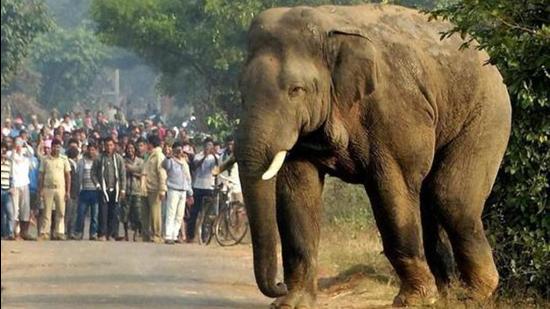
In India, nearly 80 elephants die every year due to human-elephant conflict. While poaching, poisoning and train hits are known reasons for elephant deaths, we must pay close attention to death by electrocution.
Representational image. (PTI)
Since the impact of electrocution is not visible on an animal’s body, and because it is easy to remove potential evidence, including wires, posts and machines post-electrocution, even experienced veterinarians are unable to determine the exact cause of an animal’s death, and post-mortem results often declare cardiac arrest as the cause of death.
When an elephant is electrocuted, we assume that the matter should be raised before the electricity department. However, except for a few cases, the department has a limited role in curtailing such incidents. One of the major causes of animal electrocution is live wire fencing by locals to protect their crops and property. They use power sources from the grid or captive sources such as a generator and/or batteries with inverters, and most of these are lethal.
Government data shows that electrocution kills more elephants than train accidents, poaching and poisoning. This is a nationwide problem. But it is acute in the Northeast, which is home to the second-largest population of Asian Elephant in the world. In Assam, more than 50% of the total number of elephant deaths is due to electrocution.
Lethal electric fences and transmission lines from power grids are the two major causes of electrocution. The former is a single live wire pegged to bamboo or wooden posts. Lethal AC current is used, instead of the non-lethal DC current, with low ampere value. Such fences are used by people because they do not know about the fatality of such fences.
We must educate and empower locals to use non-lethal means since these fences can be dangerous to humans too. Most deaths go unreported because people want to avoid subsequent legal hassles.
The second cause of electrocution is sagging transmission lines in elephant habitats and areas frequented by them. This can be avoided by using insulated transmission lines. Guidelines for laying electric lines already exist; what we need is effective implementation.
If we want to protect the animals and safeguard the interests of locals, it is important to install safe and low-cost electric fences. However, elephant movement paths should not be blocked while erecting fences. The idea is to replace the lethal power sources with an energizer with battery. To cut costs, a galvanised wire of 12 mm can be used at a height of about five feet so that adult elephants cannot cross.
These low-cost fences cost about ₹50,000 per km— nearly five times cheaper than a conventional electric fence. With the cooperation of the local community and forest department, a six km fence in the fringe of Singlijan Reserve Forest was installed in 2015 to restrict the movement of wild elephants. There have been no HEC incidents in 30 villages under the Gohpur Circle in Biswanath district of Assam. Almost 110 km low-cost fence has been installed in various parts of Biswanath, Sonitpur, Nagaon, Golaghat, Baksa and Udalguri districts since then. The study undertaken by WWF-India revealed that well-maintained low-cost solar fences have a success rate of 80-95% in deterring elephants.
But one hurdle remains. Victims of HEC – most of whom are marginalised – cannot afford ₹5 lakh to install a 10-km fence. Ensuring peaceful human-animal coexistence requires partnerships that foster local empowerment, elephant conservation, and support to enforcement agencies like the forest department. A growing number of corporate are supporting initiatives to reduce negative human-wildlife conflict. There is immense scope for them to contribute to conflict management by empowering people.
Hiten Kumar Baishya is landscape Coordinator, Brahmaputra Landscape, WWF India

 E-Paper