
 E-Paper



Hutong Cat | Vladimir Putin's great wall of defence in China
Chinese State media have set the tone while covering the war in Ukraine, calling it a “special military operation” and deploying Pro-Russia voices to bolster the defence


The past week must have been a trying one for Chinese State-controlled media as the Russian war machine rolled in and continued attempts to steamroll Ukraine.
Imagine the agony of reporters and editors in Chinese domestic media who have had to write “special military operation” every time they actually wanted to write the simpler words “invasion” or “war”, easily more appropriate to describe the events unfolding in the eastern European country.
The sin of verbosity aside, the Chinese phrase of the week “special military operation” — borrowed from Russian comrades cushioned inside the grand Kremlin — is a blatant lie: A country doesn’t deploy heavily armed soldiers, tanks, heavy artillery guns, cluster bombs, missiles and (unexpectedly few) fighter aircraft for a “special military operation”; you deploy them to wage an invasion, wage a war against another nation, in this case, a smaller, weaker neighbour.
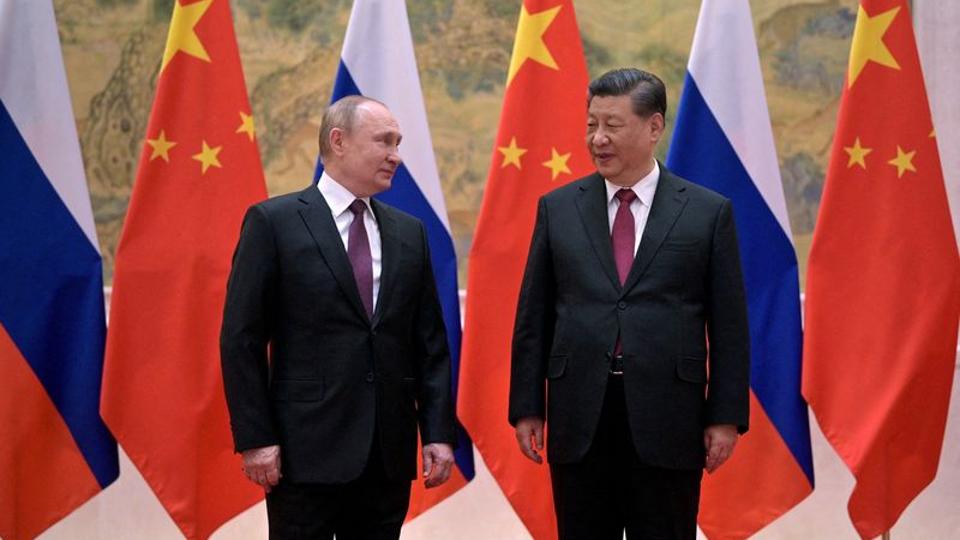
President Vladimir Putin, in fact, would be proud of the wall of defence that Chinese State media has put up on his behalf to mislead their own countrymen.
The big guns of Chinese official media, the People’s Daily (Communist Party of China’s mouthpiece), official news agency, Xinhua and State broadcaster, China Central Television have been tasked with setting the tone of coverage for the others in Chinese media.
The outlets have deployed multiple pro-Russian voices including foreign writers to bolster the defence.
The arguments have been a repeat of what Chinese foreign ministry spokespersons have been relentlessly arguing at the daily news briefings; actually, a repeat of one argument — US-led West-bashing.
The US is the “culprit” of the conflict for “hyping” war and continuously backing the expansion of the North Atlantic Treaty Organization (NATO) in Europe.
Here’s a sample of China’s diatribe against the US from a commentary published by CGTN, China’s official English television channel, part of its national broadcaster, CCTV. It was in response to President Joe Biden’s State of the Union address, “Biden’s most stirring soundbite [about the current Ukraine crisis] was ‘We are ready.’ Biden is now trying to take credit for bravery shown by the Ukrainian people, when he instead should be apologising for yet another US double-cross of its friends and allies”.
On China’s Twitter-like Weibo, an alternate reality on Russia’s war on Ukraine has been created.
It’s a reality crowded by pro-Russia and anti-US opinion, missing one critical point — Moscow launched an unprovoked attack on Kyiv, a smaller country with a smaller national strength in economic and military terms.
Contradictory voices have been censored.
Five Chinese historians, for example, had published an open letter condemning Russia’s invasion of Ukraine, Radio Free Asia, a US government-funded media, reported earlier this week.
The letter’s brief life on Chinese social media stood out because it openly broke rank from the Communist Party of China (CPC)'s ban on criticism of Russia and Putin.
“As a country that was once also ravaged by war... we sympathise with the suffering of the Ukrainian people,” the letter, signed by history professors at five top Chinese universities, said.
“The ruins of buildings, the sound of artillery fire, and the wounds of refugees in Ukraine have injured us deeply,” the RFA report said, quoting the letter.
“We emphatically call on the Russian government and President Putin to stop the war and resolve any dispute through negotiations,” it said.
In another similar online protest in late February, 130 alumni from top Chinese universities issued a joint statement opposing Russia’s invasion of Ukraine, calling on the Chinese government to fulfil its agreement signed in Kyiv after it let go of its nuclear arsenal in 1994.
Images of global anti-war protests including in Russia, Bloomberg pointed out, flickered briefly on Chinese social media before being extinguished.
“Articles mocking Russia’s limited military gains were also shared, with some comparing Putin to a disgraced tai-chi master who was defeated in seconds by an amateur… while state broadcaster CGTN aired appeals from Chinese students in Ukraine asking for peace,” the Bloomberg report said.
In the face of economic sanctions levied on Russia by western countries, online comments have also called for China to support Russia by purchasing its exports of oil, gas and other goods.
“Let the Russian Embassy sell their goods on livestream. Let’s show them China’s buying power,” said a comment signed, Bao Zou Guang Xiao Pang on Weibo, quoted by Associated Press.
A separate comment advocating that China maintain normal trade with Russia, an implicit rejection of sanctions, received some 80,000 likes.
To be sure, social media platforms have also urged users to act responsibly and have said they have removed thousands of postings about the attack on Ukraine.
Douyin, a Chinese version of TikTok, said it deleted more than 3,500 videos and 12,100 comments due to “vulgar, war belittling, sensationalist and unfriendly comments.”
Chinese State media have had to also make sense of India’s position on the situation in Ukraine.
India’s abstention from United Nations votes on Ukraine made some news here with local media trying to grudgingly welcome New Delhi’s “independent foreign policy” — an abrupt departure from its usual post-Quad argument that New Delhi was now a Washington lackey.
“India believes that the world is in an era of political confrontation between blocs, therefore, it needs to have representation in different camps in order to increase room for maneuver. As such, India has advocated a balanced diplomatic strategy and followed a course of multi-alignment so that it can gain benefits from relations with all major powers,” Lan Jianxue, noted expert on India and head of the Department for Asia-Pacific Studies at China Institute of International Studies wrote for the tabloid, Global Times on March 1.
“Taking all these into consideration, India has to take a neutral stance over the Ukraine issue,” Lan added.
Interestingly, Chinese state media blanked out the news of the China-led Asian Infrastructure Investment Bank (AIIB) freezing projects involving Russia and Belarus in the backdrop of Moscow’s attack on Ukraine.
China is the largest shareholder in AIIB, which has its headquarter in Beijing, and its head is Jin Liqun, a former vice-minister at the Chinese finance ministry.
Local media also remained silent that BRICS’ National Development Bank had stopped projects in Russia.
Given China’s leading role in both MDBs, the silence is curious.
Sutirtho Patranobis, HT’s experienced China hand, writes a weekly column from Beijing exclusively for HT Premium readers
The views expressed are personal


