In the Gulf, India must be alert to Chinese strategy
While China is the undisputed top dog in the region, India is not a minnow either. Apart from being the second largest trading partner, New Delhi is also the largest manpower provider and remittance recipient
Conventional wisdom states that Chinese President Xi Jinping’s State visit to Riyadh a fortnight ago was intended by both sides to send a message of defiance to Washington. Their respective ties with the United States (US) have been strained recently.
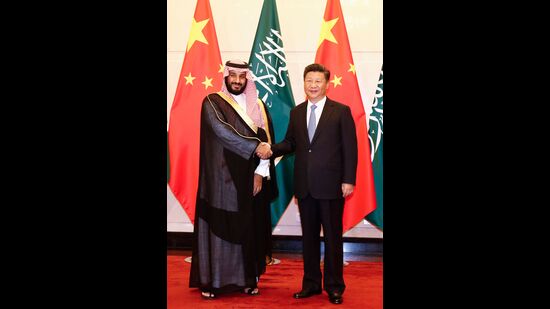
It would be simplistic to view Xi’s Riyadh visit through the prism of the US-China rivalry alone. The 3-in-1 event was meant to consolidate China’s ties with the kingdom, the GCC and the Arab world (AFP)
However, the visit was more than mere optics. It was a substantive event with three summits held at bilateral, Gulf and Arab levels. It signified not only China’s pulling power but also Saudi Arabia’s regional diplomatic heft. China, a permanent member of the United Nations Security Council, is the largest trading partner and investor in most middle eastern states. The Arabs also appreciated Beijing not being their conscience keeper. There was also extensive and high-level participation from across the region: The heads of State of four out of six Gulf Cooperation Council (GCC) countries attended the China-GCC summit and heads of State or governments of at least 13 of the 20 Arab League members were present for the China-Arab summit.
A granular look reveals Beijing’s meticulous preparation for each of these three axes, with President Xi delivering itemised speeches, laying down various action points. Among the major frameworks agreed on were a summit with Saudi Arabia every two years, the establishment of a Chinese-GCC Forum for Industrial and Investment Cooperation and a Free Trade Area, as well as the China-Arab Forum.
China’s bilateral trade with Saudi Arabia was $87.3 bn in 2021, nearly twice India’s ($42.9 bn) and four times Saudi-US trade ($24.7 bn). China, the world’s largest consumer, bought nearly a fifth of Saudi oil exports. Riyadh is keen to preserve this secure demand for its crude and has taken a final investment decision on a $10 bn refinery in China, its largest investment abroad. Chinese companies, from Sinopec to Huawei, have a major presence in the kingdom.
Unlike US President Joe Biden’s year-long reluctance to engage Crown Prince Mohammed bin Salman, Xi treated him as his counterpart and had substantive discussions, including the overlapping of China’s Belt and Road Initiative and the Saudi leader’s Vision 2030. In the post-visit joint statement, China “affirmed its opposition to any actions that would interfere in the internal affairs of the kingdom” and “welcomed the kingdom’s role as a supporter of the balance and stability in the world oil markets” — two thorny issues with the US.
In his speech at the first China-GCC summit, Xi espoused five priority areas for action, viz. energy, finance and investment, innovation, aerospace and culture. He also urged fuller use of the yuan for the oil trade. In the 18-paragraph summit statement, at least three were devoted to Iran with China agreeing to the GCC narrative on issues from nuclear proliferation to the three-island dispute. At the Arab-China summit, Xi laid out eight major common actions with “development” being the most prominent, under which Chinese offered $718 mn for 30 projects, duty-free access for the least-developed Arab countries’ exports to China and targeting China-Arab trade of $430 bn by 2027. The final communique of the summit supported the Palestinian Cause, appreciated “the important efforts made to care for minorities on both the Arab and Chinese sides”, rejected “the politicisation of human rights” and agreed to hold the next Arab-Chinese summit in China.
Thus, it would be simplistic to view Xi’s Riyadh visit through the prism of the US-China rivalry alone. The 3-in-1 event was meant to consolidate China’s ties with the kingdom, the GCC and the Arab world — replicating a similar exercise with Africa years earlier. While offering politically correct platitudes about regional security and stability, Beijing continues to avoid being drawn into commitments to put boots on the ground, having no ambition to replace Washington as the guarantor of regional security. It wishes to secure its crude supplies and expand its economic footprint using its transactional capacity while letting Washington do the heavy lifting on securing the region. Of course, China has several drawbacks — including its close ties with Iran and Israel, the controversial treatment of its Uyghur minority community, and its relatively shoddy merchandise and services — that can blight its strategic path in the region.
Even as India is locked in an intensifying standoff on its eastern border with China — exemplified by the clashes in Tawang in Arunachal Pradesh on December 9 — it also needs to look west, and carefully observe Chinese overtures during the same week in Riyadh. While China is the undisputed top dog in the region, India is not a minnow either. Apart from being the second-largest trading partner, New Delhi is also the largest manpower provider and remittance recipient.
Moreover, unlike China, our growing profile has the advantage of mutual familiarity, incrementalism and non-disruption. As the world’s third-largest fastest-growing oil importer and seventh-largest investment destination, we are perhaps destined to compete with China in this vital region. We should leverage our strengths, consolidate our network, vertically integrate our energy linkages, lay out a common vision for Southwest Asia, and pursue it with greater vigour.
Mahesh Sachdev is a former diplomat The views expressed are personal

 E-Paper