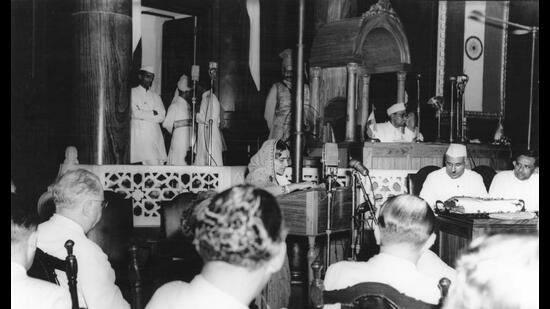
These founding mothers of the Republic may have found their contribution forgotten by unfortunate amnesia, but the imprint of their ideas and revolutionary spirit continues to animate the nation
Five days after India formally adopted the Constitution to become a Republic, the freedom fighter G Durgabai rose to speak in the provisional Parliament on February 1, 1950. Choked with emotion, she described how as a student, she would read of the men who wrote the American constitution and wonder if India would ever break free from the shackles of slavery and become competent to frame its own founding document. “As I stand here at the moment, I imagine myself to be somewhat dreaming… by the grace of providence that occasion has come and it is my good fortune that I am indulging in self-praise for being fortunate to play a part,” she said to a loud burst of applause.
These 11 women had a distinct presence in the CA and spoke in one authorial voice — explicitly feminist, morally robust, internally consistent albeit with intersectional differences — throughout the framing process. (PIB)
Durgabai was a member of an extraordinary club of women who were elected to the Constituent Assembly (CA) over three years and worked to bestow unto the nation the solemn gift of the Constitution. Eleven of them — Kamala Chaudhari, Sucheta Kripalani, Durgabai, Qudsiya Aizaz Rasul, Purnima Banerji, Dakshayani Velayudhan, Renuka Ray, Hansa Mehta, Rajkumari Amrit Kaur, Annie Mascarene, and Ammu Swaminathan — appended their signatures on behalf of “We, the people” on the original Constitution before it came into force on January 26, 1950. These founding mothers of the Republic may have found their contribution forgotten by unfortunate amnesia, but the imprint of their ideas and revolutionary spirit continues to animate the nation.
These 11 women had a distinct presence in the CA and spoke in one authorial voice — explicitly feminist, morally robust, internally consistent albeit with intersectional differences — throughout the framing process. It was a voice with a definite feminist imagination shaped by two decades of constitutional politics before 1946 and a faith in constitutionalism that was distinct from other forms of politics, such as the Gandhian satyagraha. While this imagination was grounded in the long history of feminist consciousness in India, it had been shaped into a formidable discursive force with the advent of organisational politics undertaken by the All India Women’s Conference (AIWC) and the National Council of Women in India (NCWI) founded in the late 1920s. Almost all women members of the CA, except Dakshayani Velayudhan, the only Dalit founding mother, had either been leaders of AIWC or worked as collaborators with the organisation. The voice in which these women spoke (and often wrote, as in the notes of dissent) in the CA — call it their “authorial” intention — was developed over years of constitutional politics in AIWC and other organisations in the 1930s and 1940s.
This constitutional politics was characterised by a form of political mobilisation that sought social transformation through petitions, charters, memorandums, canvassing in legislatures by bringing forward bills, and preparing survey reports about the status of women. The list of documents prepared by the founding mothers included the Report on Woman’s Role in Planned Economy (1939), a celebrated document with avowed feminist positions much ahead of its time, petitions submitted before the Hindu Law Committees of 1941 and 1945, memorandums submitted to the International Labour Organization, and various documents submitted to the colonial government and the legislatures regarding women’s issues.
It also included the exceptional Indian Women’s Charter of Rights and Duties (1945), prepared by Mehta and Ray, among others, a crystallisation of their long-term demands. The charter was circulated before the elections to the CA among members of Indian legislative assemblies, international feminist organisations and the United Nations subcommission on the Status of Women. Mehta, then the Indian delegate to the United Nations Human Rights Commission, also led efforts to change the language of the Universal Declaration of Human Rights from “man” to “human beings”.
This corpus of texts underlines that the women’s presence in the CA was presaged by a confident movement that was grounded in sound thoughts and rhetoric. It also shows that the founding mothers had already developed a conviction in constitutionalism — the notion that a stable set of ideals must act as an anchor to the turmoil of democratic politics — and the recognition of the need to locate women as a minority afflicted by social disabilities in need of constitutional protection. Many were also international stalwarts in their own right.
The contribution of women in the Constitution-framing process can, therefore, be an extension of the long years of constitutional politics of the women’s movement. Their struggle to translate a feminist and women-centric vision into the language of constitutionalism involved thorny questions of property rights, secularism, affirmative action, diversity of languages, socialism, the relation between constitutional rights and human rights, democracy and nationalism, and justice.
When Mehta and Kaur wrote a note of dissent against Article 25 of the Constitution, demanding that the right to “freely profess, practise and propagate religion” cannot be made into a fundamental right, they were speaking from a feminist perspective on the many undesirable influences of religion in the private lives of women. Their demands for the fundamental right of inter-religious marriages came from the same terrain. When their demands were defeated, Mehta and Kaur wrote the crucial note of dissent that was partially adopted as Article 37, asking that the directive principles must be “nevertheless fundamental” to the governance. This, later on, became the basis for the ascendancy of the directive principles in Indian constitutional law.
Their contribution to the Republic didn’t end with the Constitution. Many of them immersed themselves in government bodies, social organisations, and movements to further the ideals they so passionately argued for inside the CA. Durgabai became a member of the Planning Commission, Kaur became India’s first health minister, Ray became a minister in West Bengal to help with refugee rehabilitation, and Mehta helped formulate a new national education agenda for women.
To call these women our founding mothers is to engage with the compelling ethical questions they raised during the framing process, and to understand that it was not just with their consent that we got our founding document, but through an act of their will, one that is still in the process of being redeemed as the will of this Republic.
Achyut Chetan is associate professor of English, St Xavier’s University, and the author of Founding Mothers of the Indian Republic: Gender Politics of the Framing of the ConstitutionThe views expressed are personal

 E-Paper