India’s health sector presents an opportunity to transition to clean energy
Transitioning to renewable energy comes with multiple benefits. They can be deployed quickly, and will immediately enhance the reliability of the power supply. It will also bring savings on power bills and cut down on diesel expenses required for standby generators
A recent report by India’s NITI Aayog discusses various operating models of India’s not-for-profit hospitals to highlight the crucial services they provide and the challenges they face. As the country recovers from another wave of the Covid-19 pandemic, India’s overstretched and inadequate health infrastructure, which largely remained in the margins of conversations on development, has taken centre stage in the past year. And the stark differences in the quality and cost of care between private healthcare facilities and the government and not-for-profit hospitals are very evident.
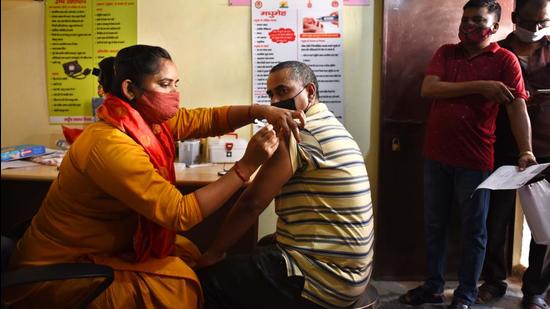
A health worker administers the Covid-19 vaccine to a man at a PHC in Nathupur Village, in Gurugram. (Vipin Kumar/HT PHOTO)
Data from the annual national Rural Health Statistics (RHS) have long informed us of the challenges that the government faces in filling rural vacancies at Primary Health Centres (PHCs) or ensuring trained medical professionals remain in their jobs in remote parts of the country. What is often missed is how the not-for-profit health sector had stepped in to fill this gap. The NITI Aayog report acknowledges these services by this sector and highlights prominent challenges it faces.
These challenges mirror those faced by the government hospitals — the severe lack of infrastructure and the constraints in expanding it, often exacerbated by insufficient funding. There is also the challenge of getting trained medical professionals to take up rural postings, leaving many jobs unfilled. This is an extremely important and timely report. We add one more challenge– the lack of reliable and affordable electricity required to power existing and future rural healthcare facilities.
Challenges in recruitment and retention of healthcare staff
These gaps present a challenge, but they also provide an opportunity to attempt a paradigm shift in building health infrastructure and provisioning power supply. Both would directly impact the quality of care, its reach, and the livelihoods this would create.
According to the RHS 2019-20, nearly a quarter of the 35,980 sanctioned positions for doctors in rural Primary Health Centres (PHCs) nationwide are unfilled. The statistics for Community Health Centres (CHCs) that provide specialised medical care are even starker. The data reveals that 63.3% of the sanctioned posts of specialists at CHCs are vacant. They comprise surgeons, obstetricians & gynaecologists, physicians and paediatricians.
More importantly, of the existing about 155,000 sub-centres, nearly one-third (44,000) and 1,000 PHCs out of about 25,000 in rural areas still operate without electricity supply.
Healthcare professionals point to multiple hardships, from low salaries to working in remote locations that lack basic facilities such as reliable electricity and water supply, motorable roads, and network connectivity. Often, rural healthcare facilities lack sophisticated diagnostic and surgical tools and medical equipment.
Also, a common refrain is the limited infrastructure for their accommodation, the lack of options for good schools and daycare support for their children. Cumulatively, these issues deter medical staff from moving to these remote locations.
Reliable and affordable energy is essential for the health sector
While more attention needs to be paid to some of these issues, the provision of reliable electricity is a low-hanging fruit.
Reliable electricity is crucial for every aspect of a health facility. It is required to run equipment for diagnostics, sterilisation, medical procedures, water supply, and store vaccines and other medications. Beyond the hospital building, reliable electricity is required to power staff quarters — not just lights and fans, but also household and kitchen appliances, charging mobile phones and internet connectivity. The efficient functioning of a health facility is underpinned by the quality of infrastructure provided to its staff, which is only possible when there is affordable and reliable power supply for all their needs.
Reliable access to energy, therefore, plays a critical role in creating a virtuous cycle. 24x7 power supply in hospitals enables upgradation of facilities to provide advanced healthcare services and for longer operating hours. This results in more patients being able to access much needed healthcare facilities, reinforcing the need for more doctors and nurses. In turn, this could possibly attract more financing for the health facility to improve its infrastructure.
The NITI Aayog report also highlights lessons that could be learnt in management from the not-for-profit sector. In terms of infrastructure and equipment, not-for-profit hospitals rely on judicious use of funding for capital expenditure and focus on cost optimisation. They achieve this through greater focus on general ward beds than on private care, limited installation of ACs in the premises, and a greater emphasis on natural ventilation and daylighting wherever feasible.
There is, however, a drawback, which is the use of medical equipment often extending beyond its lifespan and relying on second-hand parts. This might add a layer of inefficiency and consume more power than the state of the art equipment.
Challenges to expanding infrastructure
Not-for-profit hospitals are financially constrained, as most of them depend on government grants or donations to meet their capital expenditure, and at times, operating expenses as well. Any income is primarily used to fund operating expenses. This limits their ability to diversify and provide further services. Corporate Social Responsibility (CSR) funds are an avenue to explore further. However, funding for hospitals in remote regions is generally limited as companies prefer to spend in areas where they have their operations.
Financing is a significant issue for both not-for-profit and government rural health facilities, and this needs to be addressed. In 2020-21, India spent 1.8% of its GDP on health, which is one of the lowest public health spends globally, and the lowest amongst the BRICS nations. The Economic Survey 2020-2021 stated how increasing public spending to 2.5% to 3% of the GDP could more than halve out-of-pocket expenses for patients from 65% to 30%.
While the last budget did increase healthcare allocations, this was focused on Covid-19 care and vaccinations.
Additionally, increased budgetary allocations towards enhancing access and quality of all health services are needed. This requires a holistic view of creating a climate-resilient and energy-efficient healthcare infrastructure. This could be achieved by assessing healthcare facility energy requirements, retrofitting energy-efficient medical equipment and ensuring the provisioning of power through cost-effective renewable energy resources.
Transitioning to renewable energy comes with multiple benefits. They can be deployed quickly, and will immediately enhance the reliability of the power supply. It will also bring savings on power bills and cut down on diesel expenses required for standby generators. These accrued savings could be ploughed back into enhancing healthcare service delivery.
Not-for-profit hospitals that WRI partners with have already successfully attempted this transition. They are now looking at expanding their services as they reap the benefits of less expensive and more reliable renewable energy.
The NITI Aayog report has spotlighted a sector that has thousands of unsung warriors who have striven to put the care of others first, particularly in the least visible and remote regions of India. It is time to ensure lessons from this sector on resource management inspire the private and government healthcare facilities to attempt a sustainable transition to clean energy.
Lanvin Concessao and Masfick Hazarika work on expanding energy access in rural and remote parts of India as part of the World Resources Institute, India

 E-Paper