Inside story: How and why did Mulayam miss the bus to PMO in the short-lived UF
The assets that made his candidature formidable — having a mass base and experience as CM — became a liability in the peculiar situation that saw IK Gujral's selection as the preferred candidate.
Could Mulayam Singh Yadav have been prime minister (PM) in the Congress-backed United Front (UF) government that lasted two years from 1996-98? The short answer to that is: Theoretically, yes. Practically, no.
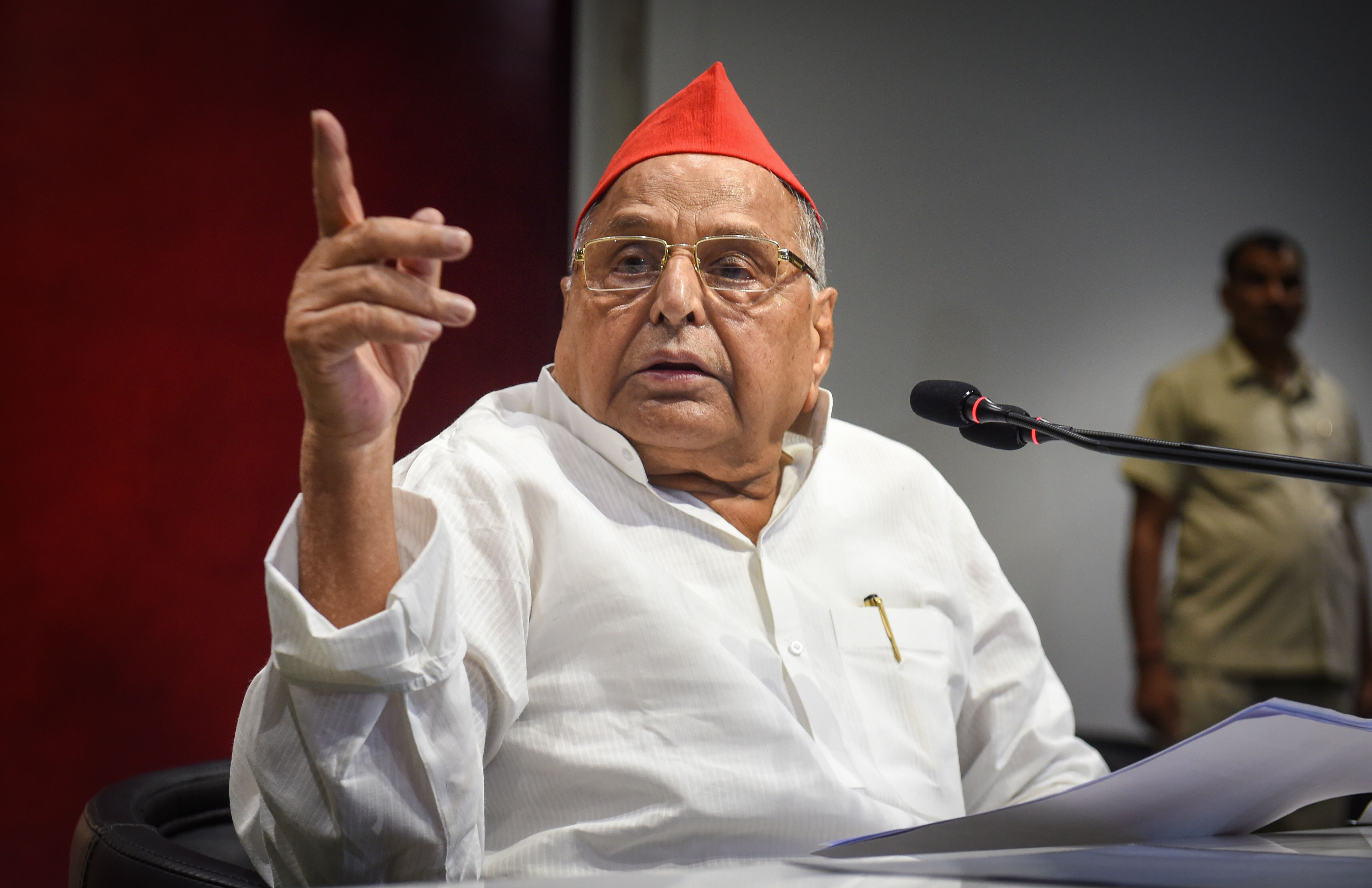
Late SP leader Mulayam Singh Yadav. (PTI)
The reason: The leaders who got lucky at his expense in the 13-member coalition were chosen for their administrative experience minus the mass base that could discomfit other stakeholders in the hydra-headed front. The first to get the trophy, Deve Gowda was chief minister (CM) of Karnataka; his appeal was restricted to his home state. The mantle fell on external affairs minister Inder Gujral when Sitaram Kesri, then Congress president, withdrew support from Gowda after a face-off.
In what was an elimination rather than a selection process, Gujral emerged a dark horse to his own surprise. He’d responded funnily when this writer broke the news to him on phone: “Hakim diyan goliyan tei theek hai, par buddhe wich he jaan nahin…” The rustic Punjabi proverb he used could be translated to mean: the healer’s doses are fine, but they won’t work on a frail body.
Gujral did eventually pick up the strength to take the oath to be PM despite Mulayam Singh and in spite of Harkisen Singh Surjeet, the influential Communist Party of India (Marxist) general secretary who lobbied hard for the Samajwadi Party chief. Then on a visit to Moscow, Surjeet spared no effort, incessantly making long-distance calls at odd hours to Andhra Pradesh chief minister Chandrababu Naidu while the latter, as the UF convenor, was busy building a consensus on Gowda’s successor.
What disqualified Mulayam?
What disqualified Mulayam Singh in the prevailing political situation were multiple vetoes the UF partners exercised against anointing a weighty politician from the North. He had already served twice as Uttar Pradesh CM besides playing a key role in the formation of the Chandrashekhar regime upon the fall of VP Singh’s government in 1990. The assets that made his candidature formidable became a liability in the obtaining, peculiar political situation.
It is well known also that the other big daddy of the social justice movement, Bihar’s Lalu Yadav, played a decisive role in cancelling out Mulayam Singh’s bid. He set up veteran Karnataka leader SR Bommai (father of the state’s current BJP CM) for the PM’s office against the SP chieftain to make Naidu look for a safer, more acceptable choice which fell on Gujral. Operating very much from behind the scenes was Singh. He hadn’t forgotten how Mulayam helped his bête noire, Chandrashekhar, occupy the coveted office with the Congress’s proximate backing when the BJP took back support from his National Front regime amid the Mandal-Mandir tussle that had a freshly minted Janata Dal CM Lalu Yadav stop LK Advani’s Ram rath in October 1990 in Bihar.
Singh was unwell those days and would regularly visit Delhi’s Apollo Hospital for dialysis. At a meeting, while he underwent the procedure, this writer got a distinct impression that the former premier, who wielded considerable clout among the UF constituents, was inclined to back Gujral in the selection/elimination that was underway on Naidu’s watch.
It is pertinent to recall here that Gowda was the UF’s third choice after Singh refused the job, fleeing his residence from the backdoor while three sitting CMs, including the CPI(M)’s Jyoti Basu, the Dravida Munnetra Kazhagam (DMK)’s Karunanidhi and Deve Gowda, stood at his doorsteps to persuade him to be the PM. He later told this writer: “I would’ve been a fool to take the bait with no prospect of the Congress (which supported the coalition from outside) agreeing on my candidacy.” The consensus choice after him was Basu who personally was game but failed to find his party’s mandate. The Marxists spurned the UF overture on the ground that they cannot be leading a dispensation at the Centre without a strong legislative presence to formulate policy. Basu accepted the decision, later calling it a “historical blunder.”
Naidu and VP Singh hoist Gujral
Operating from the CM’s suite at Andhra Bhavan, Naidu acted in concert with Singh after Gowda’s exit. The seemingly pre-arranged script of choosing a technocrat for the job was made public after ritualistic consultations held individually with UF partners. Lalu Yadav came on board and made Bommai opt out of the race when Gujral’s name surfaced. The PM-designate was first presented to the media by the Telugu Desam Party leader at the Andhra Bhavan auditorium.
The Gujral regime lasted less than a year. It fell when the Congress demanded the DMK’s ejection from the UF over the Jain Commission’s “needle of suspicion” pointing to the Dravidian party in the ‘conspiracy’ that led to Rajiv Gandhi’s assassination. The resultant elections set the stage for AB Vajpayee’s second coming and going as PM after his 1996, 13-day failed effort to show numbers in the Lok Sabha. That opened an opportunity for the Congress to take a shot at power when the BJP leader lost the majority after the All India Anna Dravida Munnetra Kazhagam’s Jayalalithaa’s mid-1999 regime toppling tantrums.
But Sonia Gandhi failed to prove the magic figure of 272 she publicly proclaimed on Surjeet’s assurance after his talks with the SP leader. There hasn’t since been unanimity on whether it was revenge or poetic justice for Mulayam Singh. The outcome of it was the UF’s decimation and Vajpayee getting lucky the third time to rule a full term after the 1999 elections.
Politics indeed has strange ways of playing out.
HT’s veteran political editor, Vinod Sharma, brings together his four-decade-long experience of closely tracking Indian politics, his intimate knowledge of the actors who dominate the political theatre, and his keen eye which can juxtapose the past and the present in his weekly column, Distantly Close

 E-Paper