
 E-Paper



Keeping up with UP | How State FM sees UP’s dreams of a trillion-dollar economy
Finance minister Suresh Khanna’s statements on the UP government's bold ambition to become a trillion-dollar economy are apt, especially with the complexities that surround the politics of welfare.


"Khamosh gile, masoom zidein, mujhse kehti hain, paisey do — silent grudges, childish whims, ask me for an allowance.”
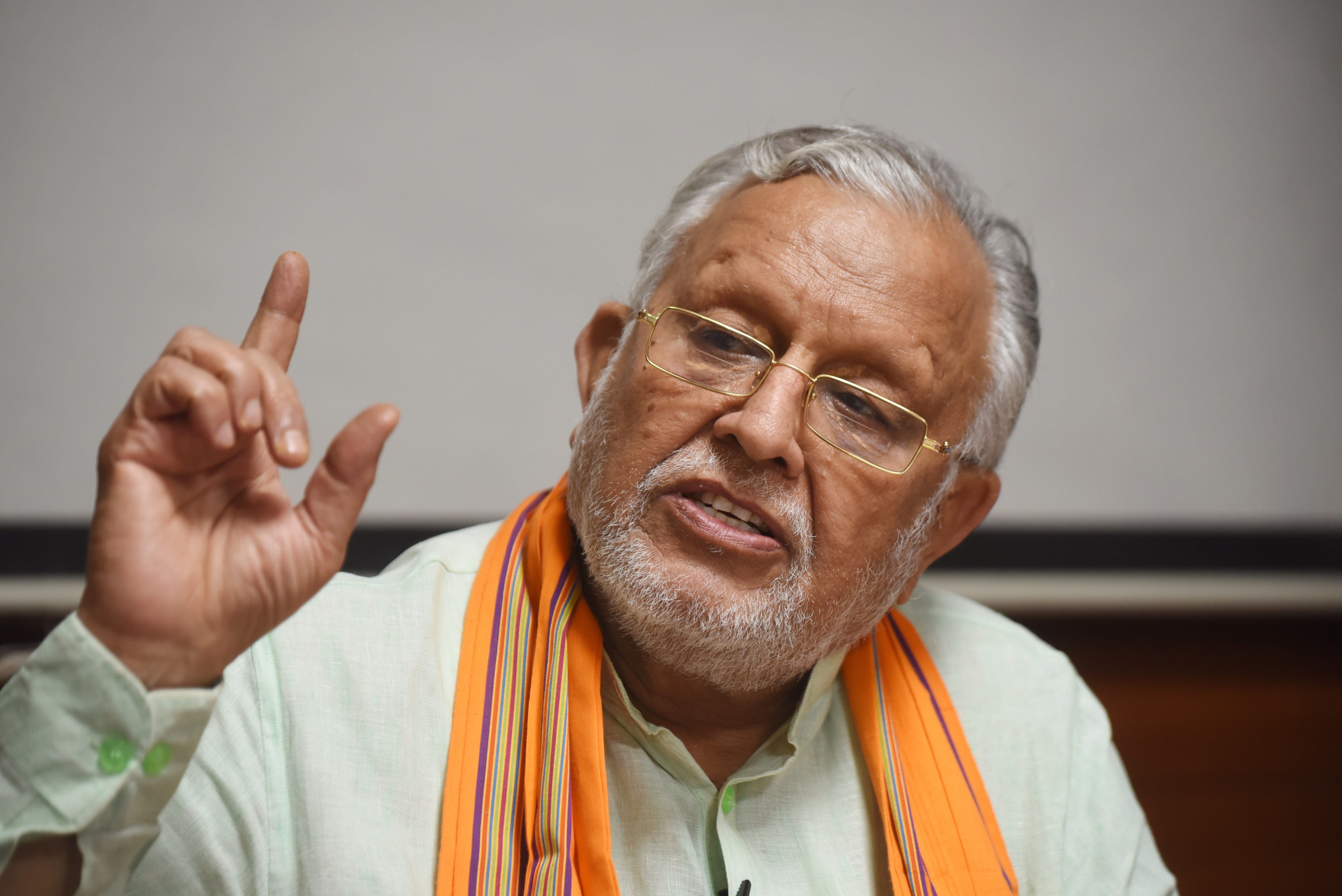
The poem, recited by Uttar Pradesh (UP) finance minister, Suresh Khanna, sounded quite apt in the complex scenario in which the politics of welfarism has increased the public appetite for free ration and cash transfers amid concerns about the country’s economic health.
Amid concerns over the impact of the Covid pandemic and the Russia-Ukraine war on India’s growth, sitting in India’s largest state of Uttar Pradesh, Khanna’s poetic turn depicted the growing demands in the market, “samjho, to samajhne jaisa hai, bazar ke shorogul ka sabab, aisa lagta hai sabke sab, sabse kehte hai paisa do — It is worth reckoning, if you so desire, the reason behind the market din, everyone asking everyone to pay up.”
The finance minister said the lines were meaningful but one has to delve deep to understand the sentiments.
For those who don’t know him, Khanna won the assembly elections nine times from the same party (the Bharatiya Janata Party) and the same constituency in the present political scenario when the party, as well as constituency-hopping, has become a common route to escape anti-incumbency.
Interestingly, Shahjahanpur, his assembly constituency, has a handful of voters belonging to his caste – Khatri, which had once prompted chief minister Yogi Adityanath to comment, ‘If caste and community are the only deciding factors in the electoral battlefield, Khanna would not have won from Shahjahanpur nine times.’
However, notwithstanding the optimism in the BJP quarters about the state's economic growth in the next five years, some scepticism prevails about the R6.15 lakh crore budget (2022-23) Khanna presented in the UP Legislative Assembly on May 26, which according to the experts is one-third of the projected GSDP of the state.
The Directorate of Economics and Statistics of the UP government, in its advance estimates, has indicated state's GSDP for 2021-2022 was about R19.10 lakh crore while the projection for 2022-2023 is R21.74 lakh crore.
The government is still in the process to appoint a consultant to draw a road map for making UP a trillion-dollar economy.
Professor Yashvir Tyagi, former head of the economics department at Lucknow University had earlier told HT that the consultant will have to work out a plan to take the size of the GSDP to nearly four-time and this would require an annual growth rate of 32%.
Khanna's ambitions are aps, if not far-fetched. He said the state government was working on boosting the size of the state’s economy to one trillion dollars in the next five years (2022-27).
It was in 2018 while addressing the UP's First Investors Summit, Prime Minister Narendra Modi had planted the idea of UP emerging as a trillion dollar economy. However, the state had not made much headway before entering the electoral arena.
Now, when Yogi 2.0 revived its plan to make the state a trillion-dollar economy in five years, experts believe this is a herculean task.
But Mahana is confident. He said, “During its visit to the state, NITI Aayog, which has studied our growth rate, was optimistic about Uttar Pradesh achieving the objective of one trillion-dollar economy. I am not in a position to give a timeline for achieving this objective. But we have targeted to achieve this by 2027. To achieve this, we need to work on increasing our growth rate.”
Significantly, the Prime Minister too displayed immense confidence in the state's resilience to grow and predicted a one-time laggard state, a member of the BIMARU states, an acronym formed from the first letters of the states in red (Bihar, Madhya Pradesh, Rajasthan and Uttar Pradesh) driving the country's economic growth story in years to come.
The PM was addressing the third groundbreaking ceremony in Lucknow on June 3. A galaxy of top-notch industrialists of the country not only heard him but promised the double-engine government of their contribution to script the success story.
That UP offers a great investment potential is indisputable but the state leadership will have to undoubtedly play a proactive role to remove bureaucratic red tapes and improve law and order.
Sometimes, religious emotions also clash with dreams of development.
AK Joshi, former director of the Giri Institute of Development Studies, said, “A look at the expenditure pattern reveals the priorities of the state government and one discerns a clear shift from infrastructure and economic development to welfarism, which paid dividends in the 2022 assembly polls."
He further said, “The budget is incremental in nature with some increase in the ongoing schemes. The estimates of revenue and expenditure are on the optimistic side but on the whole, it does not reveal a grand strategy to push economic growth to attain the oft-repeated claim of a trillion-dollar economy."
Khanna strongly disputed it, saying, “A budget with more capital expenditure is considered good and we have focused on infrastructure development. We have allocated 22% of funds to the development of infrastructure. More capital expenditure will also strengthen our economic activities.”
Khanna's statement on the need to hone the skills of the people to make them self-sufficient was important.
Khanna said, “We don’t believe in distributing freebies. We want to empower people and make them capable.”
Not many may buy his words as free ration and cash transfers had played a pivotal role in returning BJP to power for a second term- quite a feat in a state that has been changing governments every five years for 37 years.
Somewhat on the lines of Congress rule in the 1970s-80s, when late prime minister Indira Gandhi's promise of roti, kapda, makaan (food, clothing and housing) used to win votes for the party, the ruling BJP also constructed a vote bank of labarthis (beneficiaries) this election.
The Yogi government had come in for huge criticism when soon after the elections it had launched a state-wide verification drive to remove ineligible ration card holders with some over-enthusiastic district magistrates using drums to announce recovery from them if they did not submit their cards within a stipulated period.
The issue was also raised on the floor of the house.
The government, while clarifying there was no provision for recovery under the National Food Security Act, had described it as an exercise undertaken to ensure the benefits of free ration go to deserving families.
The Finance Minister’s statement that we need to focus on uplift of the downtrodden classes made it clear that free ration would henceforth be given to the poorest of the poor, thereby easing the burden on the state exchequer.
The minister also claims that the government was getting a family survey conducted after which it would ensure that at least one member in each family got a job or became capable of self-employment.
It’s a dream of every UP-wallah and may it come true in years to come. But promises will have to be executed and not broadcast alone.
From her perch in Lucknow, HT’s resident editor Sunita Aron highlights important issues related to Uttar Pradesh
The views expressed are personal


