Keeping up with UP | Today, all roads to UP go through Delhi
Unlike the past, which saw all roads to Delhi going through UP, now, it is the general elections which will help decide the fate of UP. This is what the Congress must understand. Can Rahul Gandhi pull the reverse gear through his yatra?
There is a popular saying in Indian politics that the road to Delhi passes through Lucknow, the capital of Uttar Pradesh (UP). Until 2022, Congressmen lived up to that belief.
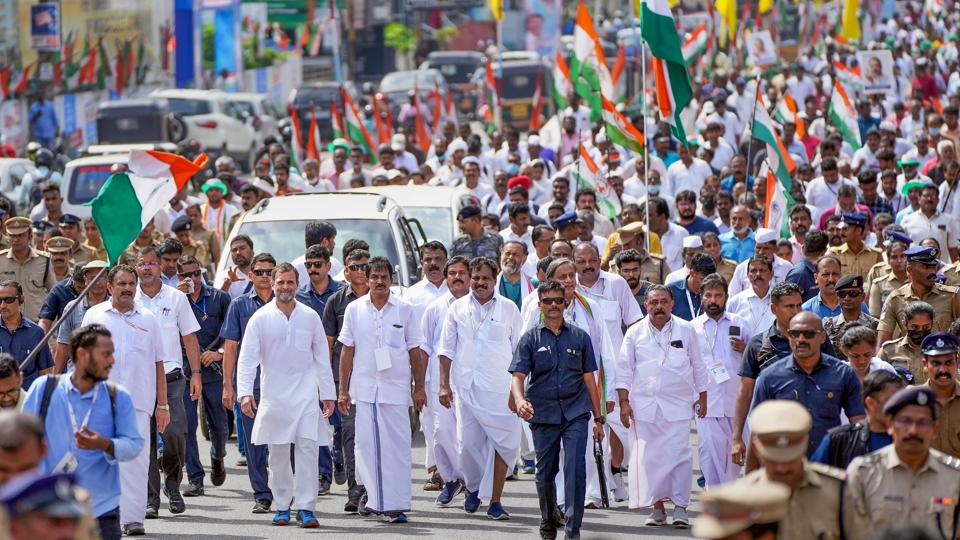
The rampant feeling in the rank and file is that Rahul Gandhi’s Bharat Jodo Yatra will pull the reverse gear. (PTI)
But after the abject failure of all experiments — from a lucrative alliance with a regional force, the Samajwadi Party (SP), in 2017, to an energetic “main ladki hoon” campaign in 2022 — party workers bereft of any local leadership with a mass appeal are now pinning their hopes on senior Congress leader Rahul Gandhi’s ongoing Bharat Jodo Yatra (Unite India march).
The Gandhis have been the face of the party in the state since the days of Jawaharlal Nehru, as rarely any chief minister or state president could evolve as a mass leader. A few who became popular like Hemvati Nandan Bahuguna or Vishwanath Pratap Singh drifted to other parties.
Thus, the rampant feeling in the rank and file is that Rahul Gandhi’s Bharat Jodo Yatra will pull the reverse gear.
“The politics of the country is changing. Now, the road to power will move from Delhi to UP, not vice versa. The BJP's win at the Centre in 2014 paved the way for the saffron party's resurrection in the state in 2017. Similarly, once the Congress regains its strength at the Centre in 2024, the voters, fed up with regional forces and their opportunistic politics, will look at the Congress as a viable option against the Bharatiya Janata Party [BJP],” said a Congress worker.
The Grand Old Party today falls behind regional outfits with pockets of influence such as the Apna Dal and the Suheldev Bharatiya Samaj Party (SBSP).
It’s quite ironic that in 2022 the Rashtriya Lok Dal (RLD), confined to West UP, won eight seats in the state assembly, the SBSP and Nishad Party, with their respective bases restricted to Varanasi and Gorakhpur regions, won six seats each. The Apna Dal with its base among Kurmis (a backward caste) of East UP captured 12 seats, while the Congress ended with two.
As of now, one doesn’t see the revival of the Congress in the state.
While many party workers are pinning their hopes on Rahul’s yatra, political experts like professor Badri Narayan find a major problem with the tone and tenor of the entire exercise. He says the Congress will have to change its public discourse as people are smitten by the personality of Prime Minister Narendra Modi and his nationalistic appeal. This “fear and divide” strategy will not impress a large section which is now driven by the politics of Hindu majoritarianism and welfarism.
And while Bihar and Telangana chief ministers Nitish Kumar and K Chandrashekar Rao are on a countrywide move to unite a fragmented Opposition, including the Congress, many are sceptical about its success as there is going to be a clash of political interests — a sample of which was evident during the Bharat Jodo Yatra.
Soon after Rahul Gandhi left Tamil Nadu and entered Left-ruled Kerala, the chinks in the Opposition were too apparent to be ignored. The ruling CPI(M) wanted to know why Rahul was spending 18 days in Kerala and just two days in UP, where “secularism is under threat”.
Rightly so, as the Rashtriya Swayamsevak Sangh (RSS)-BJP is not only the strongest in UP, but the state also sends the party’s leader, Modi to Parliament. And here exist the three shrines of Ayodhya, Kashi, and Mathura, which pitchforked the BJP to immense political heights and have also led to the Congress’s doom.
The issues are alive even today, to the advantage of the BJP for the same religious issues are dominating the country’s political discourse today. The Ram Janmabhoomi temple in all probability will be complete and thrown open to the public before the general elections. On the sidelines, the legal battle to reclaim the Krishna Janmabhoomi and Kashi Vishwanath temple will add to the religious fervour.
But for the Congress, the same religious issues will remain a grim reminder of their misadventure for the alienated Muslims.
To recall, the Congress started vacillating between secularism (redefined as the appeasement of Muslims) and soft Hindutva (appeal to Hindus, especially Brahmins) during late Prime Minister Indira Gandhi’s tenure as she sensed the growing threat from the rising Right-wing organisations. Soon, her soft Hindutva lost its traction as the BJP, born in 1980, along with its saffron allies, stepped up its campaign for the liberation of three shrines in Kashi, Mathura and Ayodhya.
Indira’s “Garibi Hatao” vote bank started shifting.
After her demise, her son Rajiv Gandhi prompted by Arun Nehru, ML Fotedar, along with the then chief minister Vir Bahadur Singh, decided to unlock the doors of the disputed shrine in Ayodhya in 1986, which depleted the Congress's strength and added steam to the BJP’s religious campaigns that they linked with pride of the Hindus and the country. Muslims questioned their secular credentials, while Hindus opted for the BJP’s aggressive Hindutva.
The second blunder was the state’s permission to the Ram Janmabhoomi Nyas and Vishwa Hindi Parishad to lay the foundation stone of the temple in 1989.
The Congress decline, and the BJP’s rise, began.
The Congress started losing election after election with the demoralised cadre shifting to the parties in power — the SP, the Bahujan Samaj Party (BSP) and the BJP. In a caste-conscious society, the Congress failed to win castes, lost minority support, and could not hold on to its secular plank.
Now, when the knives are out for Rahul Gandhi within the party, UP looks for a recipe for revival. Can it match the energy, synergy, strategy, and size of its rivals as it also lost the Opposition’s status to regional forces decades back?
A senior party leader said, “Yes, we need surgery as the decline of the Congress in the country started from UP and the adjoining Bihar.” Till 1989, the Congress ruled both the northern states that account for 120 Lok Sabha seats. Jagannath Mishra was the last Congress chief minister in Bihar and Narain Dutt Tiwari in UP.
A political expert once told me during elections, “The generations born after 1989 have not seen Congress rule in both the states as 33 years have gone by now.”
Can Rahul Gandhi pull the reverse gear in such a complicated scenario?
From her perch in Lucknow, HT’s resident editor Sunita Aron highlights important issues related to the elections in Uttar Pradesh

 E-Paper