
 E-Paper



Keeping up with UP | What the Shah-Mayawati bonhomie signals for post-poll UP
Are BSP supremo Mayawati and Amit Shah making it clear that there is room for a post-poll alliance in case of a fractured verdict?

 Prefer HTon Google


In a rare display of bonhomie — or possibly, a political overture — Union home minister Amit Shah in an exclusive interview to a news channel acknowledged the relevance of the Bahujan Samaj Party (BSP) in the ongoing Uttar Pradesh (UP) assembly elections. In a reply to a question, he said, “The BSP will get votes, but don’t know how much would it convert into seats.”
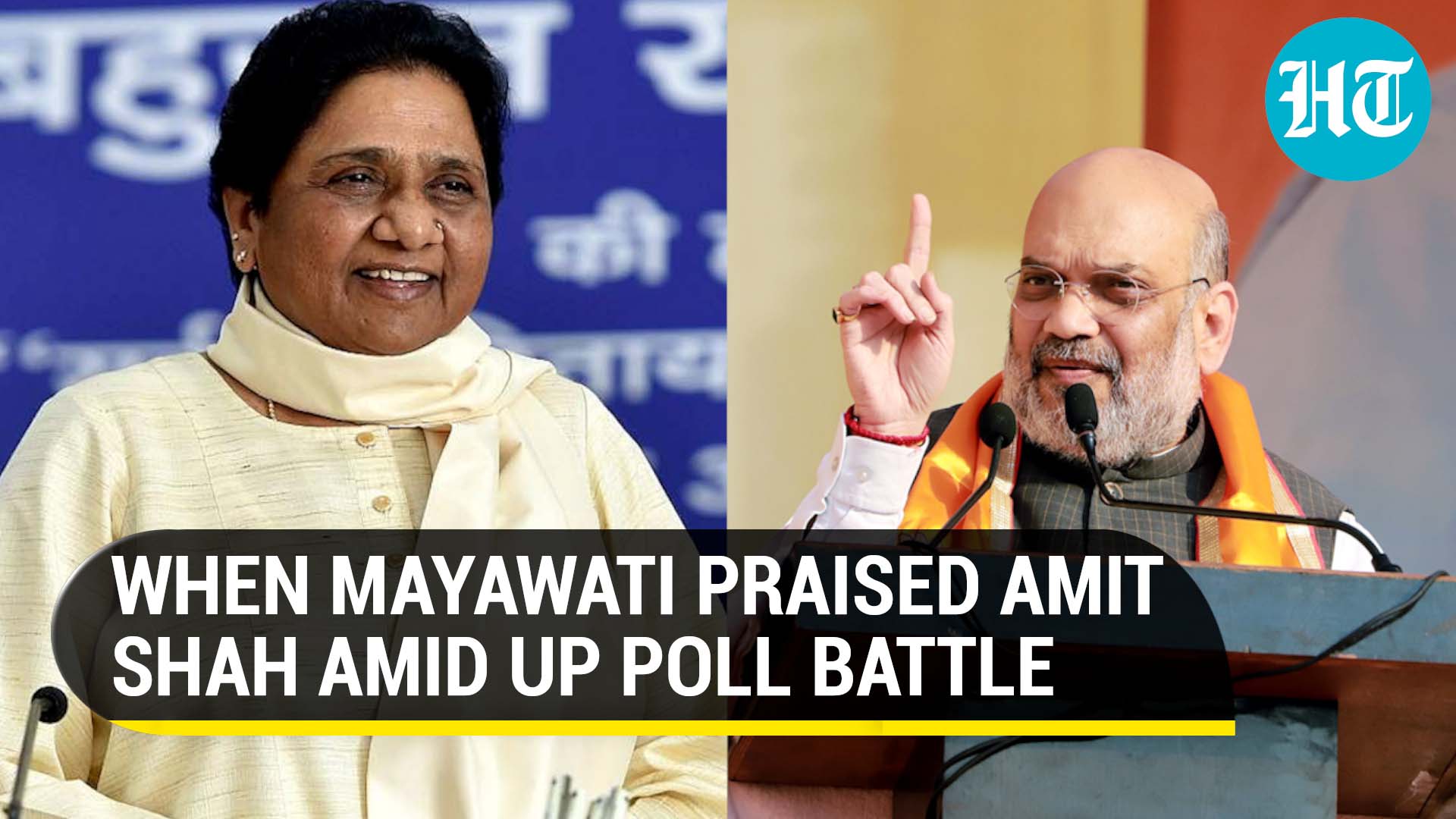
When asked whether the BSP taking away part of the Dalit and Muslim votes would help his party in UP, Shah said: “I do not know if this would be an advantage for the BJP or a loss. It depends on the seat… it is seat-specific.”
Mayawati promptly responded, praising Amit Shah’s magnanimity in accepting the BSP's strength.
It is not common for Indian politicians to shower each other with praises, more so in the middle of elections. When Shah made this statement in the last week of February, four of the seven phases had already finished polling in what's increasingly being called a bipolar election. The die has been cast.
So, why did Shah make the statement? He is known to weigh every word before uttering it, in interviews, rallies and discussions. People, including his partymen, interpret his every word as a message.
As expected, his statement triggered umpteen speculations. One is well known: A multi-cornered contest that divides the anti-incumbency votes among other players is beneficial to the ruling party. As of now, anti-BJP votes have largely gone to the Samajwadi Party (SP), which is seen as the only party throwing a strong challenge to chief minister Yogi Adityanath and Prime Minister Narendra Modi. Muslims and some backward castes have, by and large, consolidated in the favour of the SP, as the people did not perceive the BSP as a serious contender.
The perception also grew because, barring the chief minister, BJP leaders have spared the BSP and its leader Mayawati while making scathing attacks on Akhilesh Yadav and the SP. This may be because the BJP is desperate to win the votes of the Scheduled Castes, who are disillusioned by Mayawati’s toned-down speeches. Among them are also those voters, especially women, who talk of Modi and his largesse. The BJP leaders are hopeful of weaning them away from the BSP.
On the flip side, political experts believe that Shah’s statement has triggered speculation about the state throwing a fractured verdict, moving away from the clear mandates it has got in all elections since 2007. This has emboldened BSP national general-secretary, SC Mishra, who now says, “Mayawati is all set to become chief minister the fifth time.”
Mishra’s confidence comes from many factors.
First, the election is turning into a neck-and-neck contest between the BJP and the SP, so much so that the electoral behaviour of every caste varies from constituency to constituency. While most BJP leaders, as well as SP national president Akhilesh Yadav, have consistently said the voters will give a clear verdict, pollsters now foresee the probability of a hung house.
In case of a fractured verdict, the role of Raj Bhavan becomes crucial.
In 1996, the then governor Romesh Bhandari did not invite the leader of the single largest party, Kalyan Singh, to form the government as he was not convinced about the stability of the government. And it was Bhandari who invited a fragile combination of splinter groups led by Jagdambika Pal in 1998 to form the government when he was satisfied with their numerical strength. Now, Anandiben Patel from Gujarat is the UP governor.
Therefore, in a hung house, Mayawati’s role will become crucial for the BJP as the Congress, the Rashtriya Lok Dal, the Suheldev Bhartiya Samaj Party will choose the SP instead of the BJP, given their political animosity.
And if at all the BJP has to depend on the BSP, then Mayawati will exploit the fluid situation to the hilt. She is a hard-bargainer and the BJP knows this from her past.
Mayawati has formed the government thrice with the BJP's support and ditched them at her will. She became the chief minister for the first time on June 3, 1995, supported by the BJP after the SP-BSP coalition government, formed in 1993, collapsed.
Again, after the 1996 UP elections, the BSP jilted its pre-poll partner, the Congress, to form a government in coalition with the BJP. She became the chief minister with 67 members in a house of 425. The BJP had won 174 seats, but an unfriendly Raj Bhavan rejected Kalyan Singh's claim to form the government.
In 2003, the BJP once again supported Mayawati to form the government. There was a reason behind the BJP’s decision to support the BSP over and over again, as the party wanted to divide the Bahujan Samaj, which had united into a lethal combination in 1993 under the leadership of Mulayam Singh Yadav and Kanshi Ram. The SP-BSP alliance in 2019 failed to defeat the BJP that was riding the Modi wave. Now, Dalits form a part of their Hindu vote bank.
Much water has flown down the Ganga since then.
So, what can the BJP gain as it eyes her Dalit vote bank? Perhaps, an alliance in some states for the 2024 elections? After all, the 2024 general elections are crucial for the BJP-RSS ideological battle and they cannot afford to lose UP — the nerve centre of Indian politics.
From her perch in Lucknow, HT’s resident editor Sunita Aron highlights important issues related to the elections in Uttar Pradesh
The views expressed are personal


