
 E-Paper



Kolkata: A city of protest music is now numb with grief and anger
If the story of any city in India can be told through the culture of protest, Kolkata is a strong contender.

 Prefer HTon Google


In a city ripped apart by the brutal assault and murder of a young doctor, angry protests have spread through the length and breadth of the milling metropolis of Kolkata. Since that night, students and citizens have redrawn the map of the city, walking through sultry days and nights lit by candles and mobile phone torches while vested interests have tried to seek political purchase rather than justice.
This city, Kolkata now, Calcutta once, is now defined by a violent act, an incident, which revealed the deep cracks in buildings for some time. And cracks sometimes run so deep that it is only the darkest act that throws light on the steady erosion of a system, which seems to have stagnated and forgotten the importance of fair investigation and justice.
If the story of any city in India can be told through the culture of protest, Kolkata is a strong contender. The act of venturing onto the street in protest to demand what is the right of a citizen has had its expression in art, especially so in music, in this city. If the history of this city, which is now fighting its own darkness, could be parallelly told, it would be through its urban music.
Protests, especially led by students demanding fairness, are in Kolkata’s throbbing vein dating back to the years of the Naxalite movement even as the state back then had tightened its grip on dissent.
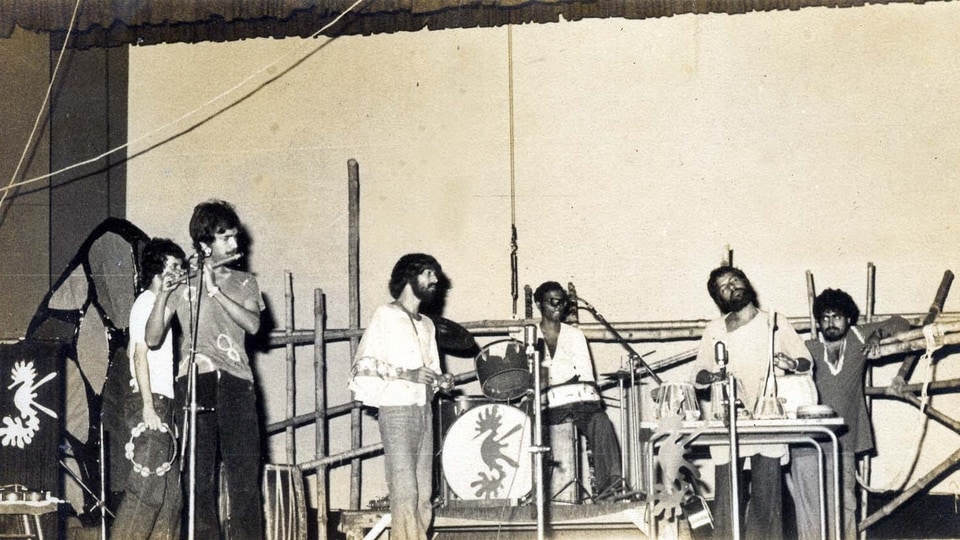
“The runway lies empty spreading only nothingness” released on EP 45 rpm by Mohinder Ghoraguli captured the desolation of the time, the city that was being nudged towards hopelessness. Inspired by the sixties protest music of Bob Dylan and Joan Baez, in 1977, the first Bengali band from Calcutta, Mohiner Ghoraguli (Sea’s horses; a phrase from modernist poet Jibanananda Das’s poem) echoed the revolution lurking in street corners among disenchanted students and youth dreaming of an equal world.
The language of their protest was music. Performing between 1976-81 in Calcutta, Mohiner Ghoraguli was said to be also active, if not as a formal band, during the time of the Naxalbadi uprising. They released their record Sambigna Pakhikul o Kolkata Bishayak (About Calcutta and anxious flights) in 1977 accompanied by a pamphlet about who and what they were. The pamphlet was a manifesto that established the kind of music they were set to stand for; music that was going to represent the time they were living.
Even before the band, protest songs had always inhabited the soundscape of Calcutta with Salil Choudhury’s music and the Indian People’s Theatre Association (IPTA) songs. But it was the voice of the youth, their dissatisfaction that needed a representation, one that was found in Mohiner Ghoraguli, a vernacular band who called themselves a collective.
Their lyrics and the music were the sound of urban protest, of a city where the cracks were visible at that point in history. Their music was about alienation, disenchantment with politics and non-belonging to the city that they inhabited. Their songs were modern, of a city that was modern but also demanded change. The band was also among the first to visualise a modernist city and the political aftermath of the years of Emergency through songs.
Sadly, since their music was available only on LP, their reach remained limited, circulating among youngsters in universities.
By the time it was the 1990s, the city was ready for its anger to be expressed in music yet again. This time the technology had changed to cassette tapes, accessible to a much wider audience, which is one reason for the popularity of the singer-songwriter Kabir Suman who would usher in what would become the new wave of urban Bengali music.
Suman musically carried forward the tradition and anger of the youth of the city ravaged by the Bangladesh War and the Naxalite movement. Suman Chatterjee (now Kabir Suman) was then a 40-year-old man whose stance was at once charismatic, rebellious and political. He strung his classical guitar and sang songs the city was to listen to for decades to come. The aesthetic of left politics informed Suman’s writings.
This new wave of music had seen more commercial success than any other kind of music in the history of Bengali music; Suman’s first three albums sold over 4,00,000 copies. His first album Tomake Chai (I Want You) was released by HMV in 1992.
Kolkata was culturally informed by Left movements since the 1940s, even though the alienation of the present had not found representation until the songs of Suman brought with it the sound of everyday protest. ‘Haal Cherona Bondhu’, an iconic Suman song, is also a way to address the dream of revolution in art and politics in Kolkata.
Suman’s image and his music were drawn from influences of the city he had grown up in and the protest music performed by singer-songwriters that he had heard in the West: Joan Baez, Pete Seeger, Paul Robeson, and so on. He became a singer who took the stage like a folk rock poet.
Suman’s was a city that needed intervention from the radical politics that the city was known for. It needed a re-fashioning of the bourgeois sensibilities that was blind to the stark class divide. His city was also a city that protested the rise of the saffron wave. It was about values of equality and justice. The unabashedly urban landscape that Suman drew in his songs represented the values associated with modernity.
The cassette tapes that flooded the homes and soundscape of the city spoke of protest against the neglect of the citizens, of an ominous and rising communal wave, the closing of the Jute mills (Kanoria mill movement of 1992-1993), and every day of the ordinary person, forgotten and neglected by the state.
His oeuvre is immense (with over 25 albums and six books of poetry) drawing from the musical traditions of the city and yet distinctly different from Ganasangeet (People’s music) and Salil Chowdhury’s songs of protest.
As Kolkata changed politically in 2011, Kabir Suman sang about the events in Nandigram before joining Trinamool Congress and abandoning it in quick succession. His songs of protest however remained relevant.
In the past couple of decades, music technology moved from cassettes to CDs to MP3 and now to convenient digital platforms.
But while the changing musical scene of the city has brought forth singers, songwriters, and bands, somewhere, somehow, the songs of protest became fewer and limited in their reach, especially with the proliferation of film songs and digital platforms.
Two decades hence, the city of course — as it must — erupted again with people’s protests at this point in history against a case of brutal gender violence. Except this time even music and the songs of protest have left the city and abandoned its women. Only screams of anger, loss, and injustice remain.
Rupleena Bose teaches English Literature at a Delhi University college. Her first novel ‘Summer of Then’ has been published by Penguin Random House. The views expressed are personal


