
 E-Paper



Return migration is inevitable, but equations have changed
The government will need to incentivise the return of migrants by subsidising travel cost, covering the cost of displacement, extending educational grants for children and by promising homes fit for families.


For some Indians, a life well lived was abruptly upended by the Covid-19 pandemic and then the series of government-mandated lockdowns. Things may never be the same again.
Prior to World War 2, affluent families in England had domestic helps mainly from Wales and Ireland because the Scots were too much canny. This changed soon after the war ended as better opportunities appeared in the economy elsewhere, principally in manufacturing. The current pandemic is as yet far from the scale of destruction of WW2 but it is a significant global event that is likely to deliver accelerated social change.
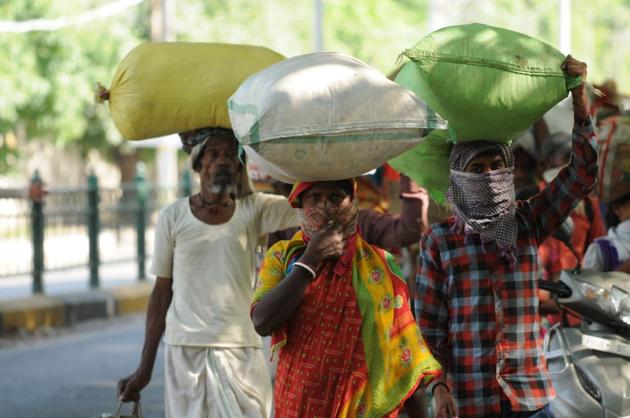
The mass migration that has taken place is distressing to the point of being gut-wrenching, the images and ordeals are unbearable, even super-human, yet in spite of what appears to be insurmountable odds, the desperate and hungry have proceeded home stoically and largely peacefully.
This in itself is not surprising. After all hunger has historically inspired wars, anarchy and revolution in almost equal measure.
LONG MARCH HOME
What has been surprising is that many migrants still in work, still with some savings, still in housing, almost simultaneously reached the same conclusion to reach home, however far it may be, without any political prompt or activist sermon.
Where hunger was not a factor, it was the fear of death from Covid-19 or from the host communities that ensured that the initial trickle developed into an exodus.
This fear of death was in part down to the Union government’s portrayal of Covid-19 as a lethal killer. Added to this was the claustrophobia created by the restrictions, which meant for many that their 24x7 stay in a tenement became psychologically and physically impossible.
Suddenly, the home far away became more appealing and migrant sentiment expeditiously accelerated to mass hysteria, leading to the Long March Home.
BACK TO WORKPLACES
While the exodus is still on, there is now speculation about how these people will fare in due course. It’s all very well for Amitabh Kant, the CEO of NITI Aayog, to impress upon the recipient states to promote industrialisation locally, in order that the interests of the returnees are secured closer to their homes, but the reality is that industrialisation cannot happen overnight.
Had the recipient states been historically more business-friendly, with in step politicians and bureaucrats, industries would have been embedded there decades ago.
Neither the Union government nor the recipient states have sufficient resources to sustain the returnees for more than a few months at best. Inevitably and regrettably, it will be hunger, stress and the accompanying poor health that drives many of them back to their recent workplaces.
Given human resilience, this return may be some months away. Some may never return. Others may find that their jobs no longer exist. Use of agricultural automation in harvesting wheat and maize, and shortly in transplanting paddy, by some farmers for the first time, may mean that these machines have replaced much of the labour forever.
INCENTIVISE THE RETURN
It was going to happen anyway, but it took a crisis to trigger. Consequently, governments and businesses will need to be creative to accelerate the migrants’ return.
The government will need to incentivise it by subsidising return travel cost, covering the cost of displacement, extending educational grants for children and promising homes fit for families.
Businesses will need to offer their own financial incentives. They may need to cover lost salaries, pay in advance and offer increased pay. The cost of labour will rise and businesses will need to adapt by delivering productivity gains from up-skilling and multi-skilling, better workplace environments, better healthcare, preferably on business premises, and more clothing allowances.
Businesses may also need to contract accommodation en-block from abusive landlords that earlier preyed individually on migrant families, in the process delivering better facilities and a more hospitable environment. Many businesses will proceed to build company-owned staff accommodation as they earlier did for higher-paid employees.
Larger businesses will accelerate the implementation of automation, robotics and artificial intelligence (AI). Smaller businesses will follow.
Housewives used to an array of domestic offerings will now experience the benefits of multi-tasking. Families will move from houses to flats to reduce their dependency on domestic helps. More cars will be owner-driven.
BACK ON BETTER TERMS
The returning migrants can expect better terms, a better environment and much more respect. In time, they will save, qualify for home loans and become local residents. Shorn of the migrant tag, they will become inherently part of the community at large.
This is not wishful thinking. Return migration is inevitable but the equations have changed forever.

The writer is a former Congress MLA. Views expressed are personal
Twitter:@jassikhangura


