Terms of Trade | What does a ‘woke’ RSS mean for the Opposition?
As the Sangh adapts to new social attitudes on issues such as gender, the Opposition’s task gets more challenging. It may consider returning to class-based mobilisation
Most opponents of the Bharatiya Janata Party (BJP) think of it as a majoritarian and socially conservative force. A historical reading of the BJP and its ideological parent, the Rashtriya Swayamsevak Sangh (RSS), shows that such an assessment is not very off the mark.
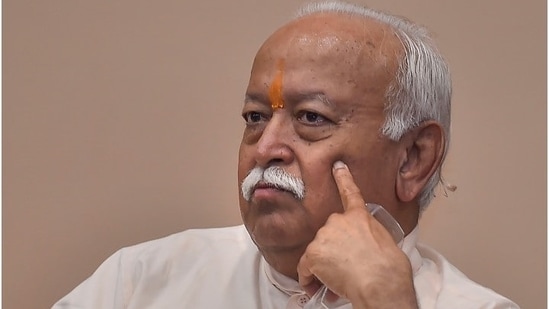
RSS chief Mohan Bhagwat even spoke about how homosexuality (minus the “hullabaloo” raised by the “neo left”) was acceptable to the Sangh Parivar. (HT Photo)
The rise of the Hindu Right in India, of which the RSS and its political arm BJP, are the most successful offshoots, found its raison d'être in mobilising Hindus against what they described as Muslim appeasement even before the country won independence. Even in the cultural realm, the Hindu Right ecosystem was invested in propagating a conservative social outlook. Akshay Mukul’s excellent book Gita Press and the Making of Hindu India provides an excellent documentary evidence of this fact.
Let us come back to contemporary politics now. The Democratic Party pulled off a surprise performance in the recently held mid-term elections in the United States. One of the biggest reasons behind the Republican Party’s underwhelming performance in the elections was a pro-Republican Supreme Court overturning the Roe versus Wade judgment that gave women the legal right to abortion. A large part of the Republican establishment was seen as siding with this socially conservative coup d'état and the party ended up paying for this by losing women voters in the elections.
Let us ask another question now. Important leaders of the RSS and BJP have given statements in the past about women ideally being homemakers. Does anybody believe that the BJP government will even try to bring a law in the country which tries to take away of right of women to work? It is unlikely that any serious political analyst will agree with such a possibility.
While the comparison is an extreme one to make, the point is the following. What differentiates the BJP-RSS from many right-wing formations in other parts of the world is that they are unlikely to do anything that will try to fulfil their socially conservative agenda at the cost of popular support, unlike what the Republicans did in the US.
Of course, the RSS-BJP are extremely nimble-footed in such an approach and given India’s federal politics, their political praxis often shows regional diversity in trying to balance this question. The BJP’s tacit silence on the question of beef eating in northeastern states and Kerala – there is a large number of non-Muslim beef eaters in both these regions – is one such example.
In fact, the RSS-BJP seem to be going a step ahead now by trying to construct a political narrative which seems to be conciliatory towards even relatively unimportant hitherto radical political constituencies. The RSS-BJP has been talking about Pasmanda (backward caste) Muslims for some time now. In a recent interview, RSS chief Mohan Bhagwat even spoke about how homosexuality (minus the “hullabaloo” raised by the “neo left”) was acceptable to the Sangh Parivar.
The question for the critics
This raises an important question for the opponents of the RSS-BJP.
If the RSS-BJP keeps making this pivot (even if purely tactical) towards socially progressive positions, is a socially-progressive broad-based alliance going to be enough to pose a political challenge to it? Of course, the most important form in which question has emerged in India is the caste question.
With the BJP finding a very large core support base among the historically socially disadvantaged groups, especially lower OBCs in large parts of the Hindi belt, the old Mandal political framework and its proponents have been struggling against the BJP, which was earlier seen as a Brahmin-Baniya party.
None of this is to argue that the struggles of various oppressed identities, no matter their numerical majority or lack of it in terms of votes, do not matter anymore or that the oppression and discrimination they face have ceased to exist.
However, a more honest approach to this question will be to ask whether the RSS-BJP has been a vanguard (read active perpetrator) or a mere reflection of such social biases, which, while they still exist, have been weakening for good, in our society. If the latter is indeed the case, then the RSS-BJP is only being pragmatic (or opportunistic) in, at worst, doing lip service to these causes, or in a better-case scenario, attempting an organic realignment of the value system within its larger ideological framework.
In either case, this means that India’s trajectory of social evolution has not turned regressive (except perhaps on the Muslim question), despite a so-called majoritarian-conservative political force being in power for almost a decade now. What it does mean however is that the political possibility of using a broad-based alliance of such progressive causes to pose a political challenge to the BJP-RSS will increasingly come under squeeze in the future.
The question, which follows from this, and many could find it provocative, is the following. Is progressive social order the only thing that is supposed to be under threat with the RSS-BJP in charge?
Does class provide an answer?
An old-school answer to such an approach will be that such a “woke” approach to politics has been found wanting on the question of class. The old Left is a pale shadow of itself today. New social movement voices like to think that they will successfully build a political intersection of all oppressed identities to bring about political change. In this political milieu, the class question has been relegated to the background.
Ironical as politics often is, class politics is one area that has the potential of disrupting the RSS’s established support bases at a time when it is trying to build newer coalitions with socially progressive movements. Its farmers’ organisation was uncomfortable during the farmers’ protests after the three farm laws. Its trade union arms are increasingly being weakened as the government plans to divest or rationalise more and more public sector units. Even its student arm is bound to come under pressure as the promotion of the principle of self-financing in higher education is bound to push fees in most government institutions. Such mass fronts of the RSS are facing increasingly difficult material questions which did not confront them when the BJP was not in power.
Will it not be interesting if social movements and the opposition at large tried to counter the RSS-BJP’s strategy of taking a woke turn to break into the progressive support base with a counter-attack into RSS ranks by giving greater priority to the class question?
Every Friday, HT’s data and political economy editor, Roshan Kishore, combines his commitment to data and passion for qualitative analysis in a column for HT Premium, Terms of Trade. With a focus on one big number and one big issue, he will go behind the headlines to ask a question and address political economy issues and social puzzles facing contemporary India.

 E-Paper