
 E-Paper



The anatomy of a Dalit lynching
As a Dalit labourer got lynched in Singhu, liberals stood silent. But for Dalits, those at the forefront of the farm protests are the oppressors


On October 15, the residents of Kundli woke up to the grisly sight of a corpse dangling from an upturned police barricade. The victim was identified as Lakhbir Singh, a 35-year-old Dalit labourer.
Violence against Dalits is an everyday occurrence. On rare occasions, a case of an atrocity committed against a Dalit gets reported in the newspapers. A smattering of voices is raised, and the incident creates a small ripple which soon dies down.
In Singh’s case, his killers, with their brutality, ensured the crime could not be ignored. He had 37 slashes on his body. They chopped off his left hand and broke his ankle and knee. They hanged the chopped-off hand grotesquely next to his head. They recorded his ordeal on their cell- phones. Lakhbir Singh was alive for 35 minutes before bleeding to death. One can see him in the videos begging his tormentors for relief from his agony.
Shockingly, there was no reaction from the anti-caste liberals. The pens of writers ran dry; the voices of Maoists who claim to fight for the oppressed were muted. Ambedkarites, who ostensibly “educate, organise and agitate” for Dalit rights, were defiantly quiet. Bollywood stars who fashionably speak against injustice turned their zeal in other directions. Human rights activists were nowhere to be found.
Baffled by the silence, I asked people, the usual ones, directly. One said he hadn’t read about it. Another said he only saw the headline and thought it to be another one of those atrocities commonly committed on Dalits. Some said they are not in the habit of writing or commenting on “every single thing that happens”. One Ambedkarite said brazenly, “What about it?” Many actually justified the killing. You see, Lakhbir Singh was accused of committing sacrilege on a Sikh holy book.
Since 2015, there has been a proliferation of sacrilege incidents in Punjab. Most often, the context of these accusations is land disputes between upper-caste Jat Sikhs, who have been illegally usurping land, which, by government law, is supposed to be leased to Dalits. When the Dalits began organising for their rights, the Jats retaliated with vicious attacks, often using sacrilege as an excuse. While politicians of all parties bend over backwards to appease Jat Sikhs whose religious sentiments are ostensibly hurt, murders committed by them go completely under the radar. Sikh society is so fixated on sacrilege that the one human rights group that did conduct a probe into the October 15 incident concluded that Singh, in fact, had committed sacrilege. The Punjab police booked him posthumously for sacrilege. His family has been ostracised and they were banned from cremating his body according to Sikh rites.
One can only speculate as to the immediate motive behind this particular murder. It could be the disgruntlement of the Sikhs over the appointment of a Dalit as the interim chief minister of the state. Or for the issue to be used by political parties in the upcoming elections in February, 2022. However, there is another reason behind the silence of the liberals, including those middle-class Dalits who have distanced themselves from the poor ones.
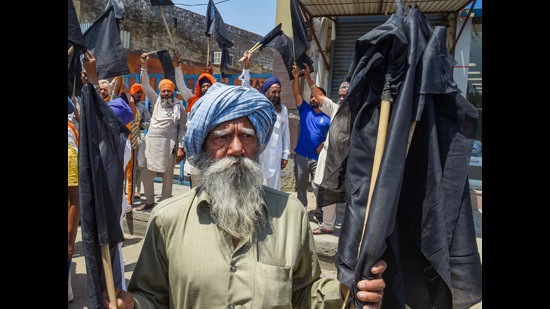
Singh’s murder was committed at Singhu border, one of the main sites of the year-long ongoing protests by (predominantly Jat) farmers from Punjab and Haryana against the 2020 farms laws. The lynching, farmer leaders alleged, was a conspiracy by the Bharatiya Janata Party (BJP) to smear the protests. Indian liberals, the most passionate supporters of the protests, don’t want the gruesome lynching of a Dalit to disrupt these protests. In their eyes, farmers are the only constituency who can end Narendra Modi’s regime.
What the liberals don’t understand is that the protesting farmers are utterly powerless. The laws affect under 6% of the farming population, almost all of whom are from just two states — Punjab and Haryana. The Green Revolution made it possible for this segment of ordinary farmers to produce small exportable surpluses, and transformed them into capitalist farmers. Not engaged in productive labour, they themselves they have no leverage of any kind. Modi is sitting pretty, tapping his index fingers together.
Unlike the liberals, the leaders of the anti-farm laws protests are aware of their powerlessness. From the beginning, they sought the participation of farm labourers, overwhelmingly Dalits who resolutely stayed away.
As capitalists, albeit small-scale, farmers strive to keep labour costs to a bare minimum. Caste is a convenient tool in their hands to put down Dalits. Last year, when the pandemic caused labour shortages, these farmers, who have been using migrant labourers, were forced to turn to Dalits, but offered them work at a lower rate than they pay migrants. When the Dalits refused, they were subjected to a social boycott.
Now, the same farmers are telling Dalits they have a common agenda against Modi. At the protests, they celebrated the birthday of Sant Ravidas, the guru of the Dalit Sikhs, while, under ordinary circumstances, caste Sikhs don’t allow Dalit Sikhs in their gurudwaras or langars. They don’t allow them to cremate their dead in the same grounds. When Dalits didn’t join the protests, with the help of clueless and/or corrupt leaders of agricultural labour unions, they resorted to busing a few Dalits to protest sites.
The liberal friends of the farmers glibly try to quash any notion that the atrocity at the Singhu border was caste-related, on the grounds that the killers themselves are Dalits. It is true that the men who claimed responsibility are Dalits. They belong to the Nihangs, a Sikh monastic sect. While the babas of all the Nihang groups are from the powerful landowning Jat caste, the foot soldiers are always Dalits, who join seeking basic necessities such as food. They delude themselves that being a monk will bring them respectability. But whether a crime is caste-related or not is determined not by the caste of the perpetrators. The lynching of Lakhbir is a caste-related crime because his caste, his being Dalit, played a role in targeting him.
Farm protests are doomed mainly because of outmoded agricultural practices, which depend on slave-like labour. These farmers don’t stand a chance against their competitors — the big global corporations. What kind of capitalist system worth its salt will allow freeloading in the name of price support? Still, the farm protests have, on their side, all the liberal spokesmen/women, writers, documentarians, activists, agitators, Greta Thunberg, Rihanna, and all the glamour.
In any case, the implementation of the laws is suspended. This will give the richer section of the farmers ample time to shift their assets out of agriculture, and strike some kind of deal with the multinational corporations. Meanwhile, the poor of India, including Dalit labourers, are facing the prospect of mass privations because the third farm law proposes to do away with price caps on essential commodities. To survive, they have to wage a fight — the success of which depends on maintaining independence from their current oppressors. Their natural allies are urban workers who, by dint of the crucial role they play in productive economic activity, can stand up to the juggernaut of the free market crushing entire sections of the Indian masses.
Sujatha Gidla is the author of Ants Among Elephants: An Untouchable Family and the Making of Modern India
The views expressed are personal


