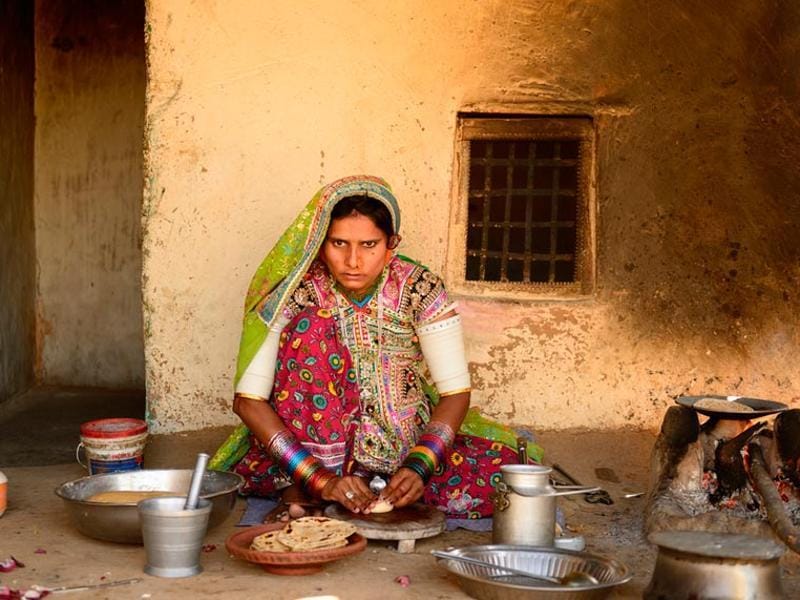
The link between clean energy use in homes and women’s health is indisputable. The use of solid fuels for cooking in homes contributes significantly to air pollution, a major contributor to the disease burden in India. According to the government, the Pradhan Mantri Ujjwala Yojana (PMUY) has improved LPG coverage and as of January of this year, 90 million connections have been distributed across the country. But many households have still not shifted to this clean energy option for cooking.
Much more needs to be done to shift attitudes in households and remove barriers in accessing and using clean fuels in households. (Shutterstock)
Rekha Devi, a homemaker from Bokaro in Jharkhand says, “We are using chulha (woodfire stove) as the primary source of cooking as our monthly income is ₹8,000 and we can’t afford an LPG connection. I face severe eye irritation and coughing while cooking on a chulha, but have no other alternative.”
Surveys done by the Centre for Sustainable Development (CFSD) and Warrior Moms, a Mothers for Clean Air initiative, show that even in many homes with an LPG connection, women continued to use chulhas for various reasons. In Nagpur, 43% of women continued to use the chulha despite having an LPG connection. There are several other factors which prompt the use of chulhas, among them availability, affordability, accessibility and socio-cultural norms. “We surveyed 1,500 households across urban slums in Nagpur, as the issue needs to be prioritised. The city’s action plans to control air pollution should provide for adequate budgets to shift households from solid fuels to cleaner cooking alternatives,” says Leena Buddhe, director, CFSD. The story is similar in most other towns.
Much more needs to be done to shift attitudes in households and remove barriers in accessing and using clean fuels in households. First, the government has to identify vulnerable households from a lens of socioeconomic status and health indicators to provide subsidies for LPG. It also needs to, with the help of experts, look for alternatives that would both work for women and reduce the family’s financial burden. Behavioural change campaigns can address the myth that certain foods taste better when cooked on a chulha and impress upon households the benefits of a transition to clean energy both in terms of cost and health, especially for women.
“Burning solid fuels results in household air pollution that has an average contribution of 30-50% to ambient air quality in India and research has established that women and children are disproportionately impacted. The problem is more complex than we think and is rooted in patriarchal norms, social and economic status and accessibility to alternatives, “ says Neha Saigal, head of programme for the NGO Asar.
Adopting clean cooking fuel could work wonders to reduce the gender gap, if time spent on fuel collection and cooking time is reduced. This would have a domino effect on the empowerment of women in terms of possible access to education and employment, as well as for more leisure time — a concept that is virtually overlooked in most Indian households — and improvements in health.
The pandemic has exacerbated economic hardship and, therefore, the government must come up with a bouquet of options to get people to opt for clean fuel. While further subsidies may not be feasible, the government could look at micro-payment schemes for clean cooking fuel. The key lies in improving women’s access and agency when it comes to clean fuel as a way of preserving their health and freeing them up for productive, paid work.
Lalita Panicker leads the opinion section at Hindustan Times. Over a 33-year career, she has specialised in gender issues, reproductive health, child rights, politics and social engineering.

 E-Paper